Trees and Shrubs Bibliography
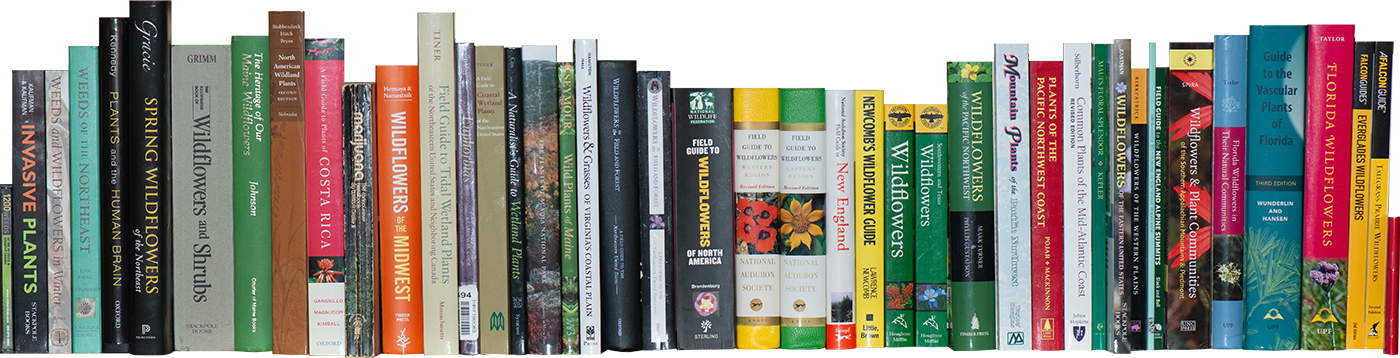
|
|
Loosely speaking, plants that regrow from the ground each year are herbaceous plants, and are listed in the wildflowers bibliography. This bibliography covers trees and shrubs—plants that persist from year to year, and having woody stems or trunks. Note: book cover sizes in the list below are shown relative to each other. The list is organized by primary author. Some out-of-copyright books are available free at the supplied links. |
|
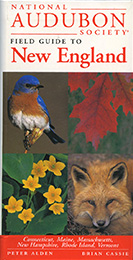
National Audubon Society Field Guide to New England Author(s): Alden, Peter; Cassie, Brian Publisher: Andrew Stewart Publishing, 1998 ISBN: 978-0679446767 View at: Barnes & Noble, or Amazon Comments: Part of a series of regional field guides, this compact guide covers the most common members from all walks of life, as well as sites of interest and even some field astronomy. If you like the outdoors and are curious about nature in all forms, this is a great choice. Photos are great, though space is necessarily tight for such an ambitious range. 448 pages. |
Connecticut, Maine, Massachusetts, New Hampshire, Rhode Island, Vermont |
|
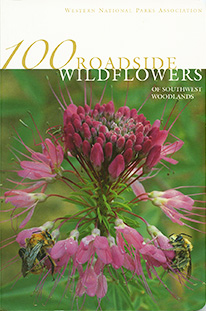
100 Roadside Wildflowers of the Southwest Woodlands Author(s): Bowers, Janice Emily Publisher: Western National Parks Association, Tucson, AZ, 2003 ISBN: 978-0911408737 View at: Barnes & Noble, or Amazon Comments: This is the kind of book you buy on impulse when you stop at a visitor stand in a national park. It allows identification of some of the most common flowers in woodland habitats, but the American southwest is a large region and the 100 species covered provide only a tantalizing glimpse. Plants are presented two per page, with a nice photograph and clear, non-technical descriptions. There is no special organization to the presentation, but the book is short enough so it is possible to flip through it in search of an ID. |
Arizona, New Mexico, Utah, Nevada, Colorado |
|
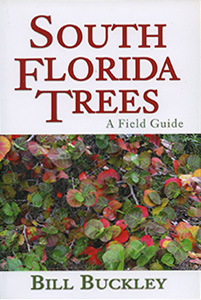
South Florida Trees: A Field Guide Author(s): Buckley, Bill Publisher: Summer Wind Productions, 2015 ISBN: 978-0990676904 View at: Barnes & Noble, or Amazon Comments: Trees present a real photographic challenge. Do you try to show the entire tree’s habit, at the expense of any detail? Or concentrate on leaves, highly variable for some species? What about trunks, which change dramatically in texture and color over time? Or flowers or fruit or seeds? The only real answer is “all of the above,” and Bill Buckley approaches this ideal by presenting three photos per species, dedicating a page to each species. He presents 150 subtropical species that occur in south Florida, providing clear, non-technical descriptions for each. The book is organized into conifers (cone-bearing trees);, palms, and hardwoods; hardwoods are organized by some basic identifying features. I found the photos to be somewhat flat and muddy, an artifact of the printing process. 170 pages. |
South Florida: areas south of Lake Okeechobee—including Lee, Hendry, Palm Beach, Collier, Broward, Monroe, and Miami-Dade counties and coastal areas. |
|
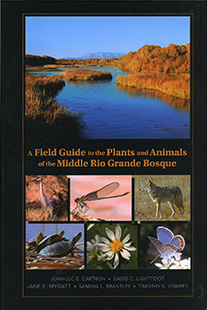
A Field Guide to the Plants and Animals of the Middle Rio Grande Bosque Author(s): Cartron, Jean-Luc E.; Lightfoot, David C.; Mygatt, Jane E.; Brantley, Sandra L.; Lowrey, Timothy K. Publisher: University of New Mexico Press, 2008 ISBN: 978-0826342690 View at: Barnes & Noble, or Amazon Comments: This volume has the ambitious goal of capturing a broad swath of life along the Rio Grande. It discusses the settings and their environmental histories, habitat types, and places to visit. It covers nonvascular plants such as lichens and fungi; vascular plants (flowering and spore-producing); invertabrate animals; and amphibians, reptiles, birds, and mammals. The section on plants makes up about a quarter of the book. It is organized by family. Blooming period is featured prominently, a good idea, since we tend to notice plants in bloom. Also included is identifying information, natural history, and whether a species is threatened. There are about three species per page, so photos tend to be smaller than with some layouts. 375 pages. |
From the back cover: “Extending from the spillway below Cochiti Dam, about fifty miles north of Albuquerque, to the headwaters of Elephant Butte Reservoir, near Truth or Consequences in the southern portion of New Mexico, the Middle Rio Grande Bosque is more than a cottonwood woodland or forest.” |
|
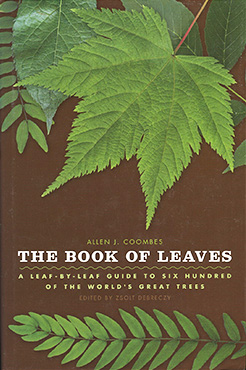
The Book of Leaves: A Leaf-by-leaf Guide to Six Hundred of the World’s Great Trees Author(s): Coombes, Allen J.; Debreczy, Zsolt (Ed.) Publisher: University of Chicago Press/Ivy Press, 2010 ISBN: 978-0226139739 View at: Barnes and Noble, or Amazon Comments: This beautiful volume falls somewhere between guide book, encyclopedia, coffee table book, and scientific treatise. It presents 600 species of trees by leaf shape alone, together with a detailed descriptions, large leaf photos, a line drawing of the tree’s shape, and a worldwide range map. The first 42 pages of the book describe the mechanics and anatomical features of trees. Trees are presented by family. This volume is too large to function as a field guide, but it is a useful and attractively laid out resource. If identification is your primary goal, other books cover a wider range of species, and a narrower range of locales. 656 pages. |
World. |
|
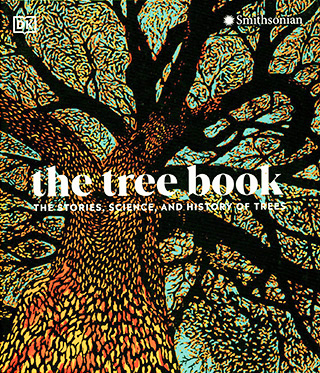
The Tree Book: The Stories, Science, and History of Trees Author(s): DK Publisher: DK, 2022 ISBN: 978-0744027464 Comments: This is a gorgeous coffee table book on trees—their natural history, identification, cultural importance, anatomy, and beauty. 352 pages. This 4 pound large format book probably won’t fit in your back pocket. |
|
|
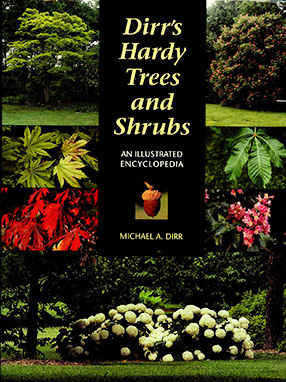
Author(s): Dirr, Michael A. Publisher: Timber Press, 1997 ISBN: 978-0881924046 View at: Barnes & Noble, or Amazon Comments: This large format, 493-page book describes 500 species in detail, as well as 700 additional cultivars and varieties. The book includes extensive excellent photos, and Michael Dirr assesses suitability for planting. This isn't a field guide, it is a guide for landscapers, but it is nevertheless a very useful reference for those identifying wild and cultivated trees and shrubs. |
Covers America. |
|
Peterson Field Guides: Eastern/Central Medicinal Plants and Herbs Author(s): Foster, Steven; Duke, James A. Publisher: Houghton Mifflin, 2000 ISBN: 978-0395988145 View at: Barnes & Noble, or Amazon Comments: This 411-page guide lists plants found in the eastern and central United States, listing their real or alleged medical properties. Descriptions cover historical beliefs about the plants as well as more recent research. Includes identifying photos. |
Covers states east of, but excluding, Colorado, Montana, and New Mexico. It does not fully cover the southern half of Florida or the southern and western halves of Texas. Adjacent regions of Canadian provinces are included. |
|
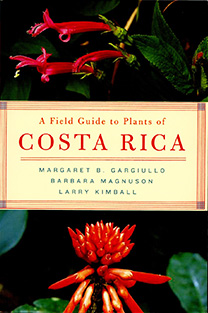
A Field Guide to Plants of Costa Rica Author(s): Gargiullo, Margaret B.; photos by Magnuson, Barbara & Kimball, Larry Publisher: Oxford University Press, 2008 ISBN: 978-0195188257 View at: Barnes & Noble, or Amazon Comments: Nearly 1400 photos illustrate 856 Costa Rican plants organized into broad plant types ("habits"); then by color; then by family, genus and species. Detailed identifying descriptions include range information. The author's writing style avoids excessive jargon. 494 pages. |
Covers Costa Rica |
|
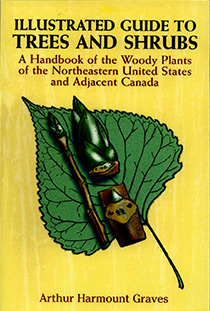
Author(s): Graves, Arthur Harmount Publisher: Dover Publications, Inc., 1992 ISBN: 978-0486272580 View at: Barnes and Noble, or Amazon Comments: This book describes trees, shrubs and vines of the northeastern United States and nearby Canada. It was orignally published in 1952, and it shows the descriptive style characteristic of the times, more akin to professional flora than is typical of newer books. The artwork in these books is stellar, a series of line drawings that combine leaves, buds, twigs, leaf scars, and other identifying features. The artwork is so concise that IDs can be made almost in absence of the text. There are formal keys as well as descriptions for each species. Field guides don’t remain in print for this long unless they offer a unique slant on species identification, and this one does. 271 pages. |
Northeastern United States and nearby Canada. |
|
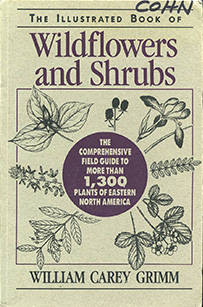
The Illustrated Book of Wildflowers and Shrubs Author(s): Grimm, William Carey Publisher: Stackpole Books, 1993 ISBN: 978-0811730853 View at: Barnes and Noble, or Amazon Comments: This volume covers 1,300 wildflowers and shrubs of eastern North America. Each pair of facing pages typically consists of a set of precisely executed black-and-white line drawings of four or five species, and descriptions of four to eight species. Descriptions are readable and thorough. Even the keys have been translated into something approximating English, fairly unusual. Plants are organized by family, genus, and species. To use this book effectively requires a reasonably detailed understanding of plant families and their properties. There are a series of useful keys near the end for difficult-to-identify shrubs. 637 pages. |
Eastern North America. |
|
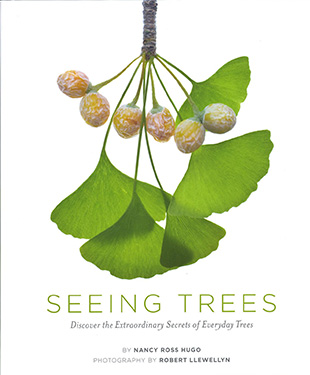
Author(s): Hugo, Nancy Ross; Photographed by Llewellyn, Robert Publisher: Timber Press, 2013 ISBN: 978-1604692198 View at: Barnes & Noble, or Amazon Comments: Seeing Trees is not a field guide, though it will most certainly improve your ability to identify trees in the wild. It falls somewhere between coffee table book, with its large format, nontechnical presentation, and arresting photography; and enthusiast's guide to the world of trees. Roughly the first half of the book is a series of discussions about traits of trees. The rest is dedicated to a much deeper discussion of only ten species of trees, with the goal of understanding how they function, reproduce, and interact with their environment. This is a book that deepens our perspective of the natural world. 242 pages. |
|
|
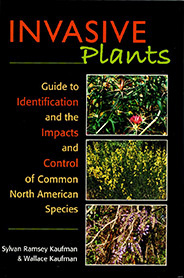
Author(s): Kaufman, Sylvan Ramsey; Kaufman, Wallace Publisher: Stackpole Books, 2007 ISBN: 978-0811733656 View at: Barnes & Noble, or Amazon Comments: Describes about 175 alien invading species, including wildflowers, trees, shrubs and grasses. Invasive plants spread quickly, displacing native species and reducing biodiversity. Entries include identifying information, habitat and range, management information, and cross references. There is also a section on how the plant affects the ecosystem, and how it was introduced to North America. 458 pages. |
North America |
|
Author(s): Kepler, Angela Kay Publisher: Mutual Publishing, 1998 ISBN: 978-1566470575 View at: Barnes & Noble, or Amazon Comments: This book is organized by flower color, and identification is effectively by flower shape. Hawaiian flowers tend to be highly unique in shape, so this approach works quite well. Descriptions are informative and readable, targeted more at the natural history of the plants than at specific identifying features. 144 pages. |
Hawaii |
|
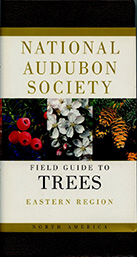
National Audubon Society Field Guide to North American Trees, Eastern Region Author(s): Little, Elbert L. Publisher: Alfred A. Knopf, 1980 ISBN: 978-0394507606 View at: Barnes & Noble, or Amazon Comments: This 714-page guide consists of groups of color photos, arranged by leaf shape; flower color and shape; seed shape; as well as by berries. The second half of the book describes each species with a detailed description, habitats, and range maps. Some black & white line drawings also appear in this section. Describes 364 species, and contains 993 color photos. The text portion of the book is printed on very thin, but rugged paper, so the book is only about an inch thick. |
|
|
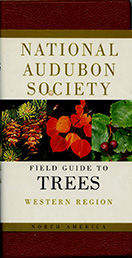
National Audubon Society Field Guide to Trees, Western Region Author(s): Little, Elbert L. Publisher: Alfred A. Knopf, Inc., 1980 ISBN: 978-0394507613 View at: Barnes & Noble, or Amazon Comments: This 639-page guide consists of groups of color photos, arranged by leaf shape; flower color and shape; seed shape; as well as by berries. The second half of the book describes each species with a detailed description, habitat and range information. Some black & white line drawings also appear in this section. Describes 312 species, and contains 855 color photos. The text portion of the book is printed on very thin, but rugged paper, so the book is only about an inch thick. |
|
|
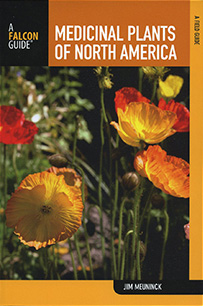
Medicinal Plants of North America: A Field Guide Author(s): Meuninck, Jim Publisher: Globe Pequot Press, 2008 ISBN: 978-0762742981 View at: Barnes & Noble, or Amazon Comments: This book describes many common North American plants, organized into groups by region and plant type (woody vs. herbaceous). The number of species covered is fairly small, about 120, with fairly large write-ups for each species. Medicinal and food uses are discussed, both traditional and contemporary. If your primary interest is identification, other guides are more comprehensive. 159 pages. |
North America |
|
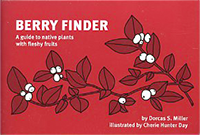
Berry Finder: A Guide to Native Plants with Fleshy Fruits Author(s): Miller, Dorcas S., illustrated by Day, Cherie Hunter Publisher: Nature Study Guild Publishers ISBN: 978-0912550220 View at: Barnes & Noble, or Amazon Comments: This diminutive 58-page guide uses black & white line drawings and plain english to provide a simple flowchart for identifying plants by their berries. Part of a series of such guides, it is a surprisingly effective aid. |
Covers Eastern United States and Canada. |
|
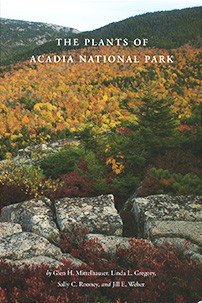
The Plants of Acadia National Park Author(s): Mittelhauser, Glen H.; Gregory, Linda L.; Rooney, Sally C.; and Weber, Jill E. Publisher: University of Maine Press, 2010 ISBN: 978-0891011200 View at: University of Maine Press, or Amazon Comments: Why would anybody buy a book for a single national park? Well, first off, it is an extremely well-designed guide, with 2-3 excellent photos per species and brief but useful descriptions. Descriptions cover the flowers, leaves, and fruit, as well as the locations and frequency of occurrence. The book describes two species per page, 862 in all, including wildflowers, ferns, grasses, sedges, rushes, trees and shrubs. The second reason for getting localized guides is that identification is greatly simplified, since you only see species known in the area. This book is a great resource for anywhere on the Maine and nearby Canadian coasts. 530 pages. |
Acadia National Park, Maine coast |
|
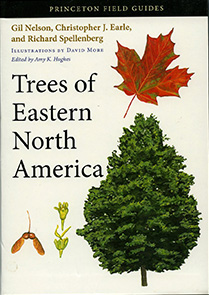
Trees of Eastern North America Author(s): Nelson, Gil; Earle, Christopher J.; Spellenberg, Richard; More, David (Illus.); Hughes, Amy K. (Ed.) Publisher: Princeton University Press, 2014 ISBN: 978-0691145914 View at: Barnes & Noble, or Amazon Comments: This reference, and its companion, Trees of Western North America, are masterpieces of design work. Gymnosperms (cone-bearing trees) are presented first, followed by angiosperms (flowering trees), both arranged by family and genus. Beautifully executed color drawings illustrate every aspect of each species: its overall habit, leaf, bark, twig, flower and seeds. These comprehensive drawings help enormously in confirming identifications. Descriptions are equally detailed, enough so to satisfy pros, yet still accessible to amateurs. Range maps offer much better detail than most. Covers 825 species. If I had to choose a single book for eastern North American trees, it would be this; if I had two, I would also include The Sibley Guide to Trees. 720 pages. |
Eastern North America |
|
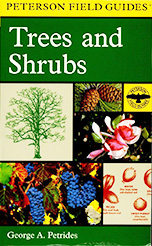
Peterson Field Guides: Trees and Shrubs Author(s): Petrides, George A. Publisher: Houghton Mifflin Co., 1972 ISBN: 978-0395353707 View at: Barnes & Noble, or Amazon Comments: This 428-page guide contains numerous line drawings of leaf and twig shapes, along with a key that shows overall tree silhouettes, and some drawings of seeds and cones. Plants are grouped in five major categories (example: plants with needle-like or scale-like leaves), then by other similarities in shape. Dichotomous keys and drawings point to other pages that contain plant descriptions of 646 species of trees and shrubs. |
Covers north to Newfoundland, south to North Carolina and Tennessee, and west to the Dakotas and Kansas. |
|
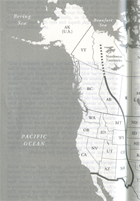
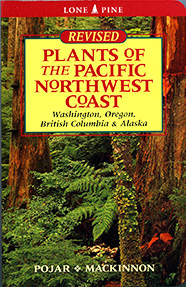
Plants of the Pacific Northwest Coast Author(s): Pojar, Jim; MacKinnon, Andy Publisher: Lone Pine, 1994 ISBN: 978-1551055305 View at: Barnes & Noble, or Amazon Comments: Describes 794 species, including trees, shrubs, wildflowers, aquatic plants, grasses, ferns, mosses and lichens. Includes 1100 color photos and 1000 line drawings and silhouettes. While many field guides cover wider regions and larger numbers of species, this provides deeper detail about each species in the more restricted region. If you search for wildflowers only in this region, this may be the only resource you need, and it is an excellent complement to other guides if you need to identify plants from a wider or different area. Includes keys that require moderate, but not advanced, understanding of botanical terminology. 528 pages. |
Washington, Oregon, British Columbia and Alaska, from the coast to the mountains. |
|
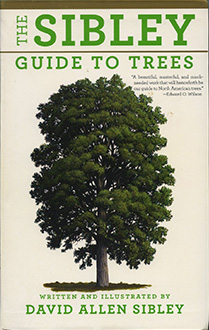
Author(s): Sibley, David Allen Publisher: Alfred A. Knopf, 2009 ISBN: 978-0375415197 View at: Barnes & Noble, or Amazon Comments: “Covers the identification of 668 native and commonly cultivated trees found in the temperate areas of North America north of Mexico.” This excellent 426-page guide uses over 4,100 superbly detailed paintings to distinguish features, and includes details of leaves, bark, seeds, flowers, as well as high resolution range maps. Start here when identifying trees. |
Includes detailed information on distribution in the United States, and less detailed Canadian data for some species. |
|
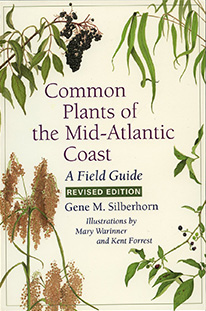
Common Plants of the Mid-Atlantic Coast: A Field Guide Author(s): Silberhorn, Gene M.; Warinner, Mary (Illus.); Forrest, Kent (Illus.) Publisher: The Johns Hopkins University Press, 1999 ISBN: 978-0801860812 View at: Barnes & Noble, or Amazon Comments: The first thing that jumps out of this book are the stunning black-and-white line drawings, which are exquisitely detailed and absolutely captivating. Focusing on the commonest species, the author lavishes two full pages on each, one for the drawing, another that includes a non-technical description for identification, and information about habitat, distribution, ecological value, and wetland status. Includes an identification key. 306 pages. |
Mid-Atlantic coast, from New York to North Carolina. |
|
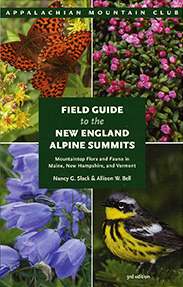
Field Guide to the New England Alpine Summits Author(s): Slack, Nancy G.; Bell, Allison W. Publisher: Appalachian Mountain Club Books, 2013 ISBN: 978-1934028889 View at: Barnes & Noble, or Amazon Comments: New England mountain tops can be challenging places for plants, and the species that colonize these exposed, cooler, more rugged climates are a hardy bunch. This books describes the trees, shrubs, herbacous plants, mosses, lichens, and ferns; as well as mammals, birds, insects, reptiles and amphibians that are common in this habitat, about 200 species in all. The book includes discussions of climate and geography. |
New England mountains |
|
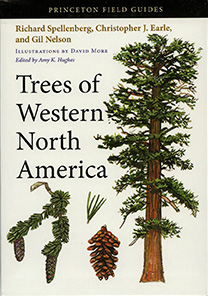
Trees of Western North America Author(s): Spellenberg, Richard; Earle, Christopher J.; Nelson, Gil; More, David (Illus.); Hughes, Amy K. (Ed.) Publisher: Princeton University Press, 2014 ISBN: 978-0691145808 View at: Barnes & Noble, or Amazon Comments: This reference, and its companion, Trees of Eastern North America, are masterpieces of design work. Gymnosperms (cone-bearing trees) are presented first, followed by angiosperms (flowering trees), both arranged by family and genus. Beautifully executed color drawings illustrate every aspect of each species: its overall habit, leaf, bark, twig, flower and seeds. These comprehensive drawings help enormously in confirming identifications. Descriptions are equally detailed, enough so to satisfy pros, yet still accessible to amateurs. Range maps offer much better detail than most. Covers 630 species. If I had to choose a single book for western North American trees, it would be this; if I had two, I would also include The Sibley Guide to Trees. 560 pages. |
Western North America |
|
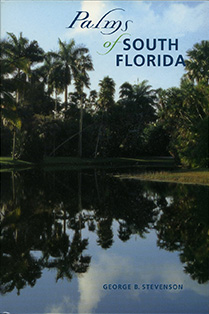
Author(s): Stevenson, George B. Publisher: University Press of Florida, 1996 ISBN: 978-0813014418 View at: Barnes & Noble, or Amazon Comments: There are a lot of books describing palms cultivated for landscape uses, but I have found almost none that focus on native species. South Florida is a habitat with many unique characteristics, and this book concentrates on the many native palm species. This book presents one or two species per pair of pages, with descriptions on one facing page and detailed black & white line drawings on the other. The line drawings show the overall habit of the tree or shrub, along with as many as a dozen drawings of particular identifying details, such as intersections of leaf groupings, precise leaf shape, trunk details, flowers and fruits, even leaf cross-sections. These details provide for precise IDs, more so than with typical photographs. The written descriptions are equally comprehensive, containing both botanical information and information useful to landscapers. 251 pages. |
Southern Florida |
|
Author(s): Symonds, George W. D.; photos by Chelminski, Stephen V. Publisher: Harper, 2003 ISBN: 978-0688050399 Comments: This book aids in identifying trees using more than 1,500 black & white photographs showing trees, trunks, leaves, seeds, and twigs. Photos are large, detailed, and the scale is often shown. Comparison information is used to discriminate among species. Detailed descriptions are not provided, but identifications for many common species are provided. |
Maine (extending into Canada), west to North Dakota and south into Texas and along the Gulf of Mexico to northern Florida. |
|
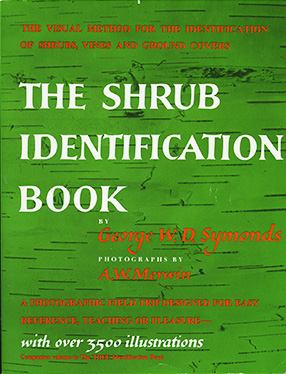
Author(s): Symonds, George W.D. Publisher: HarperCollins Publishers Inc., 1963 ISBN: 978-0688050405 View at: Barnes & Noble, or Amazon Comments: I didn't want to like this book. It is filled with black & white photos, over 3,500 of them, of shrub leaves, stems, branches, buds, flowers, berries, etc. Where possible, specimens are shown actual size. Similar ones are grouped together for comparison. The photos are high in contrast and the paper feels a bit like newsprint, undoubtedly concessions to cost. But this guide has successfully identified species that resisted identification by other means, and I now use it quite frequently. There is a companion volume for trees. |
Covers roughly the eastern half of Canada and the United States. |
|
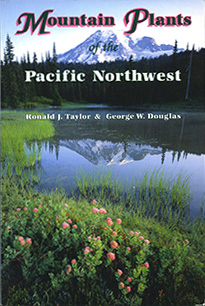
Mountain Plants of the Pacific Northwest Author(s): Taylor, Ronald J.; Douglas, George W. Publisher: Moutain Press Publishing Company, 1995 ISBN: 978-0878423149 View at: Barnes and Noble, or Amazon Comments: Alpine plants are sometimes unique, sometimes familiar species morphed into new forms, for example, by becoming smaller for protection against the weather. This books organizes plants into ferns, trees, forbs (non-grass herbaceous plants) & shrubs, and grasses. (This is a little unusual: trees and shrubs are more often grouped, leaving herbaceous plants separate.) Each section is further subdivided by family, an organization that has pros (similar species often appear together) and cons (lookups by color or shape aren’t possible). Each pair of facing pages consists of a photos page and a descriptions page, usually covering two species. Typically there are two photos per species, with descriptions of leaves, flowers, fruits, and ecology. Habitats and edibility are discussed. The broad range of plant types covered, coupled with the narrow biome, make this a very useful resource if you are tramping around Pacific northwestern mountains. 437 pages. |
Pacific Northwest |
|
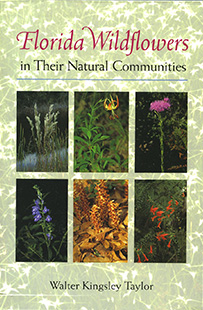
Florida Wildflowers in Their Natural Communities Author(s): Taylor, Walter Kingsley Publisher: University Press of Florida, 1998 ISBN: 978-0813016160 View at: Barnes and Noble, or Amazon Comments: Field guides are endlessly inventive in deciding how best to organize the species presented. Among the approaches are by color, by some shape property of the plant, by family, and by habitat. This guide is organized by terrestrial communities: pine flatwoods, sandhills and clayhills, scrubs, temperate hardwood forests, coastal uplands, rockland pinelands, rockland hardwood hammocks, and ruderal sites. Once you learn to distinguish the habitats, you can more quickly zero in on the species. About 450 species are covered, mostly herbaceous plants but some trees and shrubs, organized into families within each community. Each species has about half a page in coverage, including a photo, a description, flowering time, habitat, range, and perhaps comments. 370 pages. |
Florida |
|
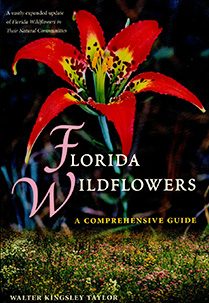
Florida Wildflowers: A Comprehensive Guide Author(s): Taylor, Walter Kingsley Publisher: University Press of Florida, 2013 ISBN: 978-0813044255 Comments: Florida has many plants that aren't found in much of the rest of North America, so this guide covers ground that is not necessarily reflected in others. This guide covers 450 species. Includes descriptions, flowering times, habitat information, distribution within Florida, and notes on related species, etymology, edibility and landscape applications. The guide is organized by broad regions (hardwood forested uplands and wetlands), then by more specific biomes. Within each such grouping, I could not discern much order in the presentation of species, so it was necessary to flip through each section a page at a time. I found this to be an impediment to an otherwise wonderful and useful book. 567 pages. |
Florida |
|
The North American Guide to Common Poisonous Plants and Mushrooms Author(s): Turner, Nancy J.; von Aderkas, Patrick Publisher: Timber Press, 2010 ISBN: 978-0881929294 Comments: It isn't often when an academic treatise is approachable enough to read from cover to cover, but I found that to be the case here. The authors cover mushrooms in detail, as well as other plants. They include coverage for some molds, some toxic algae, lichens, ferns—about 300 species in all. Descriptions for identifying these species are thorough, often accompanied by photos. They also describe symptoms, toxic agents, and treatment protocols. The discussion encompasses not only human poisoning, but plants that are toxic to pets and livestock. This is a very useful addition to any forager's library, as well as a helpful tool to those who treat victims of poisoning. 375 pages. |
North America |
|
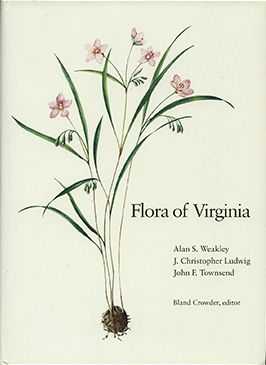
Author(s): Weakley, Alan S.; Ludwig, J. Christopher; Townsend, John F.; Crowder, Bland (Ed.) Publisher: Botanical Research Institute of Texas Press, 2013 ISBN: 978-1889878386 View at: Flora of Virginia Project, or Amazon Comments: I'm not sure where to start with the superlatives here. Flora are very specialized works intended for professional botanists. They combine complex identification keys, detailed species descriptions that are virtually incomprehensible to the unintiated, and precise line drawings that capture identifying features. All flora are towering accomplishments. This one is my favorite. The organization and layout seem to me to be flawless. Drawings are integrated into the descriptive material. Typography is necessarily cramped, but still readable. There is an aesthetic appeal to this document that stands out. It makes a dry, academic tome more approachable, easier to use. Species are organized taxonomically, as is typically the case with flora. Included are vascular spore-bearing plants, gymnosperms (cone-bearing plants), and flowering plants. Descriptions are very thorough. Keys are laid out readably. Drawings are exquisite, reproduced perfectly. As the creators of this work note, this flora appears “not a century too soon”—the last such flora for Virginia was issued 250 years ago! There is also a project to make this available as an app. 1554 pages. |
Virginia |
|
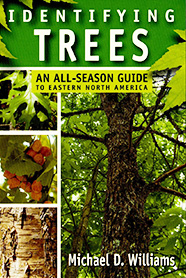
Identifying Trees: An All-season Guide to Eastern North America Author(s): Williams, Michael D. Publisher: Stackpole Books, 2007 ISBN: 978-0811733601 View at: Barnes & Noble, or Amazon Comments: It is difficult to photograph trees, because there are many identifying features. If you photograph the entire tree to capture its habit (overall shape), you lose detail. Bark changes throughout the lifetime of a tree. Branch shapes, leaf scars, fruits, flowers, and leaf shapes all play a role in identification. Identifying Trees approaches this problem by including four to six photos of each species, and, on a facing page, very detailed, highly readable descriptions. The first third of this book is dedicated to an elaborate key, non-technical in its wording, and illustrated with both line drawings and photographs. All this detail limits the range of species—I estimate there are about 130 covered—but this is a great way to learn about tree identification. 406 pages. |
Eastern North America |
|
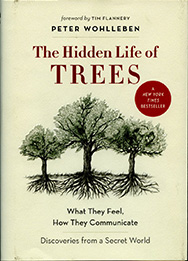
The Hidden Life of Trees: What They Feel, How They Communicate—Discoveries from a Secret World Author(s): Wohlleben, Peter Publisher: Greystone Books, 2016 ISBN: 978-1771642484 Comments: Peter Wohlleben presents trees and the ecosystems they create in a much deeper and more nuanced way. Using surprising means of communication, trees exist in cooperative groups reminiscent of animal social groups, interacting, protecting, and nurturing. You won’t think about trees the same way after you finish this resdable, nontechnical book. 288 pages. |
|
|
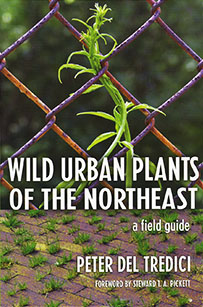
Wild Urban Plants of the Northeast: a Field Guide Author(s): del Tredici, Peter Publisher: Comstock Publishing Associates, a division of Cornell Universty Press, 2010 ISBN: 978-0801474583 View at: Barnes & Noble, or Amazon Comments: You could call this a weed book, since nearly every species in here would be so classed; or even a listing of invasive species, since many of these are a bit overly robust in some habitats. Or you could do as the author does, and recognize the vitality and sheer determination of these plants. Urban settings aren't especially friendly to wild plants, and those hardy few who manage quite nicely there deserve some respect. 158 common species are presented with two pages devoted to each. One page describes plant characteristics, germination, habitat preferences, ecological function, and cultural significance. The facing page contains many clear photos that allow an unambiguous identification. Even if you aren't a city dweller, you'll find most of these species in any temperate climate. 374 pages. |
Northeastern United States |