Acalypha wilkesiana Müll. Arg.
Copperleaf, Jacob’s coat, copper leaf, Wilkes’ acalypha
Copperleaf is native to the Fiji islands archipelago. It is grown as a garden shrub in tropical American climates.
Plants: An evergreen shrub up to 9½ ⨉ 6½′ (3 ⨉ 2 m) in size.
Leaves: A mixture of deep red and green, flat or wrinkly, up to 4–8 ⨉ 6″ (10–20 ⨉ 15 cm) in size. (Cultivars with many other color combinations have been developed.) Leaves are shiny, with coarse teeth, 5–8″ (12–20 cm) long, and oval to elliptic.
Flowers: Reddish-pink or green catkins form thin spikes up to 8″ (20 cm) long.
Fruits: Smooth, somewhat hairy, with three lobes, 1/32–1/16″ (1.5–2 mm) long and ⅛″ (4 mm) in diameter.
Edibility: Not edible.
Medical: Leaves contain phytochemicals with antimicrobial and antifungal properties, and are sometimes used as a diuretic to help manage hypertension.
Online References:
Acalypha amentacea Roxb. ssp. wilkesiana (Müll. Arg.) Fosberg
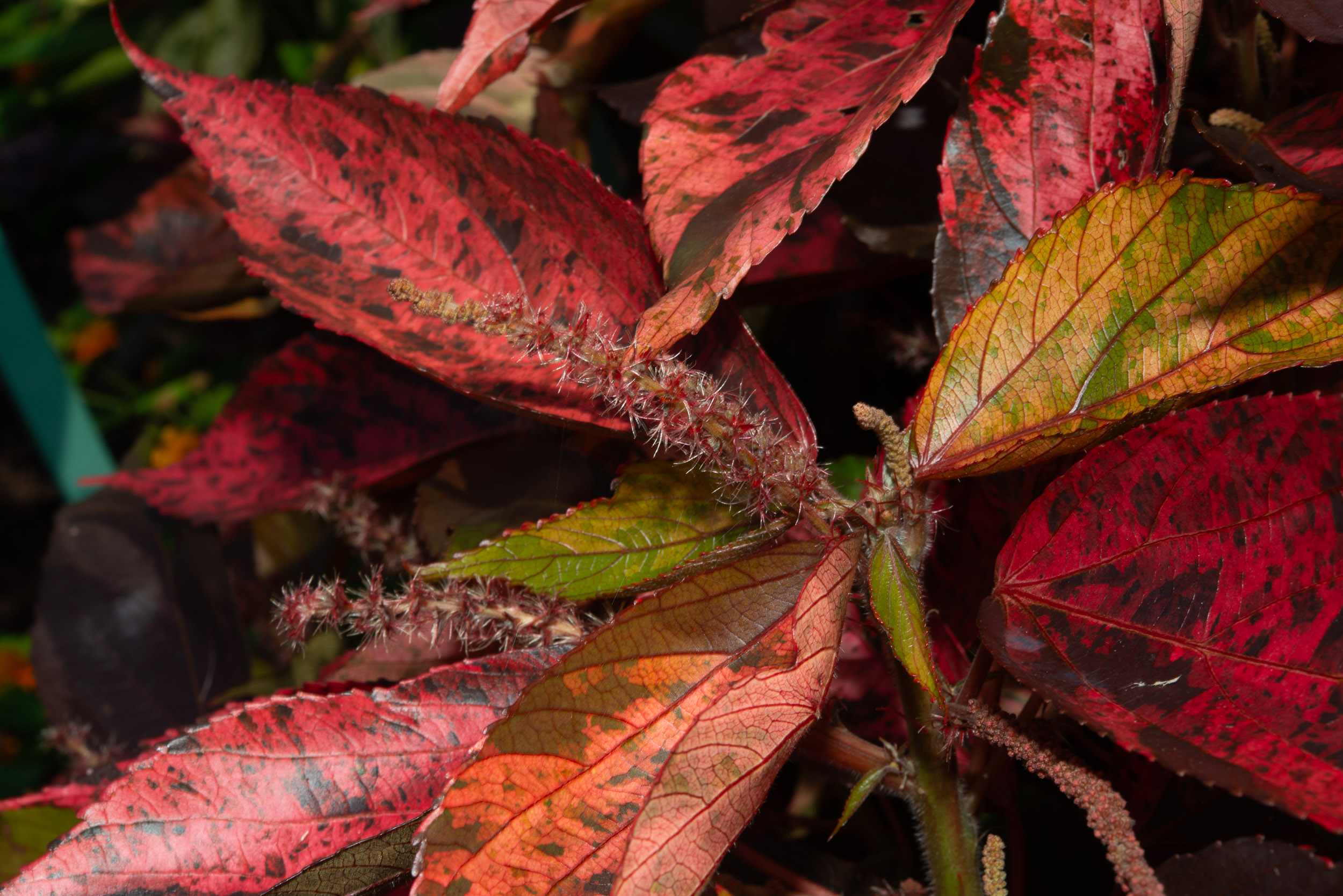
8/31/2013 · Lewis Ginter Botanical Garden, Richmond, Virginia · ≈ 9 × 6″ (22 × 15 cm) 

2/26/2010 · San Diego Zoo, San Diego, California  ID is uncertain

3/2/2001 · Kula Botanical Garden, Maui, Hawaii 
| Kingdom | Plantae | Plants, but not fungi, lichens, or algae (from Stearn's Botanical Latin) |
| Subkingdom | Tracheobionta | Vascular plants—plants with a “circulatory system” for delivering water and nutrients |
| Division | Magnoliophyta | Flowering plants, also known as angiosperms |
| Class | Magnoliopsida | Dicotyledons—plants with two initial seed leaves |
| Subclass | Rosidae | Roses, legumes, proteas, dogwoods, hydrangeas, mistletoes, euphorbias, grapes, many more |
| Order | Malpighiales | A broad group encompassing 16,000 species |
| Family | Euphorbiaceae | Euphorbia or spurge family |
| Genus | Acalypha | Copperleaves or three-seeded mercuries; means “nettle” |
| Species | wilkesiana | Honors Admiral Charles Wilkes who explored the South Pacific in the 1800s. |
Acalypha wilkesiana description by Thomas H. Kent, not updated.

© FloraFinder.org. All rights reserved.