Acer platanoides L.
Norway maple
Norway maples are native to much of Europe and portions of Asia, though they are now well established in much of the northern US and Canada. They are invasive in some habitats.
Plants: Up to 100′ (30 m) in height. Bark is gray and shallowly grooved, rather than shaggy.
Leaves: Norway maple leaves are opposite and palmate, with sharp tips that become hairlike, while most other maples have more rounded tips. Leaves are 2½–6 ⨉ 3–10″ (7–14 ⨉ 8–25 cm) in size. Leaf stalks (petioles) are 3–8″ (8–20 cm) long. Sugar maples produce clear sap, while a plucked Norway maple leaf exudes a white sap. It is easily distinguished from other maples by its leaf shape. The leaves are typically bright yellow or orange-red in the fall.
Flowers: Corymbs of 15–30, yellow to yellow-green, with five sepals and five petals 1/16–⅛″ (3–4 mm) long. Flowering occurs in early spring before the new leaves emerge.
Fruits: We used to call the seed pods “helicopters,” since they often spun quickly as they fell. They are actually called samaras. Each samara contains two winged seeds that are opposite to each other.
Habitat: Anthropogenic (man-made or disturbed habitats), forest edges, forests, and medium moisture levels.
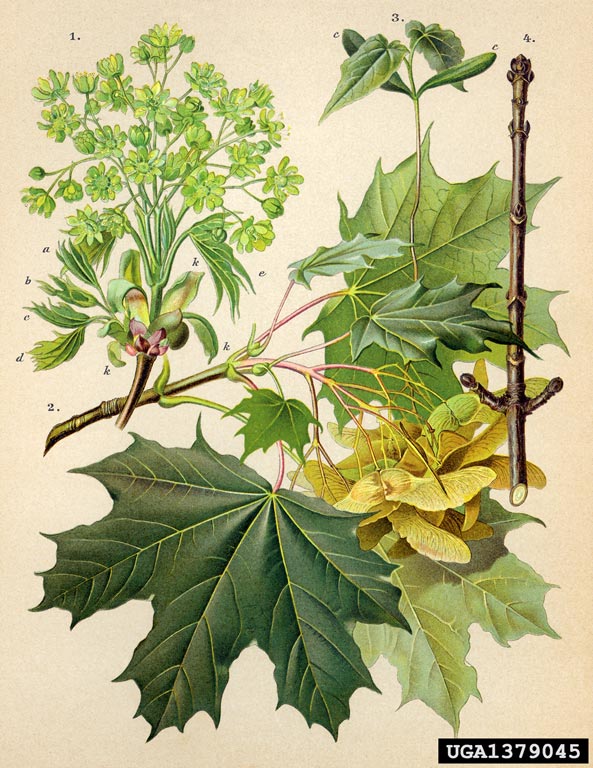
Zelimir Borzan, University of Zagreb, Croatia 
- Branchlet with corymb, terminating developing young shoots (a-e) with deciduous (typically green) transitional leaves at their base (k).
- Branchlet with mature leaves and ripe fruits (double samaras). Stalk exudes a milky sap when broken. Wings of the samaras spread are perpendicular to the pedicels (”horizontally spreading”), with conspicuously flat nutlets.
- Seedling with cotyledons (c) and first pair of ordinary leaves.
- Winter-branchlet; buds are reddish-brown, glossy, terminal bud is larger. Leaf-scars are opposite, horseshoe- or heart-shaped and connected extreme [opposite] laterally. After Hempel & Wilhelm, 1889.
My parents are not big fans of this tree, which, until it recently succumbed to a severe ice storm, grew to fill their front yard. It secretes chemicals that discourage the growth of other plants underneath, and creates baby trees by the truckload. In some areas Norway maples are regarded as invasives, though they remain popular as landscape plants and tolerate urban conditions well.
Online References:
Acer platanoides L. var. schwedleri G. Nicholson
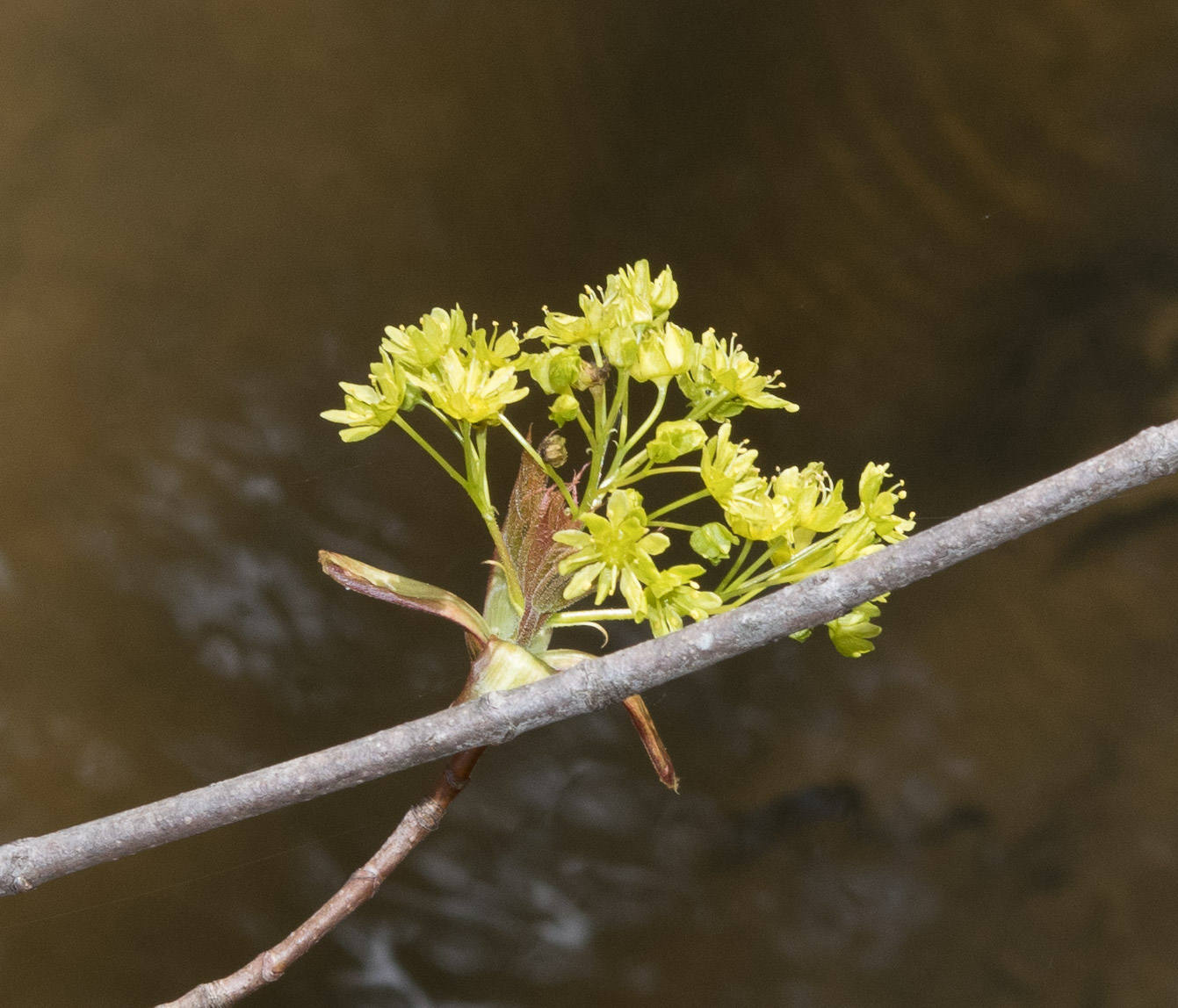
5/9/2016 · Wonder Brook Park, Kennebunk Land Trust, Kennebunk, Maine · ≈ 5 × 4″ (12 × 10 cm) 
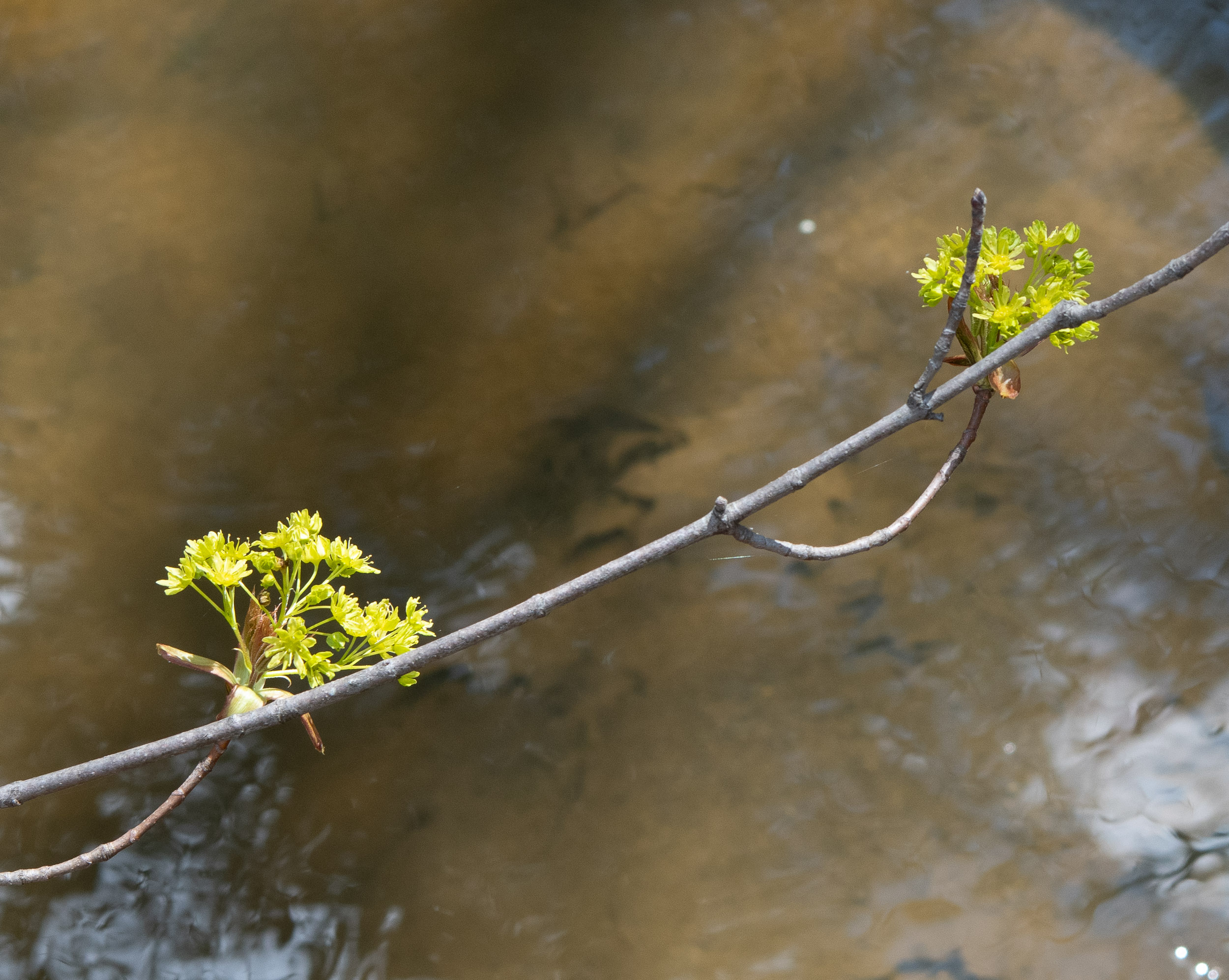
5/9/2016 · Wonder Brook Park, Kennebunk Land Trust, Kennebunk, Maine 

10/25/2009 · Nashua River Rail Trail, Nashua, New Hampshire · ≈ 1½ × 1′ (52 × 34 cm) 

4/8/2010 · Nashua River Rail Trail, Ayer, Massachusetts · ≈ 3½ × 2½″ (9.5 × 7.1 cm)  ID is uncertain

10/25/2009 · Nashua River Rail Trail, Nashua, New Hampshire · ≈ 17 × 12″ (44 × 29 cm) 

4/8/2010 · Nashua River Rail Trail, Ayer, Massachusetts · ≈ 7 × 5″ (18 × 13 cm) ID is uncertain 

5/15/2010 · Garden in the Woods, Framingham, Massachusetts · ≈ 1½ × 1′ (52 × 34 cm) 
| Kingdom | Plantae | Plants, but not fungi, lichens, or algae (from Stearn's Botanical Latin) |
| Subkingdom | Tracheobionta | Vascular plants—plants with a “circulatory system” for delivering water and nutrients |
| Division | Magnoliophyta | Flowering plants, also known as angiosperms |
| Class | Magnoliopsida | Dicotyledons—plants with two initial seed leaves |
| Subclass | Rosidae | Roses, legumes, proteas, dogwoods, hydrangeas, mistletoes, euphorbias, grapes, many more |
| Order | Sapindales | Includes citrus; maples, horse-chestnuts, lychees and rambutans; mangos and cashews; frankincense and myrrh; mahogany and neem |
| Family | Sapindaceae | Soapberry family |
| Genus | Acer | Maples |
| Species | platanoides | Means “resembles sycamore leaves” (genus Platanus) |

Acer platanoides description by Thomas H. Kent, not updated.

© FloraFinder.org. All rights reserved.