Achillea ptarmica L.
Sneezewort, pearl yarrow, sneezeweed, bastard pellitory, European pellitory, fair-maid-of-France, goose tongue, wild pellitory, white tansy
Sneezeweed is native to Europe and parts of Asia, and naturalized in parts of North America. The powdered roots induce sneezing.
Plants: Plants are 1½–2′ (45–60 cm) in size, with stems that are hairy toward the tops and hairless below. They may form colonies.
Leaves: Alternate, lanceolate to linear, 1–4 ⨉ ¼″ (3–10 cm ⨉ 6.3 mm). They are sessile, hairless except along the midrib on the underside, with finely serrated edges.
Flowers: Attractive white branched flowerheads have individual flowers that are ¼–⅝″ (7.6–17 mm) in diameter, with 8-13 ray florets. Double flowers are common. Flowers appear from June to September.
Fruits: Seeds heads ¼″ (6.3 mm) in diameter contain cypselae (seeds) about 1/16″ (2 mm) long.
Habitats: Roadsides, disturbed sites, open fields and pastures, in sandy or gravelly soils or in moist to drying silty soils.
Edibility: Leaves are edible raw or cooked, producing a tingling effect when chewed.
Online References:

7/25/2025 · River Point Conservation Area, Falmouth, Maine · ≈ 4 × 3½″ (10 × 8.9 cm) 

7/26/2025 · River Point Conservation Area, Falmouth, Maine · ≈ 4 × 6″ (10 × 16 cm) 

7/26/2025 · River Point Conservation Area, Falmouth, Maine · ≈ 4 × 6″ (10 × 16 cm) 

7/25/2025 · River Point Conservation Area, Falmouth, Maine · ≈ 5 × 4″ (12 × 10 cm) 
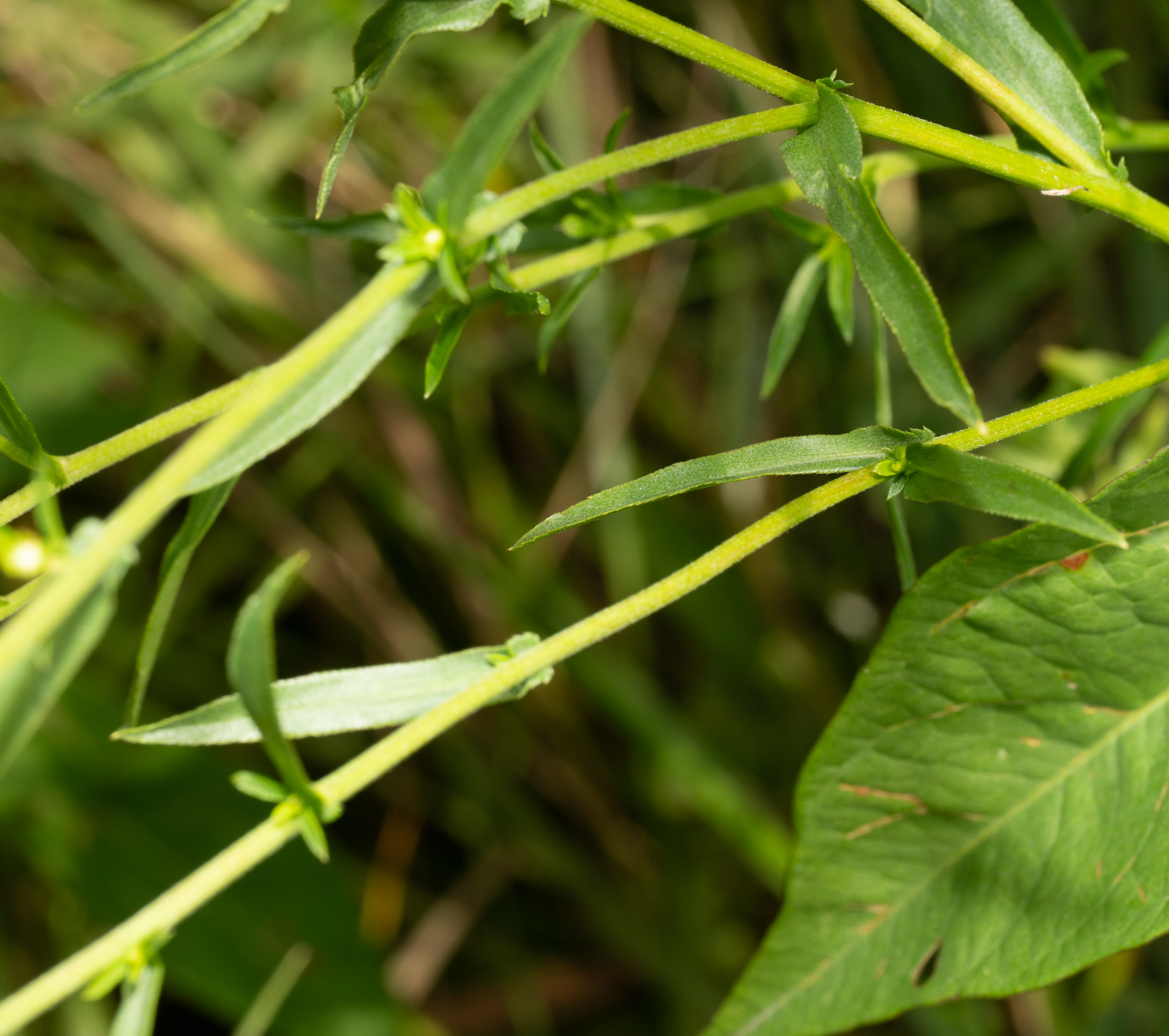
7/25/2025 · River Point Conservation Area, Falmouth, Maine · ≈ 4½ × 4″ (11 × 10 cm) 

7/26/2025 · River Point Conservation Area, Falmouth, Maine · ≈ 4 × 6″ (10 × 15 cm) 

7/26/2025 · River Point Conservation Area, Falmouth, Maine · ≈ 3½ × 4″ (8.8 × 10 cm) 
| Kingdom | Plantae | Plants, but not fungi, lichens, or algae (from Stearn's Botanical Latin) |
| Subkingdom | Tracheobionta | Vascular plants—plants with a “circulatory system” for delivering water and nutrients |
| Division | Magnoliophyta | Flowering plants, also known as angiosperms |
| Class | Magnoliopsida | Dicotyledons—plants with two initial seed leaves |
| Subclass | Asteridae | A large class that encompasses asters |
| Order | Asterales | Flowering plants with a central disk flower and surrounding petals, like daisies |
| Family | Asteraceae | The aster family, which also includes daisies and sunflowers; from the Greek ἀστήρ, “star,” for the star-shaped flowers |
| Genus | Achillea | Yarrows; “Achillea” means “Achilles,” who used the herb in battle |
| Species | ptarmica | From New Latin, from Greek ptarmikē, in turn from ptarmikos, causing to sneeze |

Achillea ptarmica description by Thomas H. Kent, not updated.

© FloraFinder.org. All rights reserved.