Aloe ortholopha Christian & Milne-Red.
These rare aloes are native to the Mvurwi range on the northern Great Dyke in Zimbabwe.
Plants: Succulent perennials.
Leaves: Dense rosettes. Leaves are 1–1½′ ⨉ 4–6″ (40–50 ⨉ 10–14 cm), ovate-lanceolate, and greenish-gray. Leaves do not have spots. They maybe tinged pink when dry, and edges have light brown teeth about ¼–⅜″ (8–10 mm) apart.
Flowers: One, or rarely two, inflorescences are up to 3′ (90 cm) tall, on one to four usually horizontal branches. Racemes are 12–16 ⨉ 1¾″ (30–40 ⨉ 4.5 cm).
Fruits: Dehiscent capsules.
Habitats: Open serpentine grasslands, on slopes and ridges, at elevations of 4757–5003′ (1.4–1.5 km) in the northern Great Dyke, Mvurwi Range, Zimbabwe.
Online References:
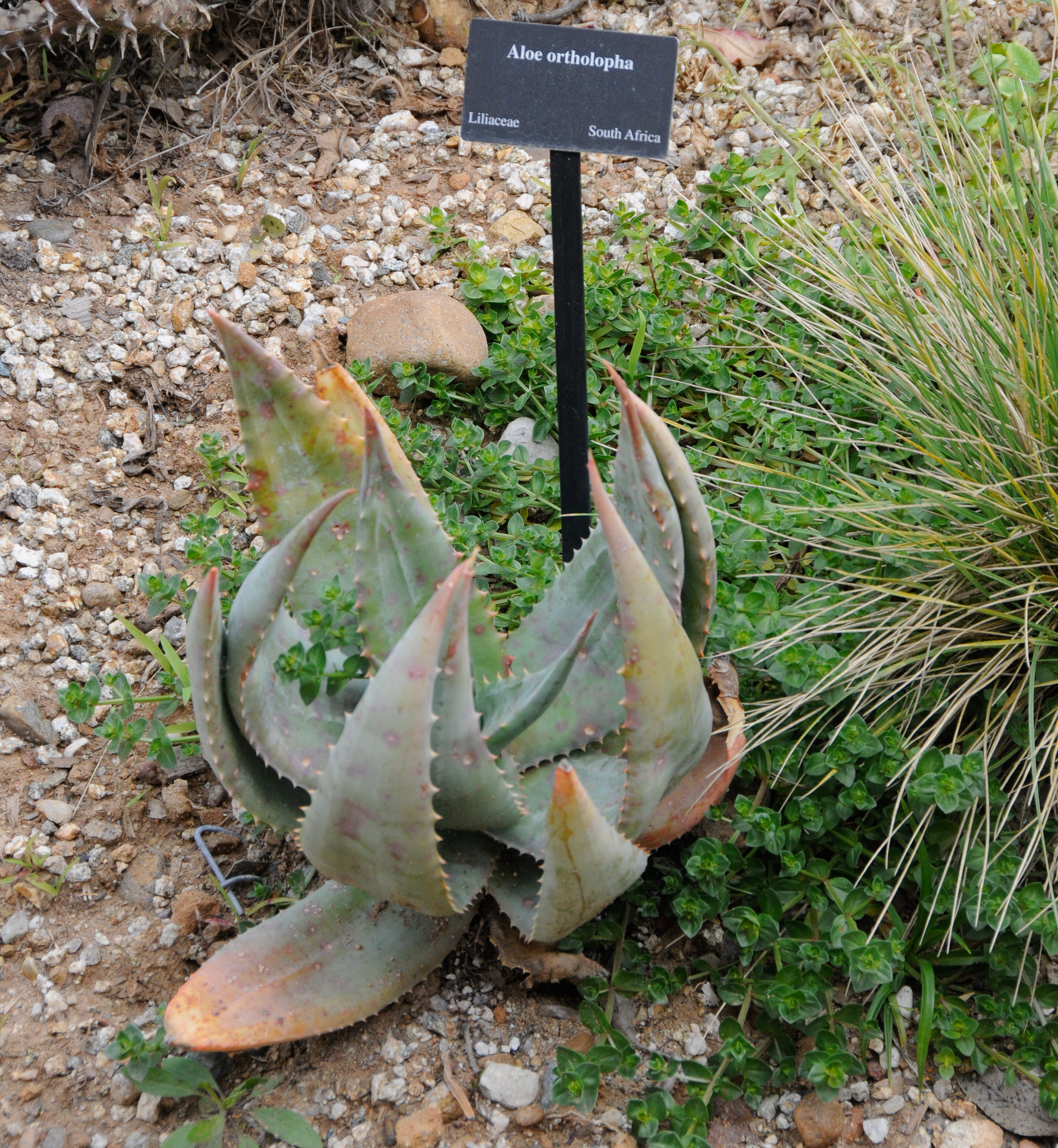
2/26/2010 · San Diego Zoo, San Diego, California 
| Kingdom | Plantae | Plants, but not fungi, lichens, or algae (from Stearn's Botanical Latin) |
| Subkingdom | Tracheobionta | Vascular plants—plants with a “circulatory system” for delivering water and nutrients |
| Division | Magnoliophyta | Flowering plants, also known as angiosperms |
| Class | Liliopsida | Monocots (plants with a single seed leaf); includes the lily family |
| Subclass | Liliidae | Includes lilies, orchids, and many others |
| Order | Asparagales | A diverse group that includes asparagus |
| Family | Xanthorrhoeaceae | Aloes, many tropical plants, flax lilies, daylilies, many others |
| Genus | Aloe | Means “goddess” in ancient Sanskrit, for its reputed use as a beauty aid; some sources suggest that the name comes from Alloeh, meaning “shining bitter substance” |
| Species | ortholopha | From Greek, orthos, erect, straight, and lophos a crest; referring to the one-sided inflorescence |

Aloe ortholopha description by Thomas H. Kent, not updated.

© FloraFinder.org. All rights reserved.