Aloe spicata
Lebombo aloe, bottle-brush aloe
Bottle-brush aloe is so-called because its flowers resumble bottle brushes. They are native to South Africa, not found in the wild in North America.
Plants: Evergreen succulent perennial shrubs are 4–6′ (1.2–1.8 m) tall and about the same around. It may appear tree-like, on a solitary trunk, or have multiple stems.
Leaves: Rosettes up to 3′ (91 cm) wide are made up 12-30 fleshy lanceolate leaves 2–2½′ ⨉ 1½″ at the base (60–80 ⨉ 3.8 cm). The recurved leaves taper to a sharp tip, and their margins have small firm teeth. They are bright green, often tinted with orange pink to red coloration.
Flowers: Each rosette produces 1-5 erect, unbranched flowering stalks up to 4′ (1.2 m) tall. Much of the stalk—1½–3′ (50–100 cm)—is a densely flowered raceme about 1¾″ (5 cm) in diameter. While most aloe flowers are hanging and tubular, these point outward, resermbling a bottle brush. They are yellow, and so densely packed as to be barely visible. Their long thin stamens provide the brushlike appearance, and the racemes may look orange depending upon the stage of flowering.
Fruits: Fruits are dark brown, releasing small black seeds without wings.
Habitats: Steep rocky slopes and cliffs, grasslands and savannas, at elevations of 2100–2953′ (640–900 m).
Online References:
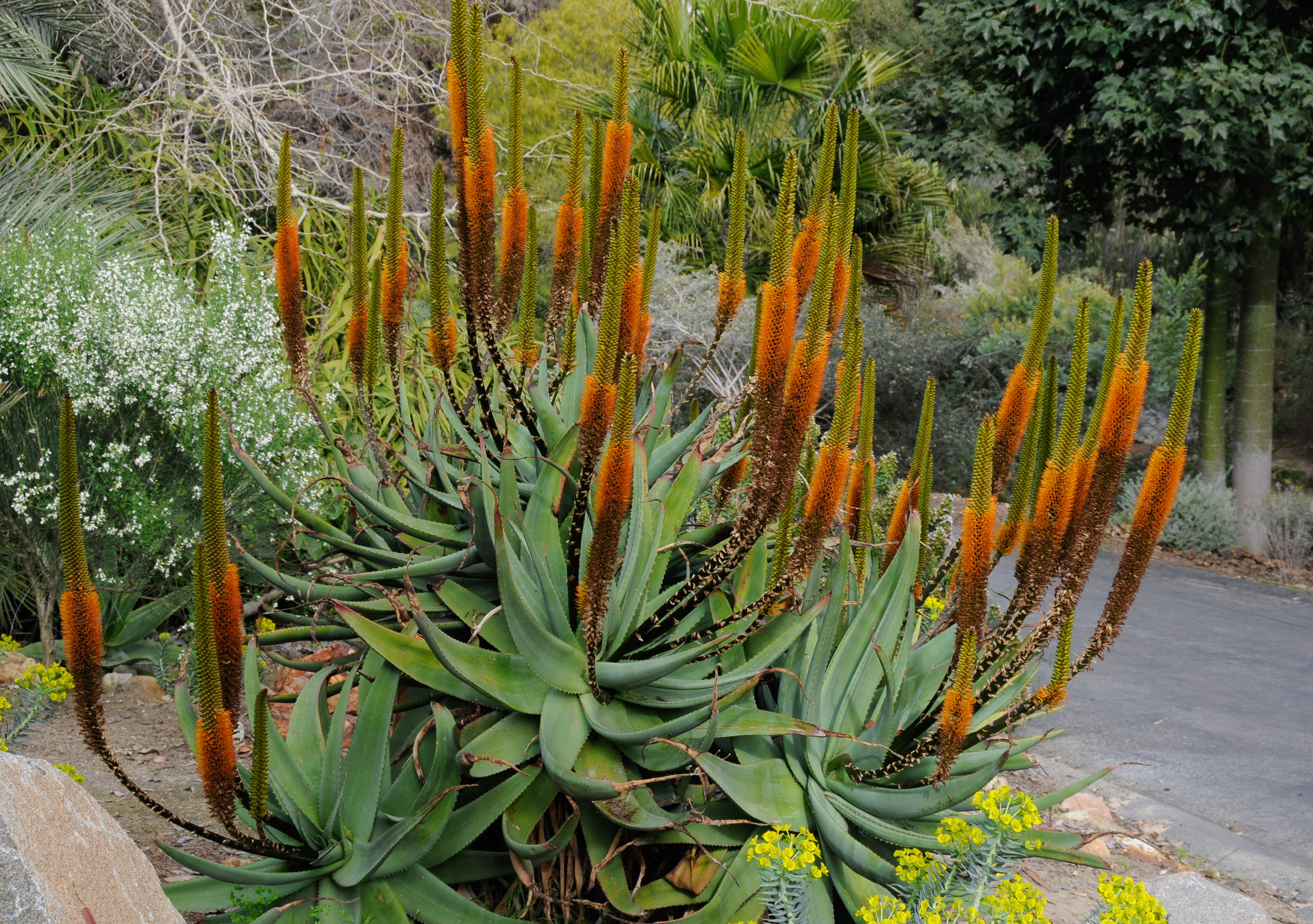
2/24/2010 · San Diego (Quail) Botanic Garden, Encinitas, California 
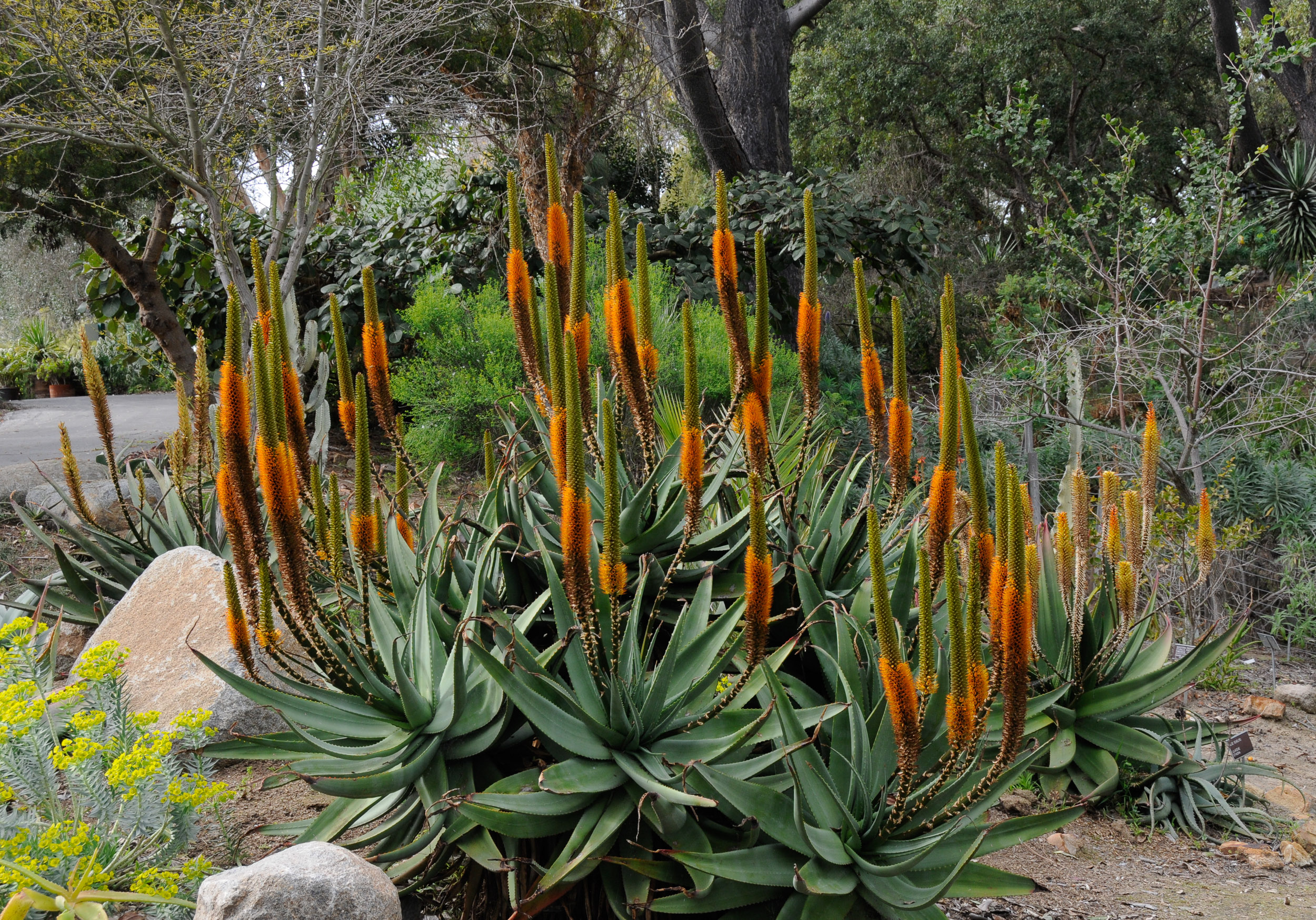
2/24/2010 · San Diego (Quail) Botanic Garden, Encinitas, California 
| Kingdom | Plantae | Plants, but not fungi, lichens, or algae (from Stearn's Botanical Latin) |
| Subkingdom | Tracheobionta | Vascular plants—plants with a “circulatory system” for delivering water and nutrients |
| Division | Magnoliophyta | Flowering plants, also known as angiosperms |
| Class | Liliopsida | Monocots (plants with a single seed leaf); includes the lily family |
| Subclass | Liliidae | Includes lilies, orchids, and many others |
| Order | Asparagales | A diverse group that includes asparagus |
| Family | Xanthorrhoeaceae | Aloes, many tropical plants, flax lilies, daylilies, many others |
| Genus | Aloe | Means “goddess” in ancient Sanskrit, for its reputed use as a beauty aid; some sources suggest that the name comes from Alloeh, meaning “shining bitter substance” |
| Species | spicata | From Latin spicata, “arranged in a spike” |

Aloe spicata description by Thomas H. Kent, not updated.

© FloraFinder.org. All rights reserved.