Artemisia stelleriana Besser
Hoary mugwort, Dusty Miller, beach wormwood, oldwoman
Beach wormwood is native to China, Japan, and Korea in Asia, to far eastern Russia, and to the Aleutian Islands in Alaska. Cultivated as an ornamental, it has escaped and established itself, or been planted intentionally to stabilize sand dunes, along North America’s Atlantic coast. They colonize both salt and freshwater sand dunes, preferring hot, dry conditions. (“Wormwood” is a related species, Artemisia absinthium.)
Plants: Typically 8–24″ (20–60 cm) high, forming mats, each with 1-3 erect white stems, tomentose to floccose.
Leaves: Pale green to bluish to silver-gray, due to the presence of fuzzy trichomes, which cover the tops and bottoms of the leaves. Leaves are alternate, and deeply lobed and toothed, and 1–4 ⨉ ⅜–1¾″ (3–10 ⨉ 1–5 cm).
Flowers: Yellow, in tall spikes. Individual flowers are disk flowers, ⅛–¼″ (6–7 mm) in size. They appear from July to late August.
Fruits: Achenes, or even more technically cypselae, are dark brown, narrow and roughly linear, slightly flattened, and 1/16–⅛″ (3–4 mm) long.
Habitats: Dunes and other sandy coastal areas; tolerant of salt spray.
Online References:
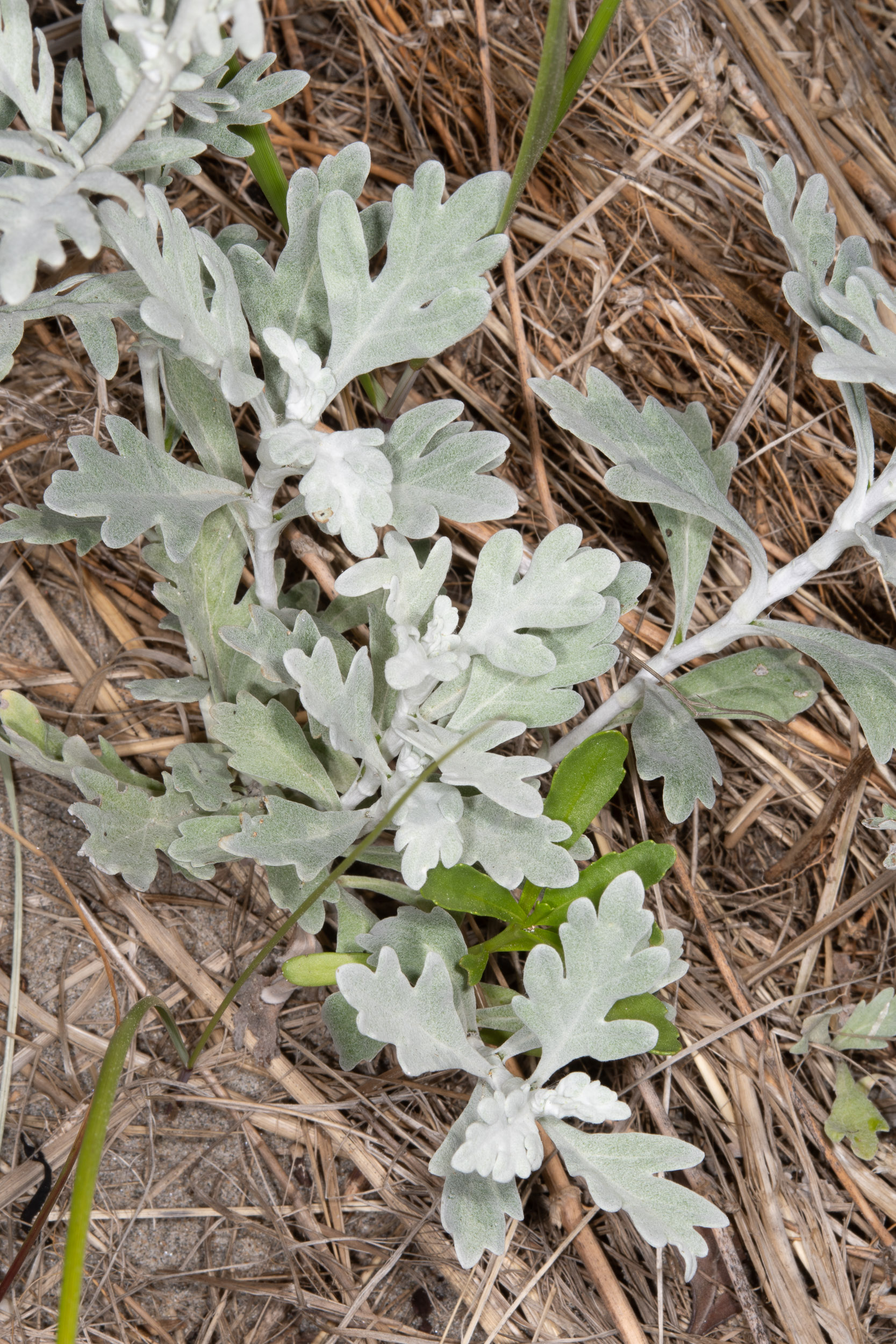
6/26/2024 · Seawall Beach, Morse Mountain, Phippsburg, Maine · ≈ 6 × 10″ (16 × 24 cm) 

6/15/2025 · Morse Mountain Preserve, Phippsburg, Maine · ≈ 3 × 2′ (96 × 64 cm) 

6/26/2024 · Seawall Beach, Morse Mountain, Phippsburg, Maine · ≈ 6 × 8″ (14 × 21 cm) 
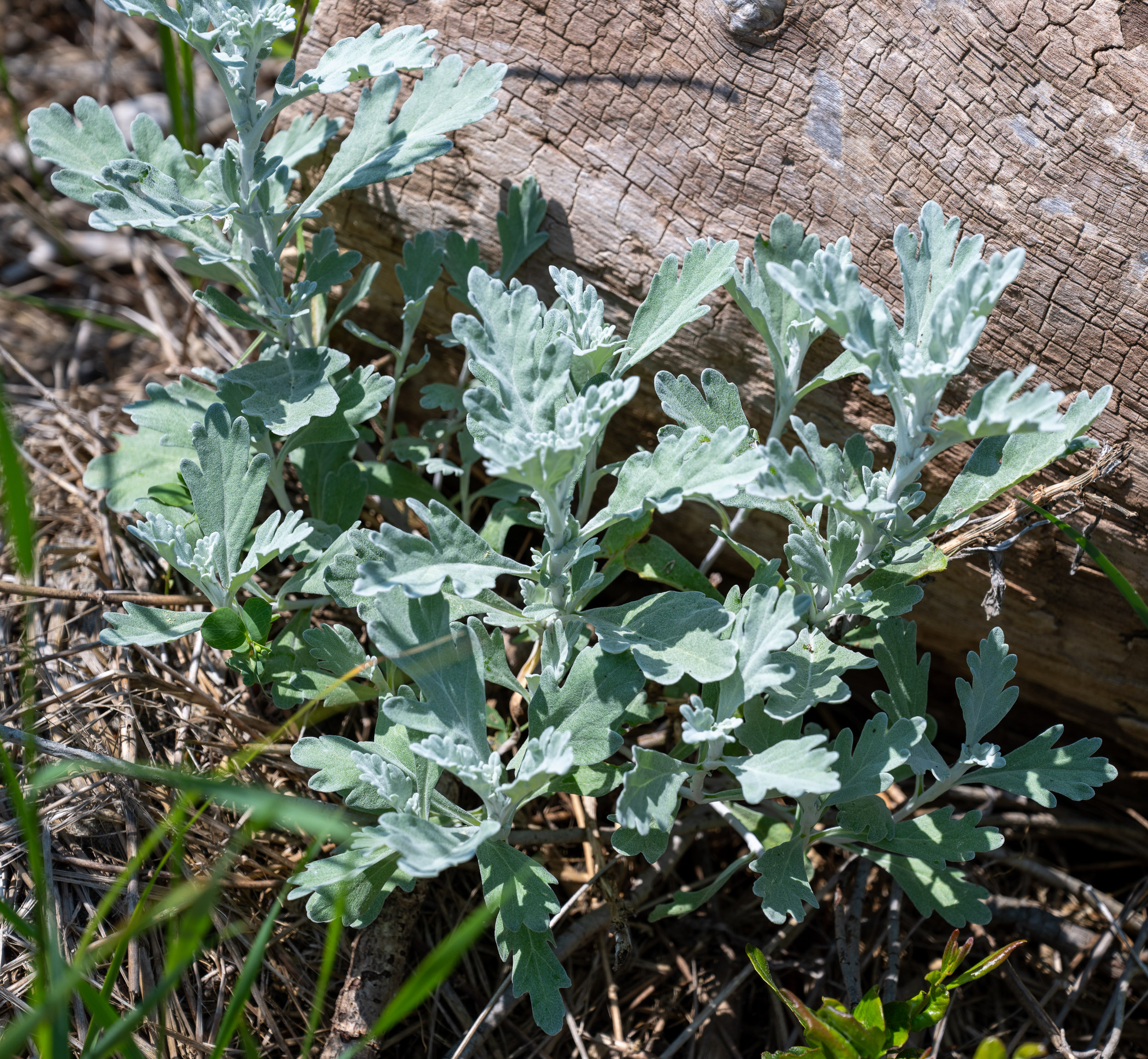
6/15/2025 · Morse Mountain Preserve, Phippsburg, Maine · ≈ 1 × 1′ (35 × 32 cm) 

6/15/2025 · Morse Mountain Preserve, Phippsburg, Maine · ≈ 11 × 17″ (28 × 43 cm) 

6/26/2024 · Seawall Beach, Morse Mountain, Phippsburg, Maine · ≈ 8 × 5″ (20 × 13 cm) 
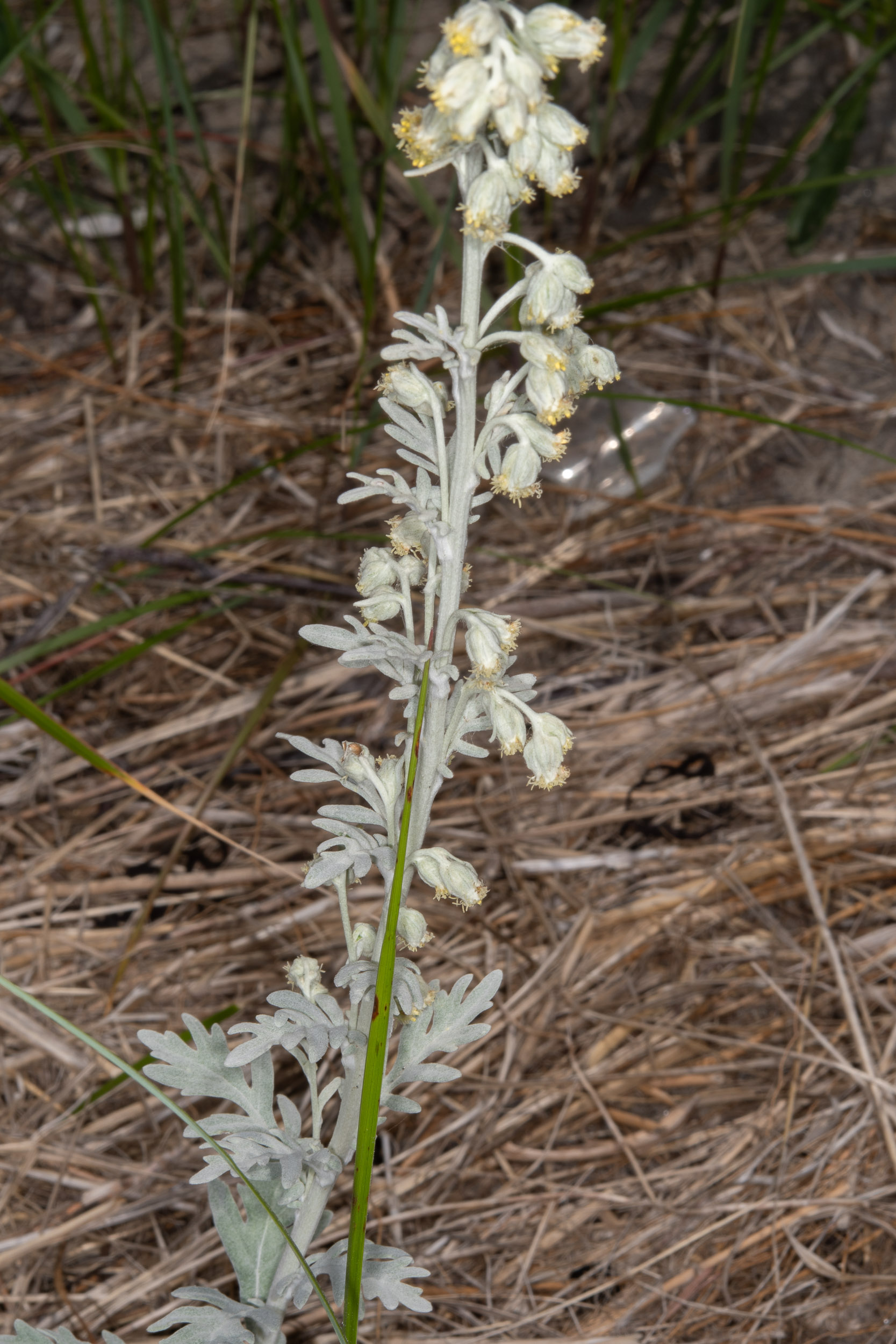
6/26/2024 · Seawall Beach, Morse Mountain, Phippsburg, Maine · ≈ 6 × 10″ (16 × 24 cm) 
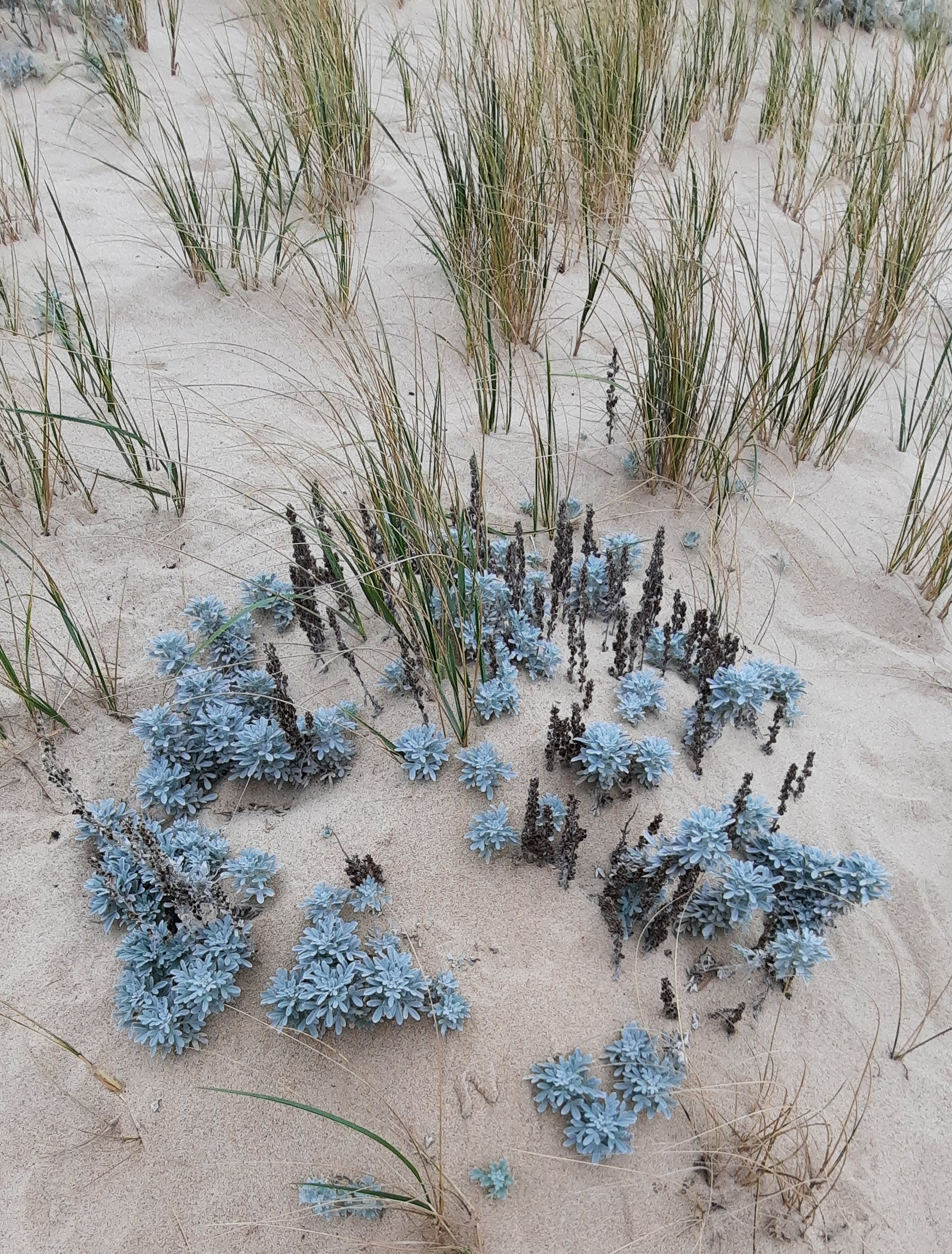
Plants are in the foreground, here with brown flower spikes that have gone to seed. · 10/14/2023 · Race Point, Cape Cod, Massachusetts · By Rhonda T. Schorer 

6/26/2024 · Seawall Beach, Morse Mountain, Phippsburg, Maine 
| Kingdom | Plantae | Plants, but not fungi, lichens, or algae (from Stearn's Botanical Latin) |
| Subkingdom | Tracheobionta | Vascular plants—plants with a “circulatory system” for delivering water and nutrients |
| Division | Magnoliophyta | Flowering plants, also known as angiosperms |
| Class | Magnoliopsida | Dicotyledons—plants with two initial seed leaves |
| Subclass | Asteridae | A large class that encompasses asters |
| Order | Asterales | Flowering plants with a central disk flower and surrounding petals, like daisies |
| Family | Asteraceae | The aster family, which also includes daisies and sunflowers; from the Greek ἀστήρ, “star,” for the star-shaped flowers |
| Genus | Artemisia | From the Greek goddess Artemis, who gave it her own name because it helped cure her (there are other possible reasons for the derivation of this name too) |
| Species | stelleriana | For Georg Willhelm Steller, 18th century German naturalist |

Artemisia stelleriana description by Thomas H. Kent, not updated.

© FloraFinder.org. All rights reserved.