Astragalus gilmanii Tidestr.
Gilman’s milk vetch
Gilman’s milk vetch is native to Nevada and a few locations in the Panamint Range next to Death Valley in California. This plant is uncommon and restricted in range.
Plants: Forms clumps of hairy stems up to 1′ (30 cm) in length.
Leaves: Up to 2½″ (7 cm) long, composed of several fuzzy leaflets with purple margins. Leaf tips are sometimes notched.
Flowers: 4-9 bright pink-purple flowers, are each about ¼″ (7 mm) long.
Fruits: Pink, papery, shiny, mostly air-filled pea-like sacks. Each fruit is about 1″ (2.5 cm) in length, ovoid, with a pointed tip, and containing one or a few green seeds.
Habitats: Desert scrub, at elevations between 1.1–1.9 mi (1.8–3 km).
Online References:
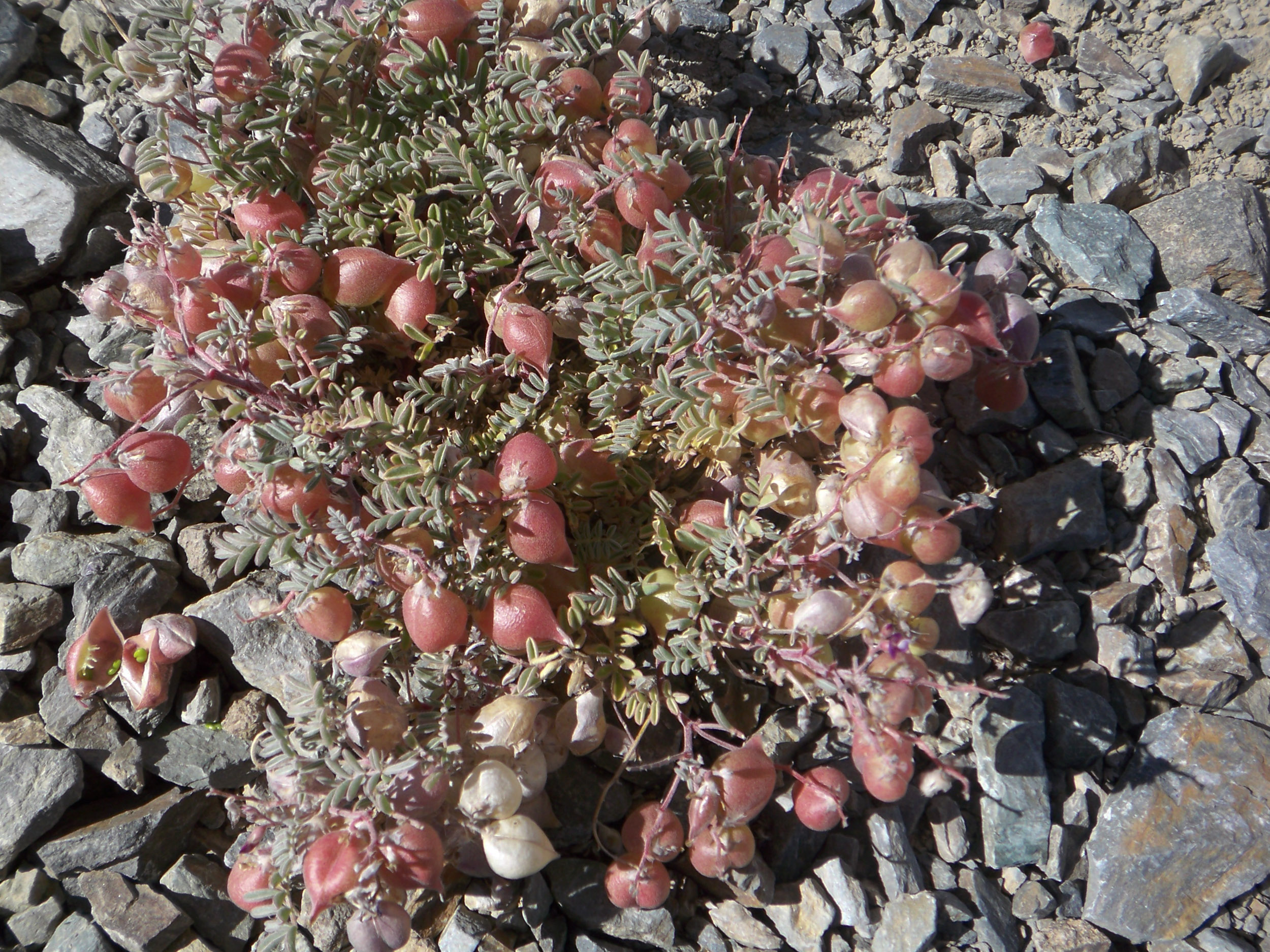
6/26/2007 · Roger’s Service Road, Death Valley, California · By Rhonda Tatiana Schorer 
| Kingdom | Plantae | Plants, but not fungi, lichens, or algae (from Stearn's Botanical Latin) |
| Subkingdom | Tracheobionta | Vascular plants—plants with a “circulatory system” for delivering water and nutrients |
| Division | Magnoliophyta | Flowering plants, also known as angiosperms |
| Class | Magnoliopsida | Dicotyledons—plants with two initial seed leaves |
| Subclass | Rosidae | Roses, legumes, proteas, dogwoods, hydrangeas, mistletoes, euphorbias, grapes, many more |
| Order | Fabales | Legumes (pea and bean families) |
| Family | Fabaceae | Legume family (peas and beans) |
| Genus | Astragalus | From the Greek astragalos meaning “ankle bone” and an early name applied to some plants in this family because of the shape of the seeds |
| Species | gilmanii | After Marshall French Gilman (1871-1944), a Death Valley naturalist |

Astragalus gilmanii description by Thomas H. Kent, not updated.

© FloraFinder.org. All rights reserved.