Astragalus whitneyi A. Gray
Balloon-pod milk-vetch, balloon milk-vetch, Whitney’s locoweed
When I was a kid I read a science fiction story about a crew of astronauts, landing on another planet. I don’t remember the details, but they noticed balloons floating in the air, and, upon examination, found they were seedpods, lofted by hydrogen gas made by the host plants. What a clever idea! It never occurred to me that something very similar exists right here on earth. The “balloons” of balloon-pod milkvetch dry out and detach, becoming brittle, and light enough to be blown hither and yon. They collide with rocks and shatter, releasing their seeds. No hydrogen needed!
Balloon-pod milkvetch is native to western North America.
Plants: 1½–16″ (4–40 cm) in height, typically spreading low across the ground.
Leaves: Leaves are green or silvery (due to fine hairs), and bipinnate or tripinnate. Leaves are ⅞–1½″ (2.5–4 cm) in length, and consist of 9-21 leaflets. Each leaflet is oblong to obovate, and ⅛–⅜″ (6–10 mm) long.
Flowers: Dense racemes of 5-20 flowers, each up to ½″ (1.5 cm) long. Flowers are tubular, bell-shaped, and pinkish, lavendar purple, or yellowish, up to ⅜″ (1 cm) long. They appear from May to September.
Fruits: The “balloons” are ⅞–1″ (2.5–3 cm) long, and sort of pear-shaped—if you have seen a lady’s slipper, the shape of the flower is similar. Pods are translucent, with very thin walls, and covered with irregular red-purple blotches, occuring in clusters. The pods are unmistakable.
Habitats: It prefers sandy, rocky, or gravelly soil, full sun, and elevations between 2500–12000′ (762–3657 m).
Online References:

5/3/2018 · Park Blvd., Joshua Tree National Park, California · ≈ 9 × 6″ (22 × 16 cm) 

5/3/2018 · Park Blvd., Joshua Tree National Park, California · ≈ 9 × 6″ (23 × 16 cm) 

5/3/2018 · Park Blvd., Joshua Tree National Park, California · ≈ 8 × 5″ (20 × 13 cm) 

5/3/2018 · Joshua Tree National Park, California · ≈ 6 × 8″ (16 × 21 cm) 

5/3/2018 · Park Blvd., Joshua Tree National Park, California · ≈ 10 × 6″ (24 × 16 cm) 
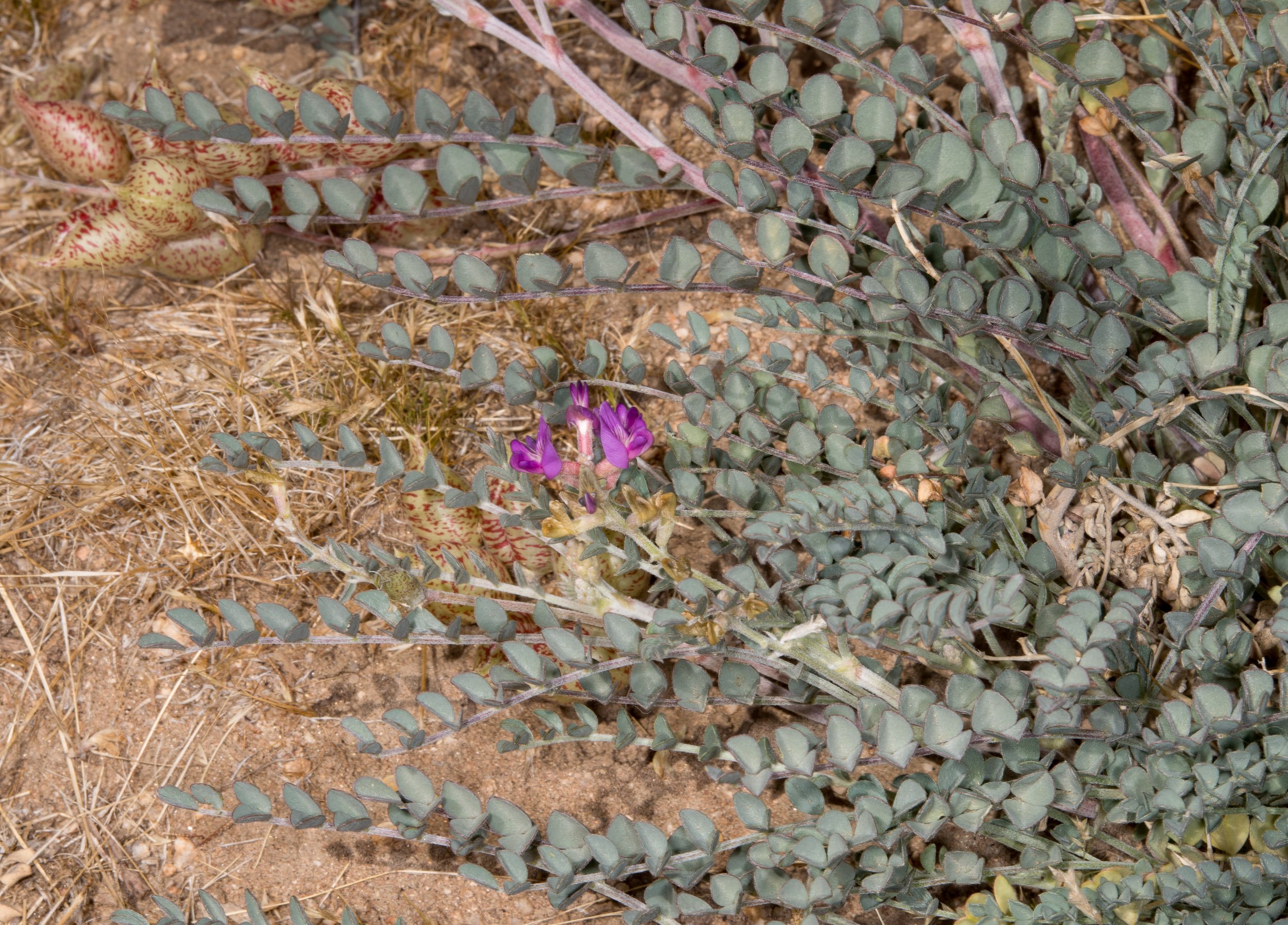
5/3/2018 · Park Blvd., Joshua Tree National Park, California · ≈ 9 × 6″ (23 × 16 cm) 

5/3/2018 · Park Blvd., Joshua Tree National Park, California · ≈ 5 × 5″ (12 × 13 cm) 

5/3/2018 · Park Blvd., Joshua Tree National Park, California · ≈ 8 × 6″ (19 × 15 cm) 

5/3/2018 · Park Blvd., Joshua Tree National Park, California · ≈ 10 × 6″ (24 × 16 cm) 

5/3/2018 · Park Blvd., Joshua Tree National Park, California · ≈ 8 × 6″ (20 × 16 cm) 
| Kingdom | Plantae | Plants, but not fungi, lichens, or algae (from Stearn's Botanical Latin) |
| Subkingdom | Tracheobionta | Vascular plants—plants with a “circulatory system” for delivering water and nutrients |
| Division | Magnoliophyta | Flowering plants, also known as angiosperms |
| Class | Magnoliopsida | Dicotyledons—plants with two initial seed leaves |
| Subclass | Rosidae | Roses, legumes, proteas, dogwoods, hydrangeas, mistletoes, euphorbias, grapes, many more |
| Order | Fabales | Legumes (pea and bean families) |
| Family | Fabaceae | Legume family (peas and beans) |
| Genus | Astragalus | From the Greek astragalos meaning “ankle bone” and an early name applied to some plants in this family because of the shape of the seeds |
| Species | whitneyi | For Josiah Dwight Whitney (1819-1896), state geologist of California from 1860 to 1876, who made the first geologic study of Yosemite Valley, and for whom Mt. Whitney was named |

Astragalus whitneyi description by Thomas H. Kent, not updated.

© FloraFinder.org. All rights reserved.