Grasses, Sedges, and Rushes Bibliography
Grasses include most of the grains we eat, and most of the grasslike plants in lawns, meadows and wild areas everywhere. Large grasses are rushes. This list also includes sedges, plants with grasslike leaves but unusual yellowish, greenish, or brown spiky flowers. Many sedges are found in wet areas. Finally, bamboos are grasses.
Sedges of Maine: A Field Guide to Cyperaceae

Author(s): Arsenault, Matt; Mittelhauser, Glen H.; Cameron, Don; Dibble, Alison C.; Haines, Arthur; Rooney, Sally C.; and Weber, Jill E.
Publisher: University of Maine Press, 2013
ISBN: 978-0891011231
View at: University of Maine Press, or Amazon
Comments: I love this book! Sedges are phenomenally difficult to identify. They look like grasses until you look closely, then they explode into over 5,000 species. So many that the study of sedges merits its own name: caricology, after Carex, the most extensive genus. Understanding these plants requires rapt attention to detail, a magnifying lens or scanner, and a great deal of patience. Oh, and a really thorough guide book. This guide devotes two full pages per species, one filled with detailed descriptions and the other with multiple extremely good photos. Species comparisons are thorough. Although written with attention to species in Maine, many of these species are widespread along both coasts as well as at the same latitude as Maine. 712 pages. See also the The Plants of Acadia National Park, The Plants of Baxter State Park, Grasses and Rushes of Maine, and Wildflowers of the Maine Islands: The Downeast and Acadia Coasts. All of these are by the same primary author.
Range: Maine
Grasses: An Identification Guide

Author(s): Brown, Lauren
Publisher: Houghton Mifflin Harcourt, 1979
ISBN: 978-0395628812
View at: Barnes & Noble, or Amazon
Comments: This guide, 240 pages in length, covers 135 species of grasses, sedges, and rushes, as well as grasslike plants such as cattails and horsetails. 386 black & white line drawings complement descriptions that provide some historical background as well as identification. I am a bit disappointed with the reproduction of the drawings, which are somewhat muddy, but I nevertheless consult this guide often.
Range:

Grasses, Sedges, Rushes: An Identification Guide
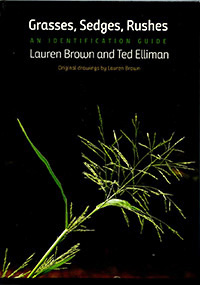
Author(s): Brown, Lauren; and Elliman, Ted
Publisher: Yale University Press, 2020
ISBN: 978-0300236774
Comments: Combining crisp line drawings by Lauren Brown, and photos, this guide makes identification a good deal easier. The volume is non-technical, and lists specific identifying traits for each plant, as well as range information. 250 pages.
Range: Northeast
A Field Guide to the Plants and Animals of the Middle Rio Grande Bosque
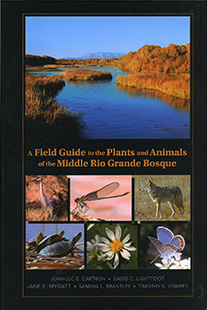
Author(s): Cartron, Jean-Luc E.; Lightfoot, David C.; Mygatt, Jane E.; Brantley, Sandra L.; Lowrey, Timothy K.
Publisher: University of New Mexico Press, 2008
ISBN: 978-0826342690
View at: Barnes & Noble, or Amazon
Comments: This volume has the ambitious goal of capturing a broad swath of life along the Rio Grande. It discusses the settings and their environmental histories, habitat types, and places to visit. It covers nonvascular plants such as lichens and fungi; vascular plants (flowering and spore-producing); invertabrate animals; and amphibians, reptiles, birds, and mammals. The section on plants makes up about a quarter of the book. It is organized by family. Blooming period is featured prominently, a good idea, since we tend to notice plants in bloom. Also included is identifying information, natural history, and whether a species is threatened. There are about three species per page, so photos tend to be smaller than with some layouts. 375 pages.
Range: From the back cover: “Extending from the spillway below Cochiti Dam, about fifty miles north of Albuquerque, to the headwaters of Elephant Butte Reservoir, near Truth or Consequences in the southern portion of New Mexico, the Middle Rio Grande Bosque is more than a cottonwood woodland or forest.”
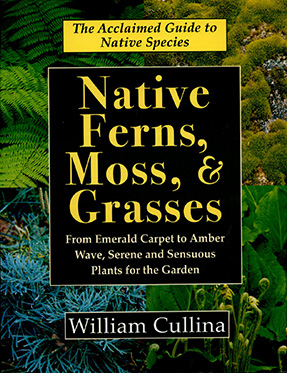
Author(s): Cullina, William
Publisher: Echo Point Books & Media, 2020
ISBN: 978-1635618969
Comments: This books presents a wide selection of native ferns, mosses, and grasses, selected for garden plantings. William Cullina, a horticulturalist, highlights these oft-overlooked “background” plantings. This is the third of three volumes in his series. 256 pages.
Range: North America
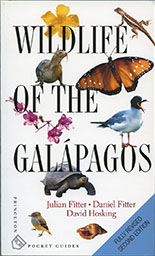
Author(s): Fitter, Julian; Fitter, Daniel; Hosking, David
Publisher: Princeton University Press, 2015
ISBN: 978-0691170428
Comments: This compact guide does an amazing job at summarizing the natural history of the Galápagos archipelago. It covers geology, vulcanism, ocean currents, ecological zones, and points of interest. It also covers animals, birds, plants, and marine animals, most with photos. It lists islands and ecological zones and some of the species to be found there. How they managed to cram all this information into a pocket guide frankly boggles the imagination! 287 pages.
Range: Galápagos Islands
A Field Guide to Plants of Costa Rica
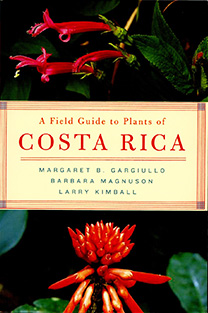
Author(s): Gargiullo, Margaret B.; photos by Magnuson, Barbara & Kimball, Larry
Publisher: Oxford University Press, 2008
ISBN: 978-0195188257
View at: Barnes & Noble, or Amazon
Comments: Nearly 1400 photos illustrate 856 Costa Rican plants organized into broad plant types ("habits"); then by color; then by family, genus and species. Detailed identifying descriptions include range information. The author's writing style avoids excessive jargon. 494 pages.
Range: Covers Costa Rica
Wildflowers & Grasses of Virginia’s Coastal Plain
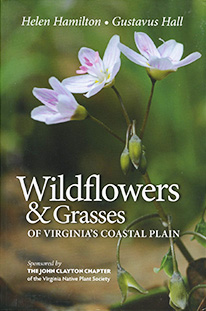
Author(s): Hamilton, Helen; Hall, Gustavus
Publisher: Botanical Research Institute of Texas Press, 2013
ISBN: 978-1889878416
View at: Barnes & Noble, or Amazon
Comments: Describes about 250 species found in Virgina's coastal plain—roughly the eastern third of Virginia. Herbaceous plants are arranged by flower color. Each entry includes a description, habitat and contents, along with a photo. Coverage includes small, weedy species that are often omitted from other guides. 276 pages.
Range: Eastern third of Virginia
How to Identify Grasses and Grasslike Plants
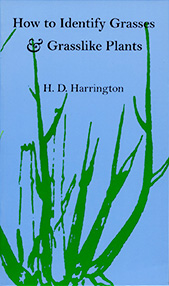
Author(s): Harrington, H. D.
Publisher: Swallow Press/Ohio University Press, 1977
ISBN: 978-0804007467
View at: Barnes & Noble, or Amazon
Comments: This is not a field guide—you won't identify a single species using this guide alone—it is best described as a book about grass anatomy. Grasses, sedges and rushes are notoriously difficult to identfiy, and this book describes the often subtle features that serve to classify and identify these plants. Nearly half the book is dedicated to an illustrated glossary. Line drawings are used extensively throughout the book. Use this resource to acquire the background you need in order to use grass field guides more effectively.
Manual of the Grasses of the United States, Volume 1

Author(s): Hitchcock, Albert Spear; revised by Chase, Agnes
Publisher: Dover Books, 1971
ISBN: 978-0486227177
View at: Download the original 1935 work free from the Biodiversity Heritage Library, or Amazon
Comments: The original 1935 edition of Manual of the Grasses of the United States (downloadable free), was reprinted in two volumes beginning in 1971 by Dover Books. The work “... catalogs and describes in detail all 1,398 numbered species in 169 numbered genera found in this country, plus 120 species in 16 genera of the so-called ‘waifs’” (from the cover). Descriptions are accompanied by clear, detailed black & white line drawings and by range maps. Sedges and rushes are not included. Detailed dichotomous keys are provided. Volume 1 and 2 together are 1051 pages. Organization is by genus and species, so unless you can navigate the dichotomous keys, or suspect the genus, it can be difficult to perform IDs.
Range: Covers the United States.
Manual of the Grasses of the United States, Volume 2

Author(s): Hitchcock, Albert Spear; revised by Chase, Agnes
Publisher: Dover Books, 1971
ISBN: 978-0486227184
View at: Download the original 1935 work free from the Biodiversity Heritage Library, or Amazon
Comments: The original 1935 edition of Manual of the Grasses of the United States (downloadable free), was reprinted in two volumes beginning in 1971 by Dover Books. The work “... catalogs and describes in detail all 1,398 numbered species in 169 numbered genera found in this country, plus 120 species in 16 genera of the so-called ‘waifs’” (from the cover). Descriptions are accompanied by clear, detailed black & white line drawings and by range maps. Sedges and rushes are not included. Detailed dichotomous keys are provided. Volume 1 and 2 together are 1051 pages. Organization is by genus and species, so unless you can navigate the dichotomous keys, or suspect the genus, it can be difficult to perform IDs.
Range: Covers the United States.
Sedges of the Northern Forest: A Photographic Guide (The Northern Forest Atlas Guides)
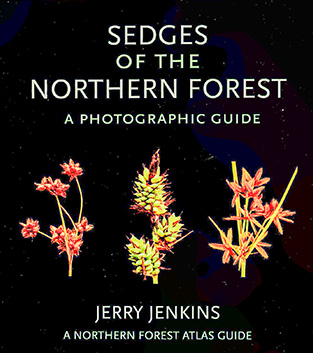
Author(s): Jenkins, Jerry
Publisher: Comstock Publishing Associates, 2019
ISBN: 978-1501727085
Comments: This presents beautifully photographed sedges. Sharp photos are displayed on a black background. 96 pages. See also Mosses of the Northern Forest: A Photographic Guide, by the same author.
Range: The northern forest comprises the central and eastern regions of the northern United States, along with a chunk of southern Canada.
Author(s): Kaufman, Sylvan Ramsey; Kaufman, Wallace
Publisher: Stackpole Books, 2007
ISBN: 978-0811733656
View at: Barnes & Noble, or Amazon
Comments: Describes about 175 alien invading species, including wildflowers, trees, shrubs and grasses. Invasive plants spread quickly, displacing native species and reducing biodiversity. Entries include identifying information, habitat and range, management information, and cross references. There is also a section on how the plant affects the ecosystem, and how it was introduced to North America. 458 pages.
Range: North America
Field Guide to the Grasses, Sedges and Rushes of the United States

Author(s): Knobel, Edward
Publisher: Dover Publications Inc., 1980
ISBN: 978-0486235059
View at: Barnes & Noble, or Amazon
Comments: This 83-page book is a reprint of an edition originally published in 1899; the original (listed elsewhere in this bibliography) is available for free download. It contains large, high quality black & white line drawings of many grasses, sedges and rushes. Many further species are distinguished using smaller drawings of the unique features. This is the book I turn to first for grasses.
Range: Covers the United States.
The Grasses, Sedges and Rushes of the United States
Author(s): Knobel, Edward
Publisher: Bradlee Whidden, 1899
View at: Free download at google.com
Comments: This 83-page book contains large, high quality black & white line drawings of many grasses, sedges and rushes. Many further species are distinguished using smaller drawings of the unique features. This is the book I turn to first for grasses. If you prefer a printed copy, this is listed separately in this bibliography.
Range: Covers the United States.
Tallgrass Prairie Wildflowers: A Field Guide to Common Wildflowers and Plants of the Prairie Midwest
Author(s): Ladd, Doug; Oberle, Frank
Publisher: Falcon Guide, Morris Book Publishing, LLC, 2005
ISBN: 978-0762737444
Comments: Tallgrass prairies, so called because the grasses populating them are often at least three feet high and sometimes much higher yet, once made up a very large part of the United States. Now greatly fragmented, their value is being rediscovered. This guide presents about 300 species, one to two per page, with a color photo above and a description below. The description includes a bloom season, habitat/range information, and comments. Species are organized by flower color and family, with separate sections on grasses and weeds. 263 pages.
Range: Parts of Minnesota, the Dakotas, Wisconsin, Michigan, Nebraska, Iowa, Illinois, Indiana, Ohio, Kansas, Missouri, Kentuky, Oklahoma, Arkansas, and Tennessee.

Author(s): Mittelhauser, Glen H.; Arsenault, Matt; Cameron, Don; Doucette, Eric
Publisher: University of Maine Press, 2019
ISBN: 978-0891011293
View at: Brickyard Books
Comments: Armed with thousands of high quality, detailed photos, and excellent keys, this guide covers grasses and rushes found in Maine. Grasses can be difficult to identify, and this book is hugely helpful. 747 pages. See also the The Plants of Acadia National Park, Sedges of Maine, The Plants of Baxter State Park, and Wildflowers of the Maine Islands: The Downeast and Acadia Coasts. All of these are by the same primary author.
The Plants of Baxter State Park
Author(s): Mittelhauser, Glen H.; Bissell, Jensen; Cameron, Don; Dibble, Alison C.; Haines, Arthur; Hockwater, Jean; Lovit, Marilee; Megquier, Aaron
Publisher: University of Maine Press, 2016
View at: Brickyard Books
Comments: This book does a beautiful job of presenting and keying 857 species of herbaceous plants, trees, and shrubs; ferns and fern allies; and grasses, sedges, and rushes found in the 200,000 acres of Baxter State Park. Photography is clear and detailed, with two species per page. About 2000 photos. 477 pages. See also the The Plants of Acadia National Park, Sedges of Maine, Grasses and Rushes of Maine, and Wildflowers of the Maine Islands: The Downeast and Acadia Coasts. All of these are by the same primary author.
The Plants of Acadia National Park
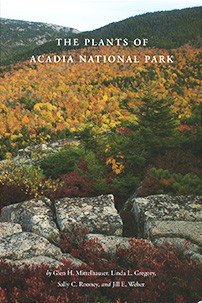
Author(s): Mittelhauser, Glen H.; Gregory, Linda L.; Rooney, Sally C.; and Weber, Jill E.
Publisher: University of Maine Press, 2010
ISBN: 978-0891011200
View at: University of Maine Press, or Amazon
Comments: Why would anybody buy a book for a single national park? Well, first off, it is an extremely well-designed guide, with 2-3 excellent photos per species and brief but useful descriptions. Descriptions cover the flowers, leaves, and fruit, as well as the locations and frequency of occurrence. The book describes two species per page, 862 in all, including wildflowers, ferns, grasses, sedges, rushes, trees and shrubs. The second reason for getting localized guides is that identification is greatly simplified, since you only see species known in the area. This book is a great resource for anywhere on the Maine and nearby Canadian coasts. 530 pages. See also the The Plants of Baxter State Park, Sedges of Maine, Grasses and Rushes of Maine, and Wildflowers of the Maine Islands: The Downeast and Acadia Coasts. All of these are by the same primary author.
Range: Acadia National Park, Maine coast
Plants of the Pacific Northwest Coast
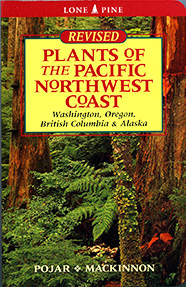
Author(s): Pojar, Jim; MacKinnon, Andy
Publisher: Lone Pine, 1994
ISBN: 978-1551055305
View at: Barnes & Noble, or Amazon
Comments: Describes 794 species, including trees, shrubs, wildflowers, aquatic plants, grasses, ferns, mosses and lichens. Includes 1100 color photos and 1000 line drawings and silhouettes. While many field guides cover wider regions and larger numbers of species, this provides deeper detail about each species in the more restricted region. If you search for wildflowers only in this region, this may be the only resource you need, and it is an excellent complement to other guides if you need to identify plants from a wider or different area. Includes keys that require moderate, but not advanced, understanding of botanical terminology. 528 pages.
Range: Washington, Oregon, British Columbia and Alaska, from the coast to the mountains.
Common Plants of the Mid-Atlantic Coast: A Field Guide
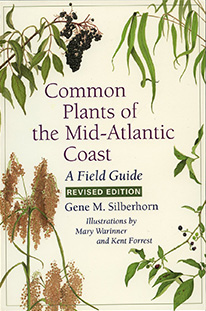
Author(s): Silberhorn, Gene M.; Warinner, Mary (Illus.); Forrest, Kent (Illus.)
Publisher: The Johns Hopkins University Press, 1999
ISBN: 978-0801860812
View at: Barnes & Noble, or Amazon
Comments: The first thing that jumps out of this book are the stunning black-and-white line drawings, which are exquisitely detailed and absolutely captivating. Focusing on the commonest species, the author lavishes two full pages on each, one for the drawing, another that includes a non-technical description for identification, and information about habitat, distribution, ecological value, and wetland status. Includes an identification key. 306 pages.
Range: Mid-Atlantic coast, from New York to North Carolina.
Field Guide to the New England Alpine Summits
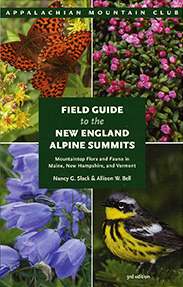
Author(s): Slack, Nancy G.; Bell, Allison W.
Publisher: Appalachian Mountain Club Books, 2013
ISBN: 978-1934028889
View at: Barnes & Noble, or Amazon
Comments: New England mountain tops can be challenging places for plants, and the species that colonize these exposed, cooler, more rugged climates are a hardy bunch. This books describes the trees, shrubs, herbacous plants, mosses, lichens, and ferns; as well as mammals, birds, insects, reptiles and amphibians that are common in this habitat, about 200 species in all. The book includes discussions of climate and geography.
Range: New England mountains
North American Wildland Plants, 2nd Ed.
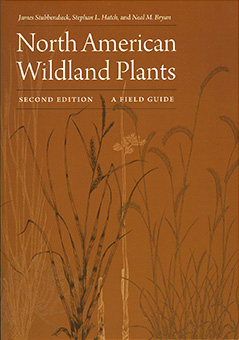
Author(s): Stubbendieck, James; Hatch, Stephan L.; and Bryan, Neal M.
Publisher: University of Nebraska Press, 2011
ISBN: 978-0803234857
View at: Barnes and Noble, or Amazon
Comments: There is a lot to like about this volume, which is divided roughly evenly between grasses and herbaceous plants, with a smattering of trees & shrubs; and with special interest in plants that are good or bad for forage. Plants are organized by family. In the hands of a gifted botanical artist, line drawings capture all the essential traits of a plant with none of the background clutter in photographs. These full-page line drawings are superb, showing the entire plant, the roots, and detail views. Range maps are detailed, not restricted to state boundaries. Descriptions cover plant shapes, flowering times, fruits, leaves and stems. Comments cover use for food or medical purposes. Plants poisonous to people or livestock are so noted. Habitats are also described. Each species is given two full pages, so per-species coverage is deep. As a consequence, the range of species is limited to about 200. 496 pages.
Range: North America
Mountain Plants of the Pacific Northwest
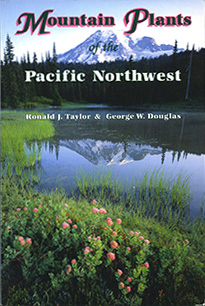
Author(s): Taylor, Ronald J.; Douglas, George W.
Publisher: Moutain Press Publishing Company, 1995
ISBN: 978-0878423149
View at: Barnes and Noble, or Amazon
Comments: Alpine plants are sometimes unique, sometimes familiar species morphed into new forms, for example, by becoming smaller for protection against the weather. This books organizes plants into ferns, trees, forbs (non-grass herbaceous plants) & shrubs, and grasses. (This is a little unusual: trees and shrubs are more often grouped, leaving herbaceous plants separate.) Each section is further subdivided by family, an organization that has pros (similar species often appear together) and cons (lookups by color or shape aren’t possible). Each pair of facing pages consists of a photos page and a descriptions page, usually covering two species. Typically there are two photos per species, with descriptions of leaves, flowers, fruits, and ecology. Habitats and edibility are discussed. The broad range of plant types covered, coupled with the narrow biome, make this a very useful resource if you are tramping around Pacific northwestern mountains. 437 pages.
Range: Pacific Northwest
Florida Wildflowers: A Comprehensive Guide
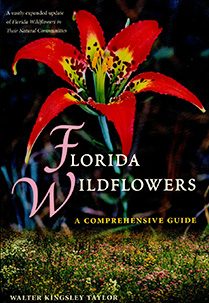
Author(s): Taylor, Walter Kingsley
Publisher: University Press of Florida, 2013
ISBN: 978-0813044255
Comments: Florida has many plants that aren't found in much of the rest of North America, so this guide covers ground that is not necessarily reflected in others. This guide covers 450 species. Includes descriptions, flowering times, habitat information, distribution within Florida, and notes on related species, etymology, edibility and landscape applications. The guide is organized by broad regions (hardwood forested uplands and wetlands), then by more specific biomes. Within each such grouping, I could not discern much order in the presentation of species, so it was necessary to flip through each section a page at a time. I found this to be an impediment to an otherwise wonderful and useful book. 567 pages.
Range: Florida
Coastal Wetland Plants of the Northeastern United States
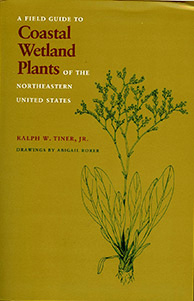
Author(s): Tiner Jr., Ralph W.
Publisher: University of Massachusetts Press, 1987
ISBN: 978-0870235382
Comments: New England’s craggy shores are host to numerous varieties of herbaceous plants, grasses, sedges, shubs, and aquatic plants that are well-adapted to the habitats. This guide book has crisp, well-executed line drawings and identifying information for many of these species. Most of the species appear along the entire Atlantic coast, and especially the northern parts of the Pacific coast. 285 pages.
Range: Northeastern United States
Field Guide to Tidal Wetland Plants of the Northeastern United States and Neighboring Canada
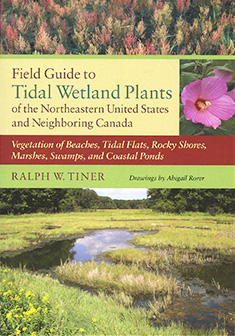
Author(s): Tiner, Ralph W.; Rorer, Abigail (illus.)
Publisher: University of Massachusetts Press, 2009
ISBN: 978-1558496675
View at: Barnes & Noble, or Amazon
Comments: I love the drawings in this book. They are large and detailed. Write-ups include detailed descriptions of plant features, the flowering period, the wetland indicator status, and similar species. Includes keys organized by detailed habitats and plant descriptions organized by habitat. Contains a good deal of supporting information too. This is the first comprehensive book I have seen that is specifically about wetland plants. It covers beaches, tidal flats, rocky shores, marshes, swamps, and coastal plants.
Range: Northeastern United States and neighboring Canada
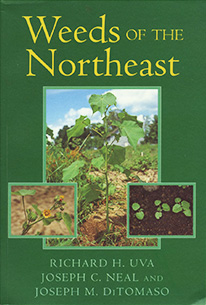
Author(s): Uva, Richard H.; Neal, Joseph C.; DiTomaso, Joseph M.
Publisher: Comstock Publishing Associates, 1997
ISBN: 978-0801483349
View at: Barnes & Noble, or Amazon
Comments: This 396-page guide describes 299 common or economically important weeds. Facing pages offer a detailed description of each weed, and multiple photographs of various aspects of the plant, including seeds. Includes several tables and keys.
Range: Covers northeastern North America south to Virginia, north to Maine and southeastern Canada, and west to Wisconsin.
Field Guide to the Sedges of the Pacific Northwest
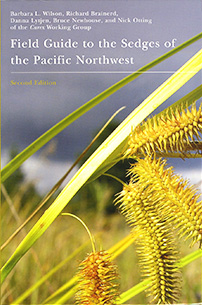
Author(s): Wilson, Barbara L.; Brainerd, Richard; Lytjen, Danna; Newhouse, Bruce; and Otting, Nick, of the Carex Working Group
Publisher: Carex Working Group, 2008
ISBN: 978-0870717284
View at: Barnes and Noble, or Amazon
Comments: Sedges look a lot like grasses until you look more closely. Then you find a diverse and difficult-to-identify group. Most sedges are members of the genus Carex, hence the name caricology for those hearty soles who specialize in the study of sedges. If you get interested in this field you’re going to need specialized guides, either professional flora or books devoted to sedge identification, like this one. In Oregon and Washington alone there are 169 sedges, all covered in this guide. The book includes a discussion of the morphology of sedges, as well as detailed keys. Each species receives a full page of photos and a facing page that includes key features, a detailed description, habitat and distribution information, identification tips, and comments. Species are organized alphabetically: there really isn’t any other natural organization. If you are in the Pacific northwest or northern California, this is a great resource. 432 pages.
Range: Pacific Northwest
Wild Urban Plants of the Northeast: a Field Guide
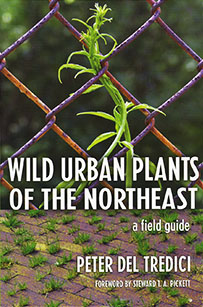
Author(s): del Tredici, Peter
Publisher: Comstock Publishing Associates, a division of Cornell Universty Press, 2010
ISBN: 978-0801474583
View at: Barnes & Noble, or Amazon
Comments: You could call this a weed book, since nearly every species in here would be so classed; or even a listing of invasive species, since many of these are a bit overly robust in some habitats. Or you could do as the author does, and recognize the vitality and sheer determination of these plants. Urban settings aren't especially friendly to wild plants, and those hardy few who manage quite nicely there deserve some respect. 158 common species are presented with two pages devoted to each. One page describes plant characteristics, germination, habitat preferences, ecological function, and cultural significance. The facing page contains many clear photos that allow an unambiguous identification. Even if you aren't a city dweller, you'll find most of these species in any temperate climate. 374 pages.
Range: Northeastern United States
Note: book cover sizes in the list below are shown relative to each other. The list is organized by primary author. Some out-of-copyright books are available free at the supplied links.