Bidens frondosa L.
Devil’s beggartick, devil’s-pitchfork, devil’s bootjack, sticktights, bur marigold, pitchfork weed, tickseed sunflower, leafy beggarticks, common beggar-ticks
Some similar species
Bidens cernua
Bidens frondosa


|
Bidens frondosa L. Devil’s beggartick, devil’s-pitchfork, devil’s bootjack, sticktights, bur marigold, pitchfork weed, tickseed sunflower, leafy beggarticks, common beggar-ticks Some similar species | ||
Bidens cernua |
You are here Bidens frondosa |
|
|---|---|---|
| Common Name | |
|
| Plant | Up to 13′ (4 m) high, usually less than 3′ (91 cm) | 1–3′ (30–91 cm) high, rarely up to 6′ (1.8 m). Stems are square in cross-section, nearly hairless, and light green, reddish green, or purple |
| Leaves | Opposite, and sessile or clasping—leaf bases wrap around the stem. Leaves are 1½–8″ (4–20 cm) long × up to 1″ (2.5 cm) wide, and simple (unlobed) | Lower leaves are odd pinnate clusters on long petioles, in opposite pairs; upper leaves may be alternate. Leaves are up to 3″ (7.6 cm) × 1″ (2.5 cm), coarsely toothed, deltate or lanceolate. |
| Flowers | Composite flowers are 1–2″ (2.5–5 cm) across, have up to 8 petals, though rarely the ray flowers are missing and only the tubular disk flowers are present. The flowers are sideways-facing, rather than upward-facing | Each composite flower is composed of 20-60 orange-yellow disc florets about ⅜–½″ (9.5–12 mm) around, and rarely a few yellow rays, each 1/16–⅛″ (2–3.5 mm) long. They are encompassed in 6-10 phyllaries, like a rosette of small leaves. Flowers occur in groups of 1-12, appearing from late summer to early fall. |
| Fruit | Fruits are brown, hard, and triangular in shape, with four barbed spears of roughly equal length called awns | The seeds or achenes are shaped like a narrow triangle, with two barbed fork tips that attach to fur or clothes. The seeds are also distributed by the wind. |
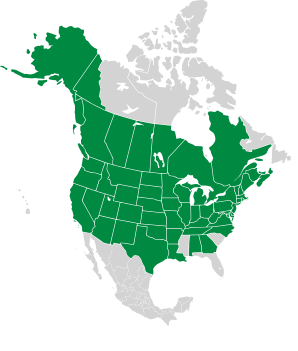
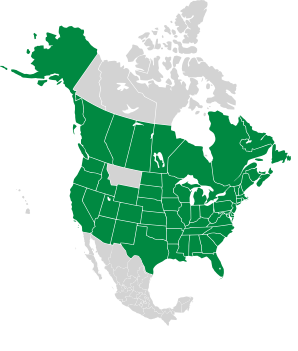
| Range/ Zones |
|
|
| Habitats | Near shorelines and the edges of wetlands, in sandy or mucky soil | Moist woods, meadows, thickets, fields, roadsides, railroads, borders of streams, ponds, sloughs, swamps, ditches |
Bidens frondosa description by Thomas H. Kent, not updated.
© FloraFinder.org. All rights reserved.