Caesalpinia pulcherrima (L.) Sw.
Red bird of paradise, pride-of-Barbados
The red bird-of-paradise is believed to be native to the West Indies and tropical America. It has escaped cultivation and become naturalized in tropical regions throughout the world.
Plants: Varies from a shrub or small tree to an gangling 20′ (6.1 m) tree, depending upon climate. Stems have sharp prickles.
Leaves: Bipinnate, fernlike in appearance. They are 8–16″ (20–40 cm) long, with 3-10 pairs of pinnae. Each of those in turn has 6-10 pairs of leaflets, each ½–⅞ ⨉ ⅜–½″ (1.5–2.5 ⨉ 1–1.5 cm).
Flowers: Like its cousin the yellow bird-of-paradise, red bird-of-paradise has crinkly bowl-shaped five-petaled flowers with long thin bright red stamens. Racemes are up to 8″ (20 cm) long. Flowers of the red variety are brilliant orange and red.
Fruits: Oblong, flat pods are 2–4½″ (6–12 cm) long. They are dehiscent, drying and bursting explosively, scattering seeds.
Habitats: Tropical.
Edibility: Seeds are poisonous. 

This photo by Martin LaBar won Botany Photo of the Day in 2006 
Online References:
Poinciana pulcherrima L.
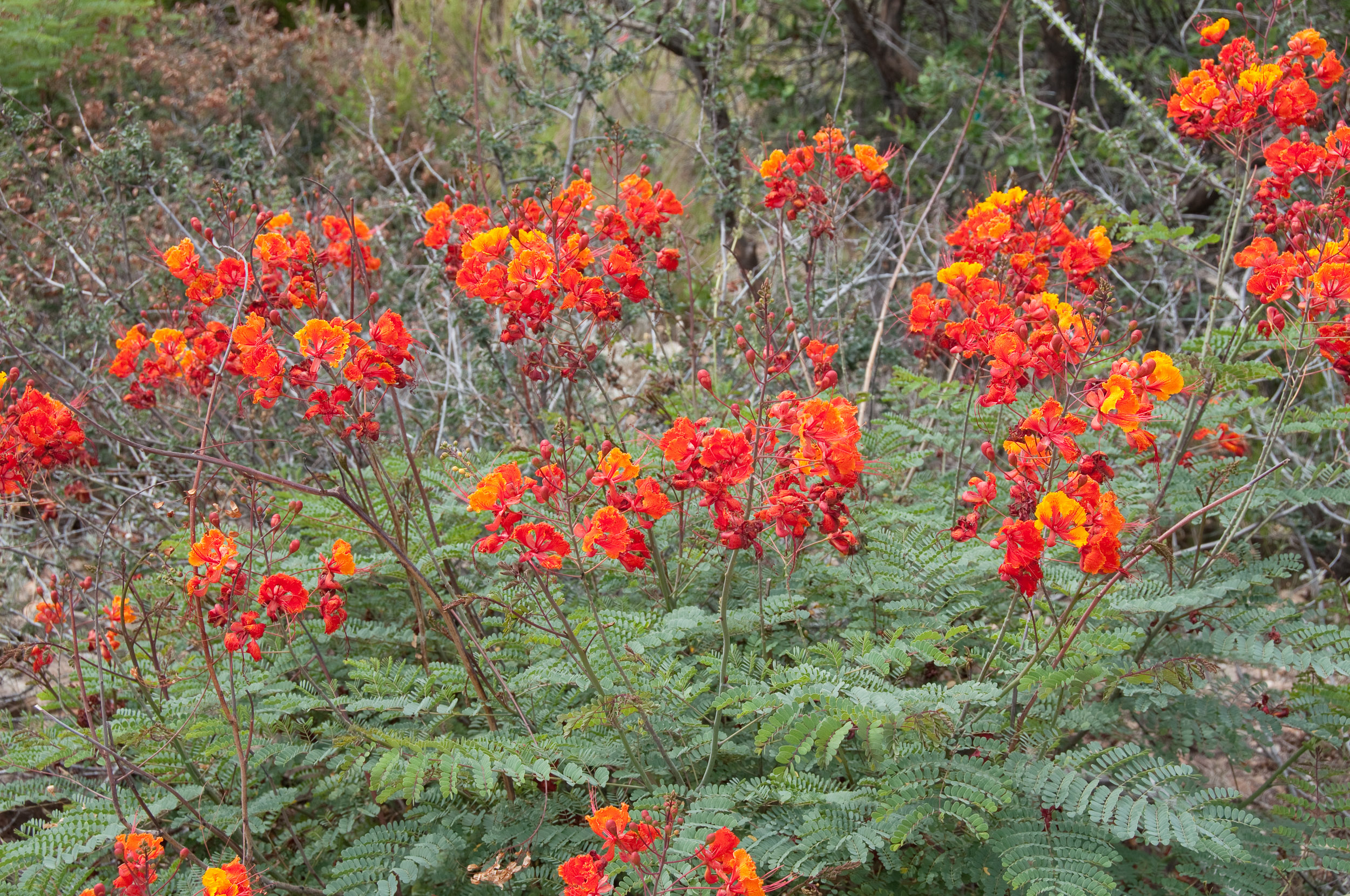
5/24/2009 · Arizona Sonora Desert Museum, Tucson, Arizona · ≈ 3 × 2′ (99 × 66 cm) 

5/24/2009 · Arizona Sonora Desert Museum, Tucson, Arizona · ≈ 6 × 4″ (15 × 10 cm) 
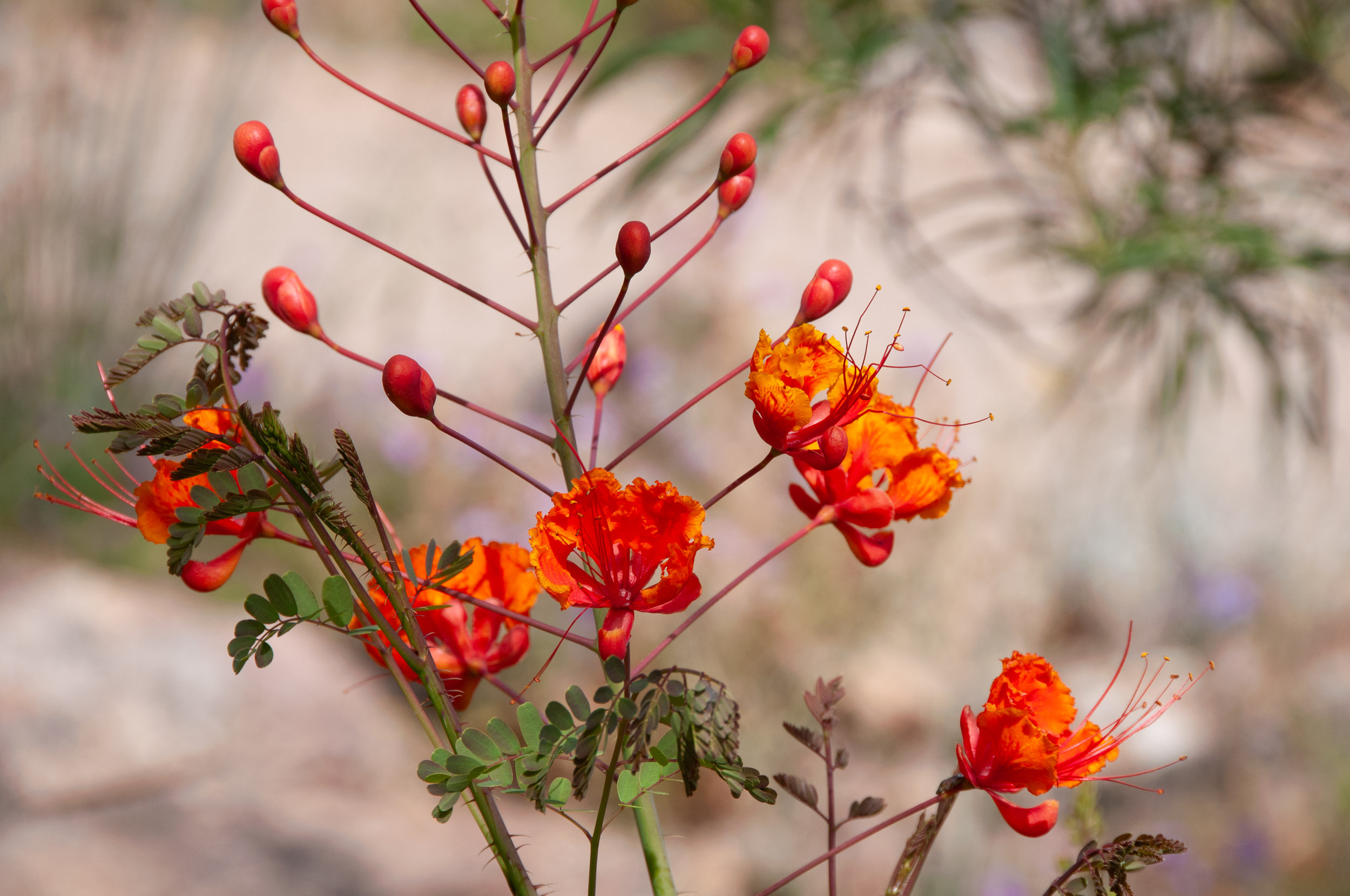
5/24/2009 · Arizona Sonora Desert Museum, Tucson, Arizona · ≈ 8 × 5″ (19 × 13 cm) 
| Kingdom | Plantae | Plants, but not fungi, lichens, or algae (from Stearn's Botanical Latin) |
| Subkingdom | Tracheobionta | Vascular plants—plants with a “circulatory system” for delivering water and nutrients |
| Division | Magnoliophyta | Flowering plants, also known as angiosperms |
| Class | Magnoliopsida | Dicotyledons—plants with two initial seed leaves |
| Subclass | Rosidae | Roses, legumes, proteas, dogwoods, hydrangeas, mistletoes, euphorbias, grapes, many more |
| Order | Fabales | Legumes (pea and bean families) |
| Family | Fabaceae | Legume family (peas and beans) |
| Genus | Caesalpinia | Named after Andrea Cesalpino (1519-1603) of Italy |
| Species | pulcherrima | Most pretty or prettiest |

Caesalpinia pulcherrima description by Thomas H. Kent, not updated.

© FloraFinder.org. All rights reserved.