Chrysothamnus viscidiflorus (Hook.) Nutt.
Yellow rabbitbrush, green rabbitbrush
Yellow rabbitbrush is native to western North America, as well as Chile and Argentina. The thick shrubbery provides nesting for sage-grouse, small birds and rodents, and a source of forage for black-tailed jackrabbits, cattle, sheep, horses, elk and antelope.
Plants: Deciduous shrubs are 8–43″ (20–110 cm) tall, with densely spaced brittle stems. Stems may be smooth or hairy, depending on the subspecies.
Leaves: Alternate, simple, ⅜–2″ long ⨉ 1/32–¼″ wide (1–6 cm ⨉ 0.5–8 mm), and linear or oblong. Leaves are glandular, sticky, resinous, and often twisted.
Flowers: Stems are tipped by compact to open rounded cymes of yellow flowerheads, each ⅛–¼ ⨉ 1/16–⅛″ wide (5–7.5 ⨉ 2–4 mm). Each flowerhead is lined with sticky yellow-green bracts, called phyllaries. Individual flowers are ⅛–3/16″ (4–6 mm) long. Flowers appear from June to October.
Fruits: Five-ribbed achenes are ⅛″ (4 mm) long, with tufts of hair for wind distribution.
Habitats: Sagebrush and woodland habitats, especially soils rich in calcium, at elevations of 3281–13123′ (1–4 km). Tolerates alkaline and saline soils. It is an early colonizer of soils disturbed by burns, floods, or rockslides.
 |
Similar species. |
Online References:
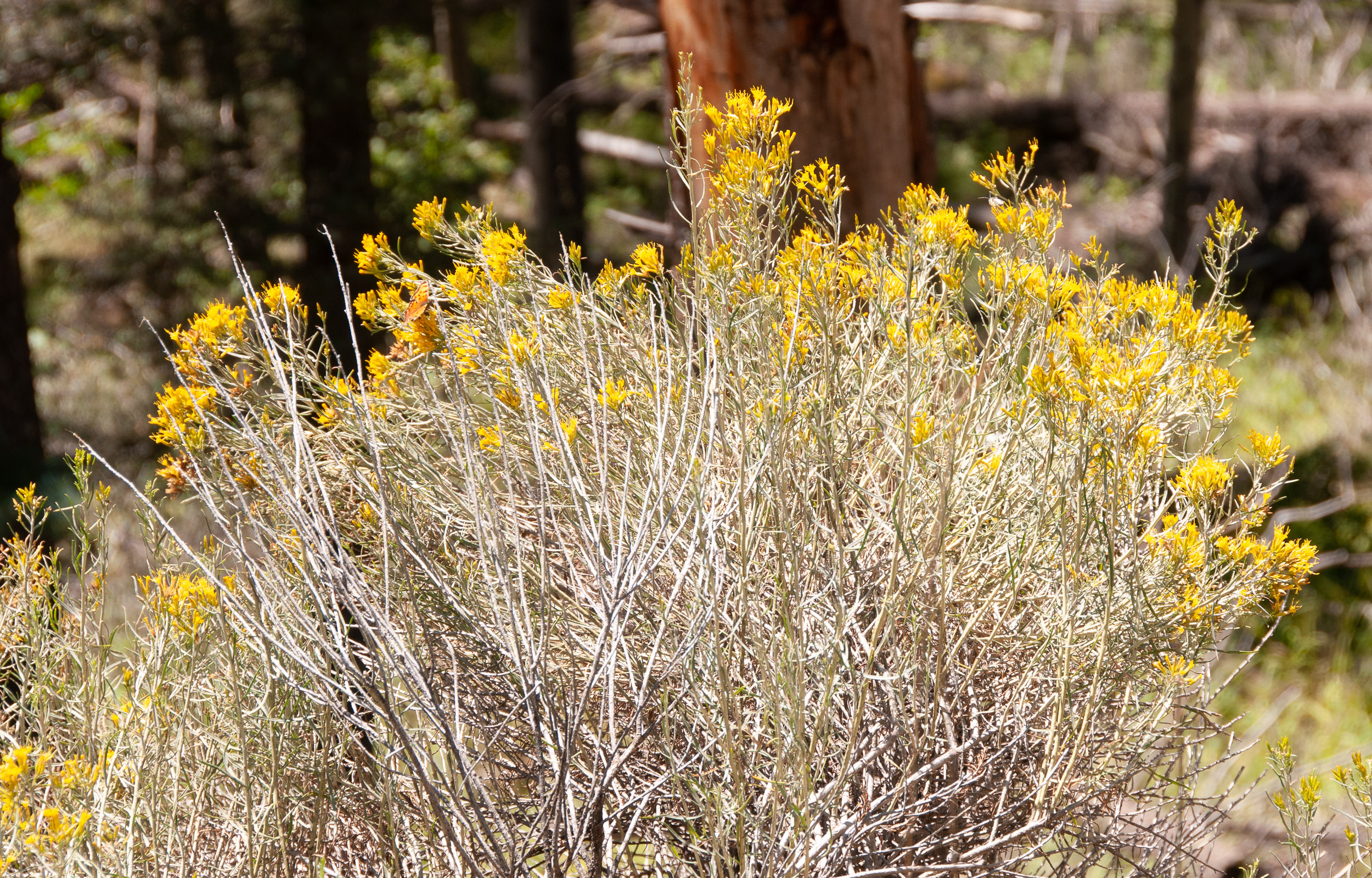
8/28/2014 · New Mexico · By Susan M. Kent 
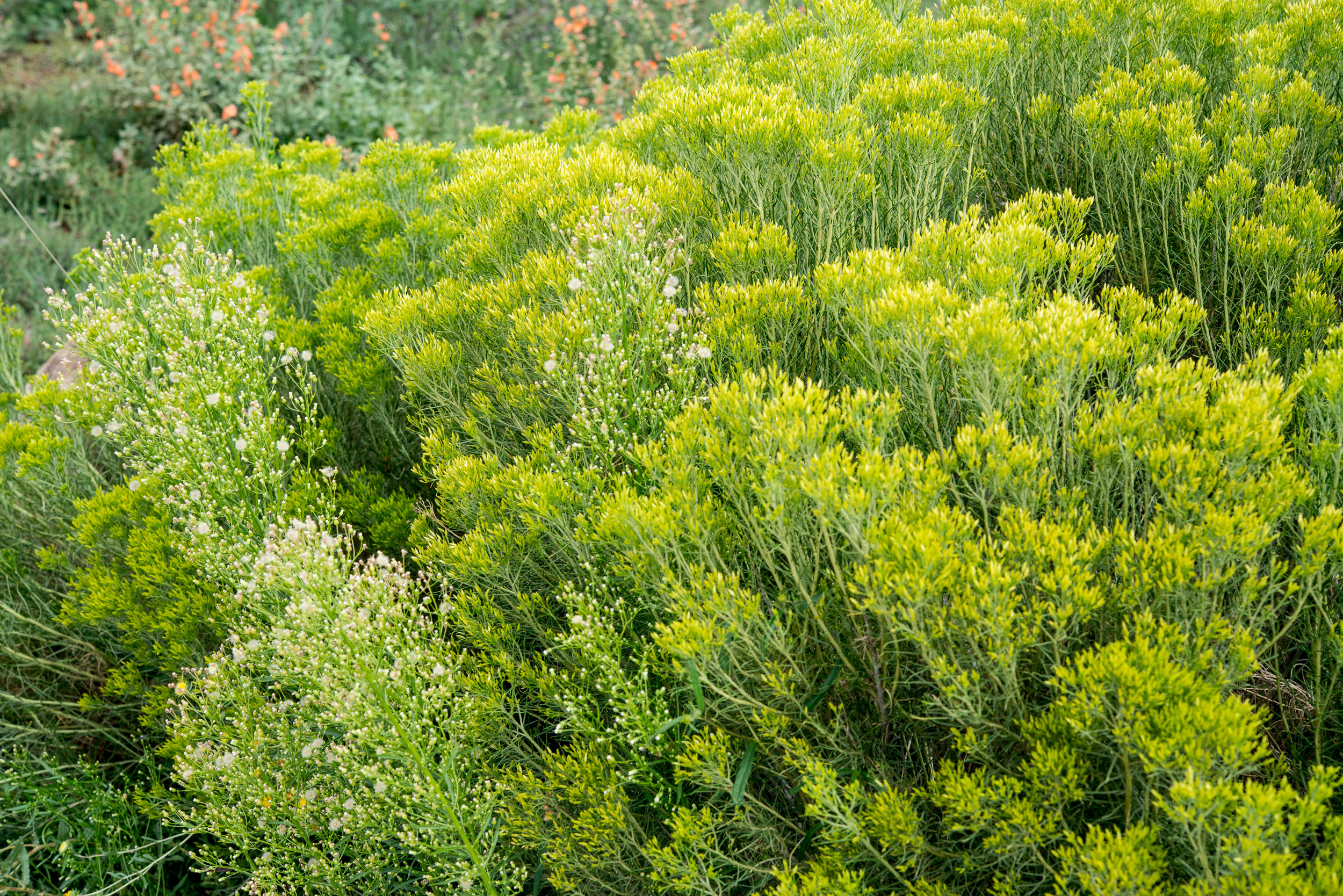
8/26/2014 · Rt. 53, El Malpais Nat. Monument, El Caldaron Area, El Malpais, New Mexico 

8/26/2014 · Rt. 53, El Malpais Nat. Monument, El Caldaron Area, El Malpais, New Mexico 
| Kingdom | Plantae | Plants, but not fungi, lichens, or algae (from Stearn's Botanical Latin) |
| Subkingdom | Tracheobionta | Vascular plants—plants with a “circulatory system” for delivering water and nutrients |
| Division | Magnoliophyta | Flowering plants, also known as angiosperms |
| Class | Magnoliopsida | Dicotyledons—plants with two initial seed leaves |
| Subclass | Asteridae | A large class that encompasses asters |
| Order | Asterales | Flowering plants with a central disk flower and surrounding petals, like daisies |
| Family | Asteraceae | The aster family, which also includes daisies and sunflowers; from the Greek ἀστήρ, “star,” for the star-shaped flowers |
| Genus | Chrysothamnus | From the Greek chrysos, “gold,” and thamnus, “bush,” thus literally “golden bush,” and it is a yellow-flowered bush although its common name is rabbitbrush |
| Species | viscidiflorus | With sticky flowers |
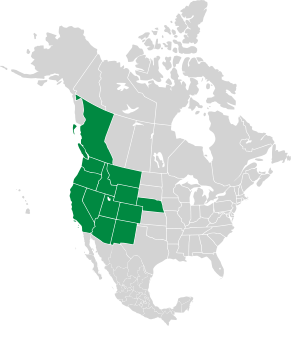
Chrysothamnus viscidiflorus description by Thomas H. Kent, not updated.

© FloraFinder.org. All rights reserved.