Cornus sericea ‘Silver and Gold’
Silver and gold red osier dogwood
Red osier dogwood is native to North America. It produces its own antifreeze, surviving temperatures down to –32°F. Red osier means “red-twigged,” but the ‘Silver and Gold’ cultivar has variegated leaves and yellow stems instead of red.
Plants: This deciduous shrub is 5–7′ (1.5–2.1 m) high, and a bit more in width. It is extensively branched. Stems are yellow in winter, instead of dark red fading to gray-green in the natural species.
Leaves: 2–5″ long ⨉ 1–2½″ wide (5–12 ⨉ 2.5–6.3 cm), ovate to lanceolate, variegated in color, and bright red in the fall.
Flowers: Red osier flowers are small and white, occurring in flat-topped groups. Blooms appear from May to June.
Fruits: The fruits are white or dull white berries, about ¼″ (6.3 mm), on bright red stems.
Online References:
Www.calflora.org (Cornus sericea)
CalPhotos at the University of California, Berkeley (Cornus sericea)
The Jepson Manual (Cornus sericea)

4/7/2012 · Ladew Topiary Gardens, Monkton, Maryland · ≈ 1 × 2′ (41 × 62 cm) 
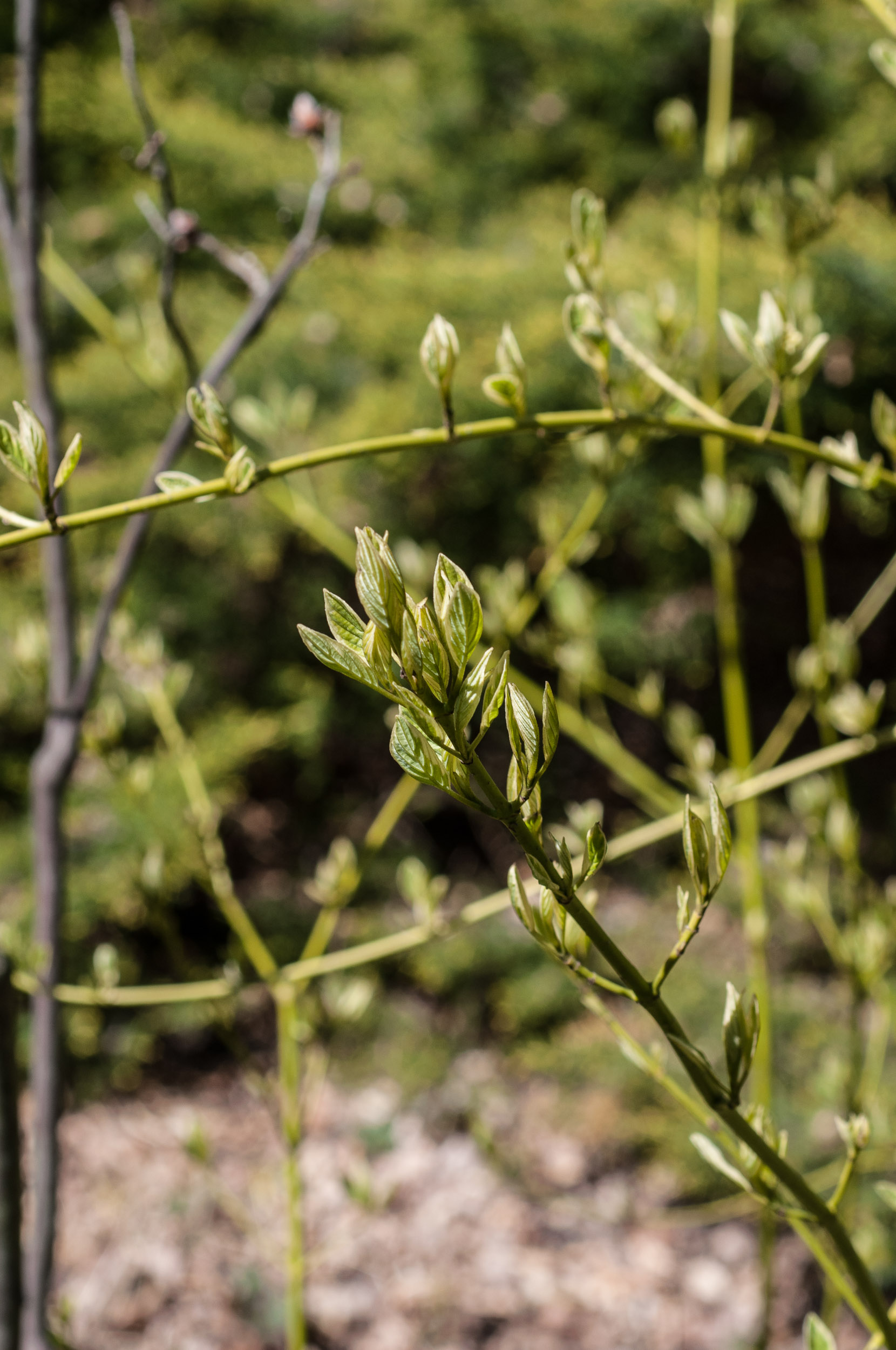
4/7/2012 · Ladew Topiary Gardens, Monkton, Maryland · ≈ 8 × 12″ (20 × 31 cm) 
| Kingdom | Plantae | Plants, but not fungi, lichens, or algae (from Stearn's Botanical Latin) |
| Subkingdom | Tracheobionta | Vascular plants—plants with a “circulatory system” for delivering water and nutrients |
| Division | Magnoliophyta | Flowering plants, also known as angiosperms |
| Class | Magnoliopsida | Dicotyledons—plants with two initial seed leaves |
| Subclass | Asteridae | A large class that encompasses asters |
| Order | Cornales | Includes dogwoods, hydrangeas, stickleafs, tupelos, even sillyberries |
| Family | Cornaceae | Dogwood family |
| Genus | Cornus | Latin for “a horn” |
| Species | sericea | Silky |

Cornus sericea ‘Silver and Gold’ description by Thomas H. Kent, not updated.

© FloraFinder.org. All rights reserved.