|
Daucus carota L.
Queen Anne’s lace, wild carrot, bird’s nest, bishop’s lace
Similar species
|
| |
Achillea millefolium |
You are here
Daucus carota |
Heracleum mantegazzianum |
| Common Name |

common yarrow |

Queen Anne’s lace |

giant hogweed |
| Plant |
Up to 3′ (91 cm) in height. The stem has woolly hairs. |
Grows to 3' in height. Plant smells like carrots. There are fine hairs on stems and leaves. |
Extremely large: 6½–16′ (2–5 m) tall, sometimes reaching 23′ (7 m). Poisonous  : causes phytophotodermatitis. Hollow stems are 1–4″ (3–10 cm) in diameter, with deep purple raised blotches containing white hairs. : causes phytophotodermatitis. Hollow stems are 1–4″ (3–10 cm) in diameter, with deep purple raised blotches containing white hairs. |
| Leaves |
Feathery, fernlike, bi- and tripinnately divided, attached almost directly to the stem in a spiral pattern. Individual leaves are 1¾–8″ (5–20 cm) long. The leaves are the most obvious identifying characteristic. |
Compound leaves are deeply divided and subdivided. |
Leaves are up to 5′ (1.5 m) across, extensively divided into sharp-tipped sections. |
| Flowers |
Flowers are flat-topped or umbrella-shaped corymbs 3–4″ (7.6–10 cm) across. Each flower is a composite flower, about ¼″ (6.3 mm) in diameter, |
Pale pink before opening. When open, forms an umbrella-shaped flower cluster up to 3" across, composed of tiny 5-petaled flowers. |
White flowers form flat-topped compound umbels (flowerheads) up to 2½′ (76 cm) in diameter. |
| Fruit |
Flowerheads turn brown and hard, filled with numerous tiny seeds. |
Small, dry, bumpy, oval and flattened, with short styles and hooked spines, as well as protective enveloping hairs. |
Each seed is up to ¼″ (8.3 mm) long. |
| Range/ Zones |

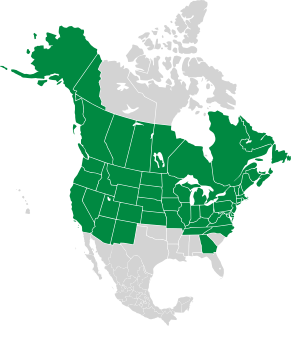
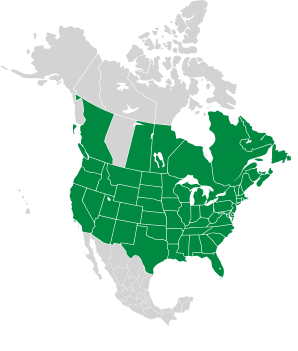
USDA Zones: 3-9 |
|

|
| Habitats |
Pastures, grasslands, woodlands, waste grounds, open forests, prairies, fallow fields, pathway edges, subalpine zones, and exposed ridges—nearly anywhere there is full or partial sun. |
Very common along roadsides, or in fields. |
Rich, moist soils in ditches, stream banks, vacant farmland, and fence and tree lines |
© FloraFinder.org. All rights reserved.