Dithyrea wislizeni Engelm.
Dithyrea wislizeni Engelm. var. griffithsii (Wooton & Standl.) Payson
Dimorphocarpa wislizeni (Engelm.) Rollins
Spectacle pod, touristplant, Wizlizeni’s spectaclepod
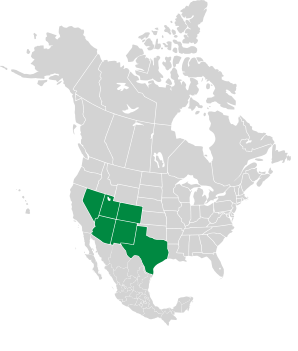
Spectacle pod is native to the American southwest and Mexico. Its two-lobed seed capsules resemble miniature pairs of spectacles, hence the name.
Plants: On branched or unbranched stems 4–28″ (10–70 cm) tall. Buds, stems, and leaves are tomentose, covered with thick hairs.
Leaves: Alternate, pubescent. Basal leaves are lanceolate, and toothed or lobed, up to 6″ (15 cm) long. Higher leaves become narrower and less lobed (or unlobed).
Flowers: Thick racemes of white to lavendar or pale pink flowers, each ⅛–¼″ (4–8 mm) long, with 4 petals, purplish stamens and yellow-green anthers.
Fruits: Double-lobed winged silicle that splits at maturity into two lobes, each with a flat seed 1/16–⅛″ (2–3 mm) wide.
Habitats: Sandstone-based desert shrubland, or areas of pinyon-juniper and pondersoa pine, appearing at elevations of 1000–6500′ (304–1981 m).
Medical: This species has a rather long list of highly various medical uses by various indigenous peoples.
Online References:

8/26/2014 · Northwest New Mexico Visitor Center, Grants, New Mexico · ≈ 7 × 9″ (16 × 23 cm) 
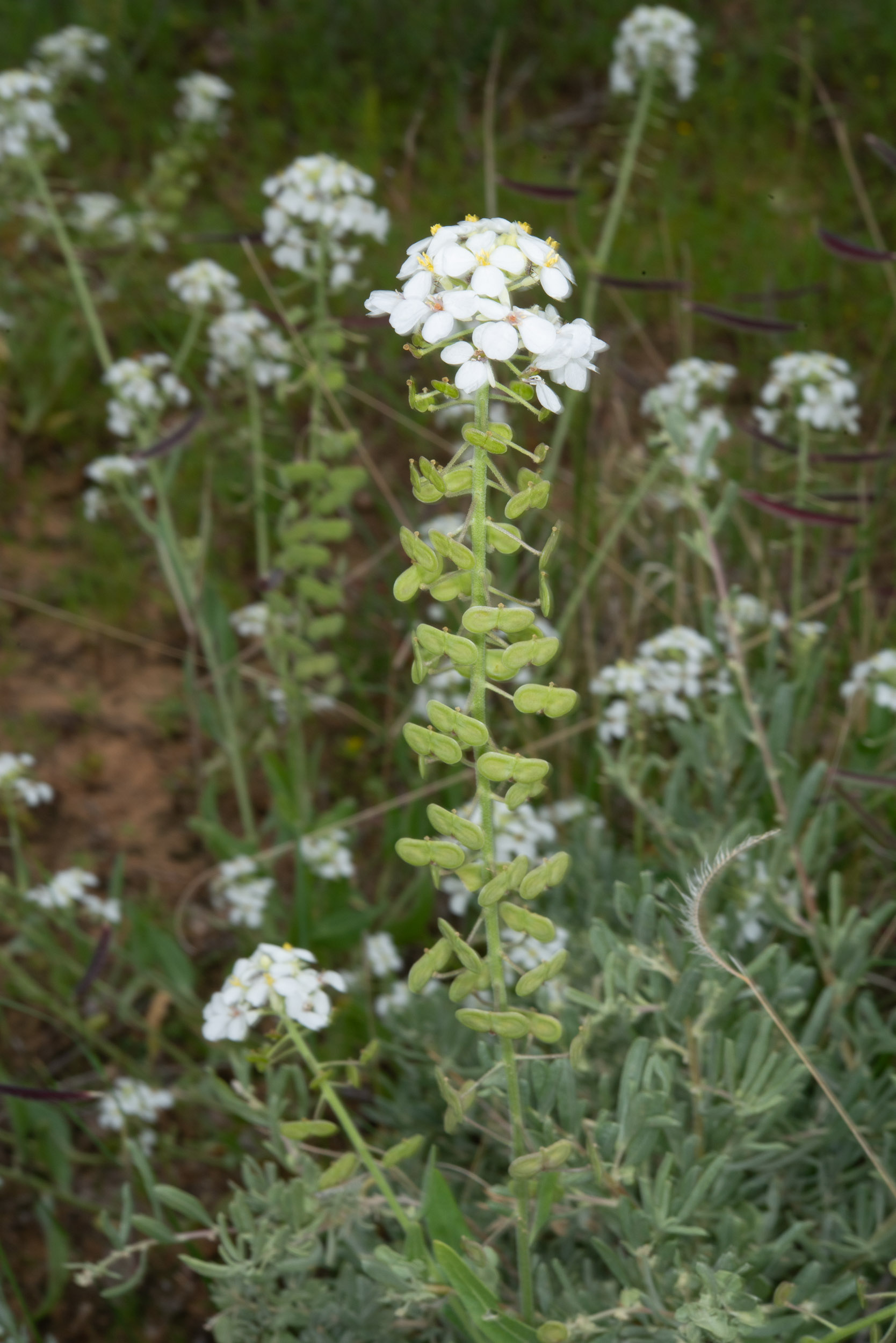
8/26/2014 · Sandstone Bluffs, El Malpais National Monument, New Mexico · ≈ 7 × 10″ (16 × 25 cm) 
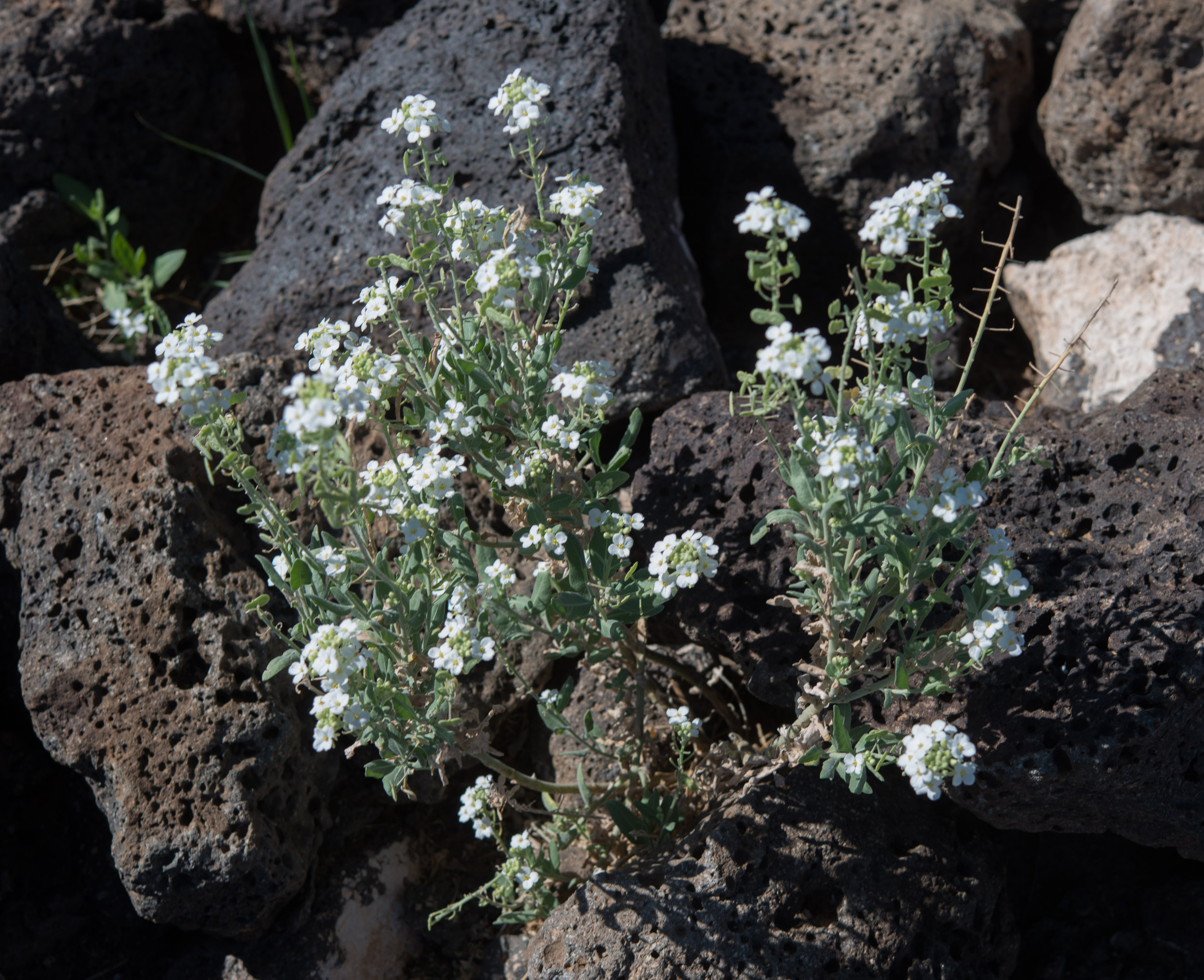
8/27/2014 · Petroglyph National Monument, New Mexico · ≈ 2 × 1½′ (60 × 49 cm) 
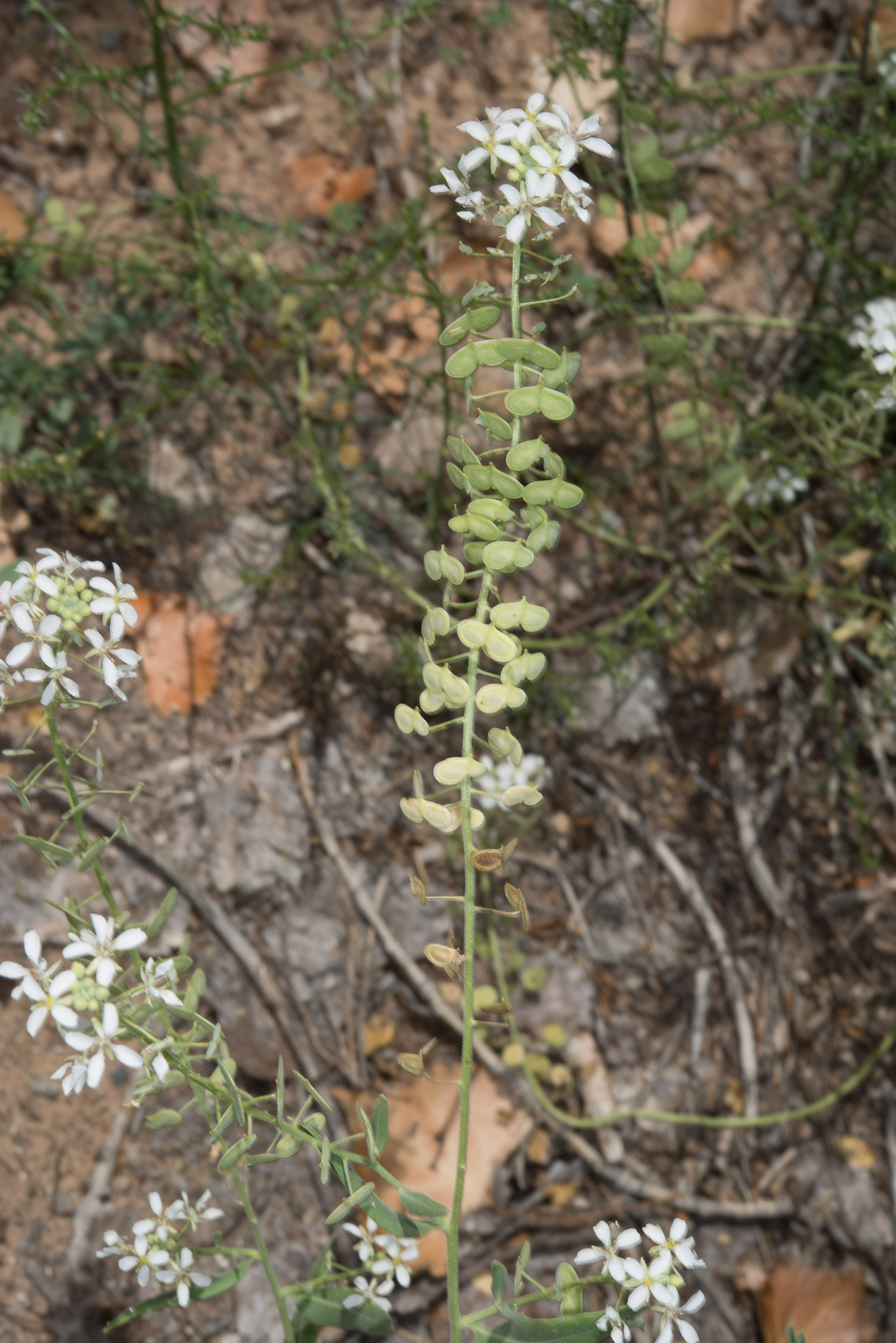
8/27/2014 · Rio Grande Nature Center, Albuquerque, New Mexico · ≈ 7 × 11″ (18 × 28 cm) 

4/29/2018 · Red Spring Calico Basin, Red Rock Canyon, Nevada · ≈ 6 × 4″ (16 × 11 cm) 

8/27/2014 · Rio Grande Nature Center, Albuquerque, New Mexico · ≈ 7 × 9″ (18 × 23 cm) 

4/29/2018 · Red Spring Calico Basin, Red Rock Canyon, Nevada · ≈ 5 × 4″ (13 × 10 cm) 
| Kingdom | Plantae | Plants, but not fungi, lichens, or algae (from Stearn's Botanical Latin) |
| Subkingdom | Tracheobionta | Vascular plants—plants with a “circulatory system” for delivering water and nutrients |
| Division | Magnoliophyta | Flowering plants, also known as angiosperms |
| Class | Magnoliopsida | Dicotyledons—plants with two initial seed leaves |
| Subclass | Rosidae | Roses, legumes, proteas, dogwoods, hydrangeas, mistletoes, euphorbias, grapes, many more |
| Order | Brassicales | Mustard, cabbage, caper, papaya, nasturtiums, many others; most produce mustard oil |
| Family | Brassicaceae | Mustards, cabbages |
| Genus | Dimorphocarpa | Latin dimorphus, “having two forms,” and carpus, “fruit,” alluding to production of two fruit types in some species |
| Species | wislizeni | After Frederick Adolf Wislizenus (1810-1889), Army surgeon, explorer, botanist and plant collector of German birth who travelled extensively in the southwestern United States |
Dimorphocarpa wislizeni description by Thomas H. Kent, not updated.

© FloraFinder.org. All rights reserved.