Drosera intermedia Hayne
Spatulate-leaved sundew, oblong-leaved sundew, spoonleaf sundew
Spoonleaf sundew is native to Europe, southeastern Canada, the eastern half of the United States, Cuba, and northern South America. Sundew secretes a sugary nectar that attracts insects into small pods. If the insect grazes against strategically-placed trigger hairs more than once, this marvelously fiendish plant snaps the pod shut, trapping the insect in a sticky mucilage. It slowly digests the bug, extracting nitrogen and other nutrients that are not available in its natural environment.
Plants: Sundews are very small, 2–8″ (5–20 cm) high, inhabiting bogs near coasts. These inconspicuous reddish-looking plants are easily missed, but amazing at close range.
Leaves: A stemless rosette of spatulate leaves. Each leaf is covered with stalked sticky glands that secrete a sweet nectar to attract insects. The sticky hairs ensnare insects, eventually killing them if they cannot escape. The plant then secretes digestive enzymes, absorbing the partially emulsified insect. This nutrition allows the plant to survive in otherwise nutrient-poor environments.
Flowers: White or pale pink, with five petals, ¼″ (6.3 mm) wide. They form inflorescences up to 6″ (15 cm) tall, with 3-8 flowers. Flowers appear from June to August.
Fruits: Egg-shaped dehiscent seed capsules bear numerous tiny seeds.
Habitats: Bogs near coasts.

Photo by Zeimusu, Ashdown Forest, near Broadstone Visitor Center, UK, 6/29/2008. 
If you are curious about carnivorous plants, visit the Carniverous Plant FAQ.
Online References:
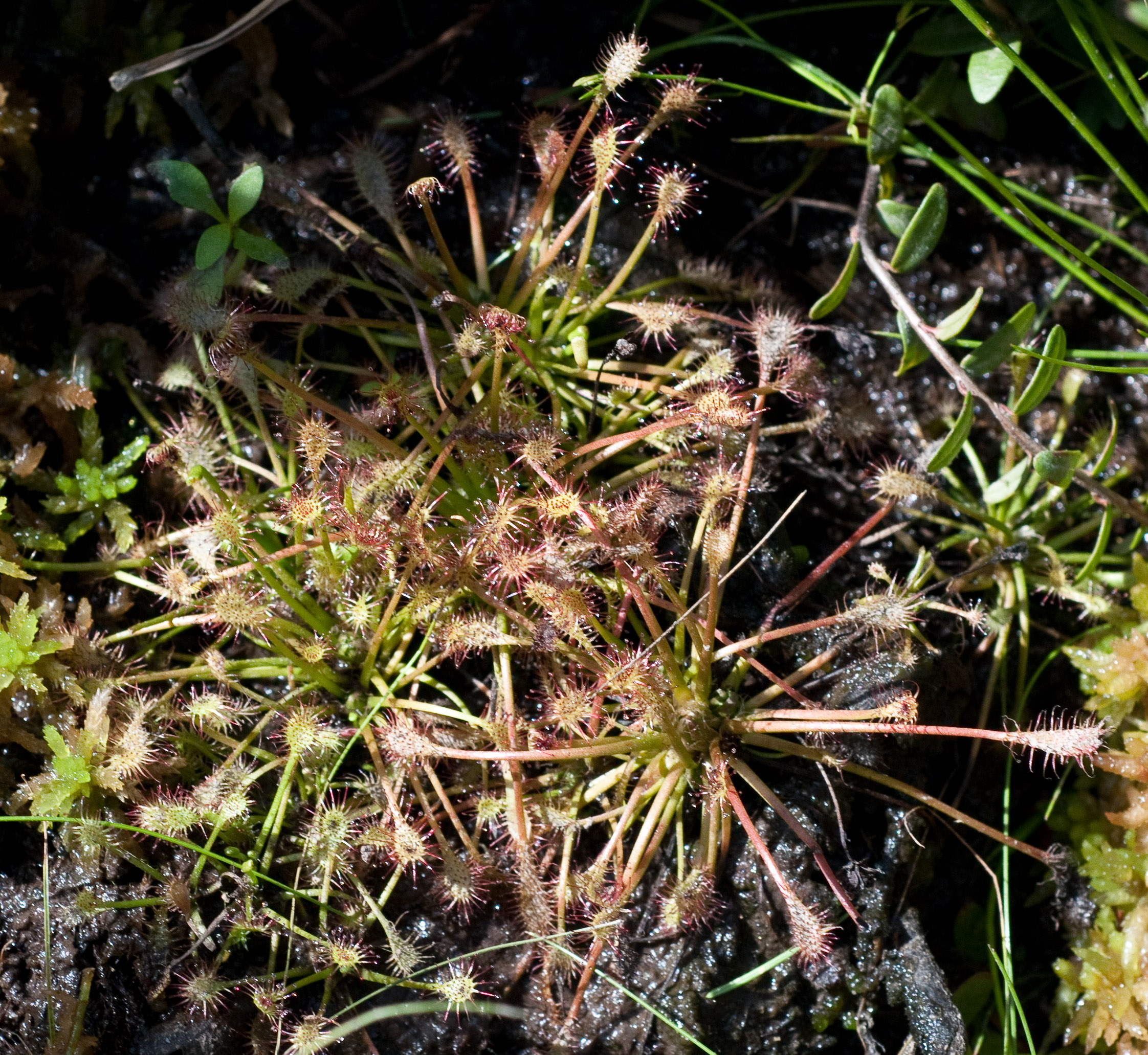
9/20/2009 · Wild Gardens of Acadia, Acadia National Park, Bar Harbor, Maine · ≈ 4½ × 4½″ (12 × 11 cm) 
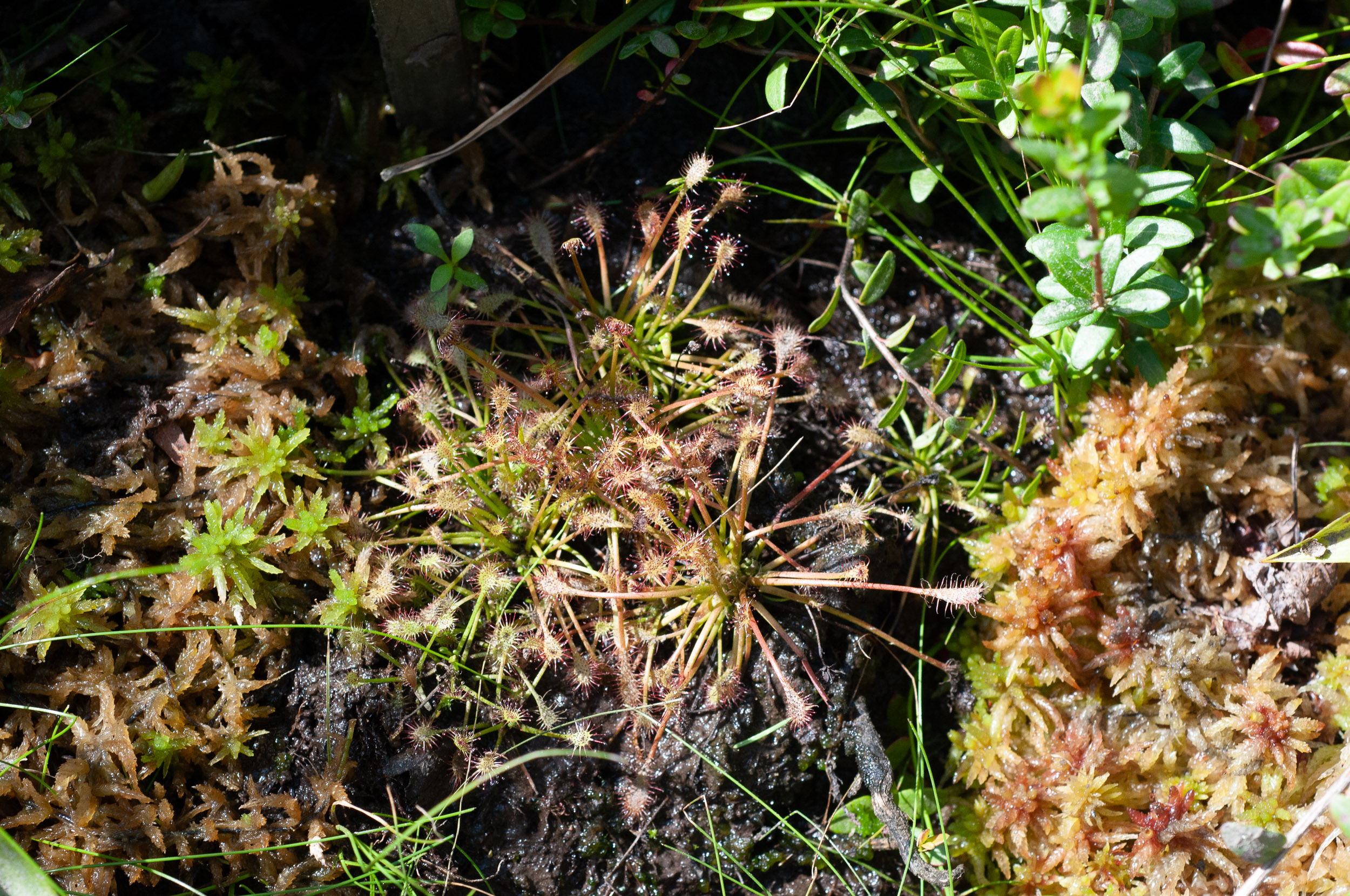
9/20/2009 · Wild Gardens of Acadia, Acadia National Park, Bar Harbor, Maine · ≈ 9 × 6″ (23 × 15 cm) 
| Kingdom | Plantae | Plants, but not fungi, lichens, or algae (from Stearn's Botanical Latin) |
| Subkingdom | Tracheobionta | Vascular plants—plants with a “circulatory system” for delivering water and nutrients |
| Division | Magnoliophyta | Flowering plants, also known as angiosperms |
| Class | Magnoliopsida | Dicotyledons—plants with two initial seed leaves |
| Subclass | Caryophyllidae | Cacti, many other succulents, carnivorous plants, and leadworts |
| Order | Nepenthales | Carniverous (or more precisely insectiverous) plants |
| Family | Droseraceae | Sundews and related plants |
| Genus | Drosera | From Greek drosus, “dew” |
| Species | intermedia | Intermediate, indicating an observation that a species was probably considered as being halfway or partway between two others with regard to some particular characteristic, e.g. tall, short, and “intermediate” |
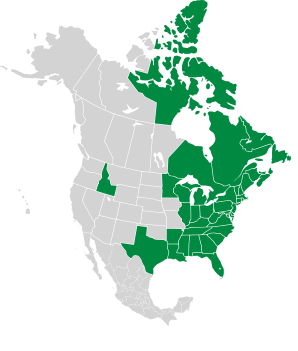
Drosera intermedia description by Thomas H. Kent, not updated.

© FloraFinder.org. All rights reserved.