Mimosa ebano Berl.
Pithecellobium ebano (Berl.) C.H. Mull.
Pithecellobium flexicaule (Benth.) J.M. Coult.
Ebenopsis ebano (Berl.) Barneby & Grimes
Texas ebony, black-bead ebony, ebony ape’s-earring, ébano
Texas ebony is found in Texas and eastern Mexico. It is sought after as a landscape plant, for bonsai, and for woodworking. These trees are hardened desert dwellers, and they produce seeds that would probably survive in space. The seeds have an unusually hard epiderm that needs a scarification treatment: they must be weakened in some way so they can germinate. Techniques include soaking in 95% sulfuric acid, processing in a rock tumbler, or manually chipping or filing. Concentrated sulfuric acid converts most organic materials into a smoking pile of charcoal, so that gives you some idea of the toughness of these seeds.
Ebony is prized by woodworkers for its rich heartwood, which is dark reddish-brown tinged with purple (not actually black as the name implies). The heartwood is unusally close-grained, strong, dense and oily. It finishes naturally, with a robust luster. [Texas ebony isn’t “real” ebony at all. Species of ebony include Diospyros ebenum (Ceylon ebony), native to southern India and Sri Lanka; D. crassiflora (Gabon ebony), native to western Africa; and D. celebica (Makassar ebony), native to Indonesia and prized for its luxuriant, multi-colored wood grain. Mauritius ebony, D. tesselaria, was exploited by the Dutch in the 17th century. Some species in the genus Diospyros yield an ebony with similar physical properties, but striped rather than evenly black (Diospyros ebenum).]
Plants: A slow-growing tree 15–30′ (4.6–9.1 m) in height, often with multiple trunks, with a rounded, dense crown. Bark is smooth in young trees, gray-brown to reddish brown, becoming scaly as the tree ages. Young branches have a characteristic zig-zag pattern, and all the branches are thorny.
Leaves: Alternate and bipinnate. Each compound leaf has 3-5 pairs of oblong, obovate, or elliptic leaflets up to ½″ (1.3 cm) long.
Flowers: Flowers occur in dense slender spikes up to 0.0 mils (0 µm) long, appearing June-August. They are small, musty fragrant, and cream-colored.
Fruits: Like most members of the pea family, the tree produces long-lasting dark brown “pea pods” 4–8 ⨉ 1–1½″ (10–20 ⨉ 2.5–3.8 cm), sometimes curved or twisted. Individual seeds are up to ½″ (1.3 cm) long.
Habitats: Desert regions of southern Texas and parts of Mexico, from sea level to 3281′ (1 km).
Online References:
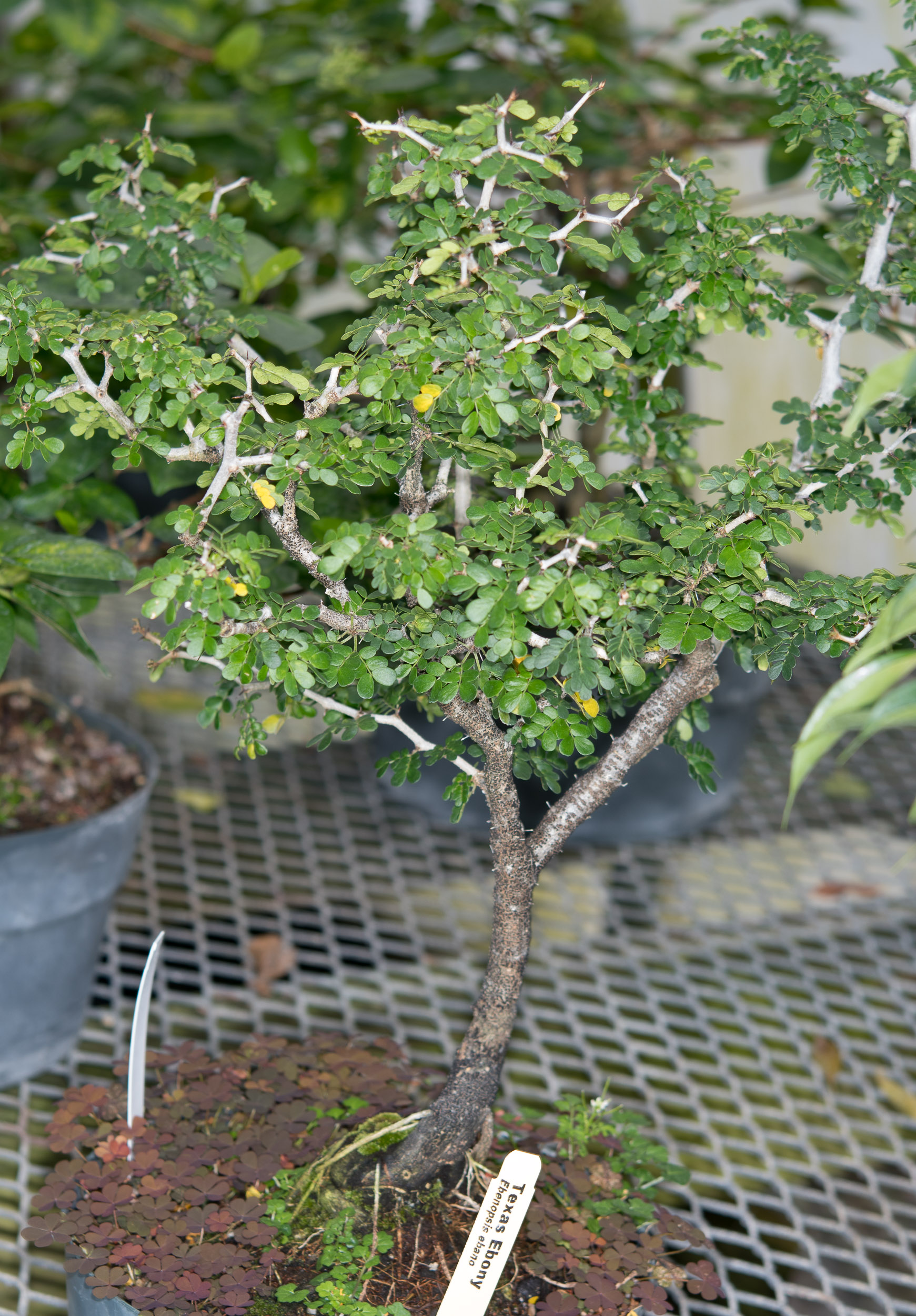
Bonsai. · 12/12/2016 · Bonsai West, Littleton, Massachusetts · ≈ 1 × 1½′ (34 × 50 cm) 
| Kingdom | Plantae | Plants, but not fungi, lichens, or algae (from Stearn's Botanical Latin) |
| Subkingdom | Tracheobionta | Vascular plants—plants with a “circulatory system” for delivering water and nutrients |
| Division | Magnoliophyta | Flowering plants, also known as angiosperms |
| Class | Magnoliopsida | Dicotyledons—plants with two initial seed leaves |
| Subclass | Rosidae | Roses, legumes, proteas, dogwoods, hydrangeas, mistletoes, euphorbias, grapes, many more |
| Order | Fabales | Legumes (pea and bean families) |
| Family | Fabaceae | Legume family (peas and beans) |
| Genus | Ebenopsis | From the Greek ἔβενος (ébenos), meaning “ebony,” and ὄψις (opsis), meaning “view.” |
| Species | ebano | From the Ancient Egyptian hbny, via the Ancient Greek ἔβενος (ébenos) |
Ebenopsis ebano description by Thomas H. Kent, not updated.

© FloraFinder.org. All rights reserved.
