Encelia hispida Andersson
Hairy goldeneye
Hairy goldeneye is native to the Galápagos Islands, where it is an endangered species. One source also lists Baja California, the Sonoran desert, and parts of the American southwest as part of its range, but documentation on this species is very limited, and I cannot confirm this. Dimensions here are estimates only.
Plants: Perennial deciduous shrubs are 1½–4′ tall ⨉ 3–8′ around (50–120 cm ⨉ 1–2.5 m).
Leaves: Gray-green, due to fine hairs. Leaves are 1–1½″ long ⨉ ½–¾″ wide (2.5–3.8 ⨉ 1.3–1.9 cm), elliptic, with sharp tips and spines, and winged petioles about ½″ (1.3 cm) long
Flowers: Loose corymbs are branched into composite flowers on long pedicels. Each flower is about 1″ (2.5 cm) in diameter, with a dome of purple disc flowers and about 8-12 yellow ray flowers. Flowers appear in spring and summer.
Habitats: Dry, rocky coastal and desert habitats.
Online References:
References:
McMullen, Conley K., Flowering Plants of the Galápagos, Comstock Publishing Associates, 1999, p. 124

The smooth-edged elliptic leaves at top belong to this species, not the toothed leaves. · 4/4/2025 · Punta Pitt, San Cristóbal, Galápagos Islands, Ecuador · By Kathryn Morgis 

4/4/2025 · Punta Pitt, San Cristóbal, Galápagos Islands, Ecuador · By Heather Kent 
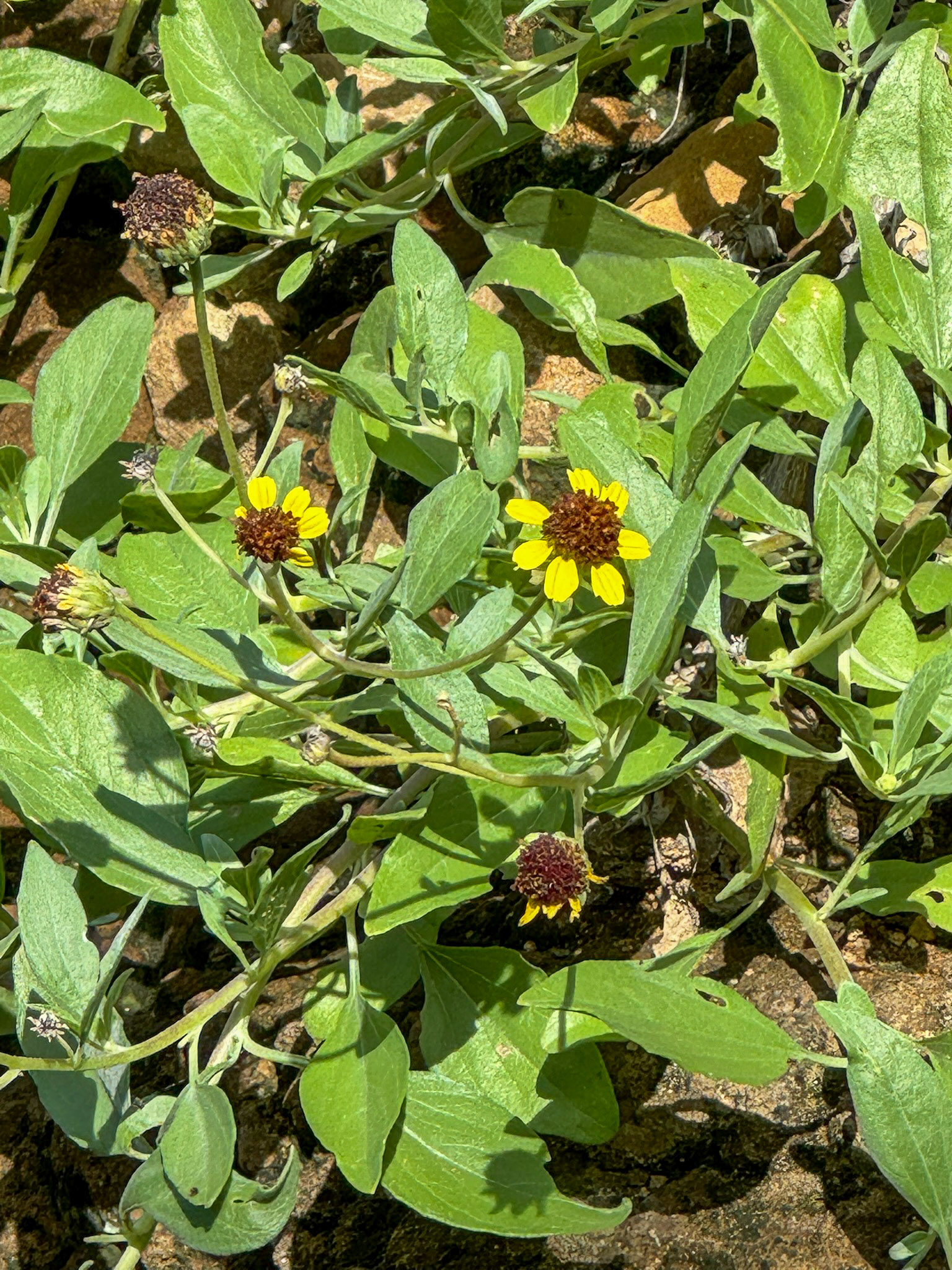
4/4/2025 · Punta Pitt, San Cristóbal, Galápagos Islands, Ecuador · By Kathryn Morgis 
| Kingdom | Plantae | Plants, but not fungi, lichens, or algae (from Stearn's Botanical Latin) |
| Subkingdom | Tracheobionta | Vascular plants—plants with a “circulatory system” for delivering water and nutrients |
| Division | Magnoliophyta | Flowering plants, also known as angiosperms |
| Class | Magnoliopsida | Dicotyledons—plants with two initial seed leaves |
| Subclass | Asteridae | A large class that encompasses asters |
| Order | Asterales | Flowering plants with a central disk flower and surrounding petals, like daisies |
| Family | Asteraceae | The aster family, which also includes daisies and sunflowers; from the Greek ἀστήρ, “star,” for the star-shaped flowers |
| Genus | Encelia | Named for German naturalist Christoph Entzelt |
| Species | hispida | Rough, with bristly hairs |
Encelia hispida description by Thomas H. Kent, not updated.

© FloraFinder.org. All rights reserved.