Equisetum variegatum Schleich. ex F. Weber & D. Mohr
Variegated horsetail, variegated scouring-rush
Variegated scouring-rush is variegated because of its black-and-white sheaths, which look quite distinctive compared to other horsetails. “Scouring rush” comes from the presence of unusually high levels of silica, making the stems and branches abrasive enough to polish metal and wood, or scour pans. Like all members of the genus Equisetum, these prefer moist, sandy enviroments, such as the shores of rivers or lakes, or ditches and borrow pits.
Plants: Usually stems are erect, though they are relatively narrow-stemmed and often bend under their weight. Sterile stems are evergreen, rough, 3–19″ (7.6–48 cm) tall, 1/32–⅛″ (1.5–4 mm) in diameter, dark green and unbranched. They have 3-12 vertical ridges. In cross section, the stems have a central cavity that is ¼ to ⅓ of the diameter of the stem. Vallecular canals, which ring the central cavity, are a bit less than half the diameter of the central cavity. Fertile stems resemble the sterile stems, but there is a “cone” atop each stem.
See Equisetum for comparison charts.
Leaves: Tiny, non-photosynthetic leaves form small sheaths that encircle nodes along the stem. There are 3-14 tiny, sharp-pointed black leaves, often called teeth, per sheath. Each sharp black tooth is surrounded by white. The teeth tend to persist all season, and they are sometimes tipped with hairlike bristles.
Fruits: A “cone”—strobilus—appears at the tip of each fertile stem. It is green, with a black, sharp-pointed tip, and ⅛–¼″ (5–8 mm) long. The spores are green, and spherical.
Habitats: Cool, shady spots.
Edibility: Poisonous.  Contains thiaminase, an
enzyme which breaks down thiamin (vitamin B1). Small quantities of the plant are not toxic,
but larger quantities are toxic to both humans and livestock.
Contains thiaminase, an
enzyme which breaks down thiamin (vitamin B1). Small quantities of the plant are not toxic,
but larger quantities are toxic to both humans and livestock.
Medical:
Online References:
References:
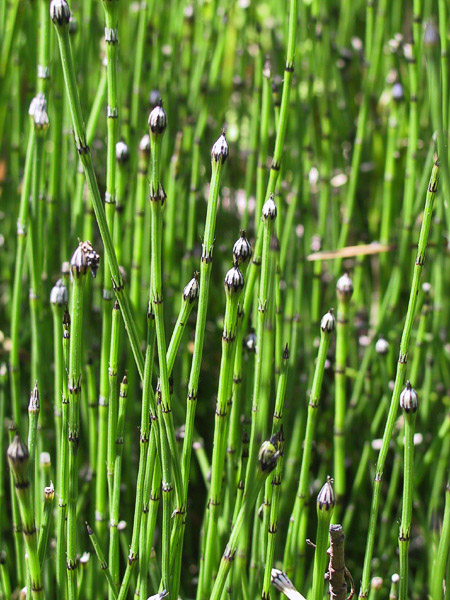
8/21/2003 · Chandos Lake, Ontario, Canada · By Janet Novak 
| Kingdom | Plantae | Plants, but not fungi, lichens, or algae (from Stearn's Botanical Latin) |
| Subkingdom | Tracheobionta | Vascular plants—plants with a “circulatory system” for delivering water and nutrients |
| Division | Equisetophyta | Horsetails, which date back to the Devonian era |
| Class | Equisetopsida | Horsetails, spore-bearing plants related to ferns |
| Order | Equisetales | Living horsetails (most are extinct) |
| Family | Equisetaceae | Living horsetails |
| Genus | Equisetum | From equus, horse; and seta, bristle |
| Species | variegatum | Variegated, i.e. different in some way |
Equisetum variegatum description by Thomas H. Kent, not updated.

© FloraFinder.org. All rights reserved.