Euphorbia candelabrum Kotschy
Euphorbia, candelabra tree
This candelabra-shaped euphorbia is native to southern and eastern Africa. It is not found in North America.
Plants: The upper parts of this cactus-like succulent euphorbia, which can reach 39′ (12 m) in height, branch repeatedly into a shape that is sometimes reminiscent of candelabras. Dark brown ridges are called “chocolate drop” ridges. A single trunk may produce as many as 150 thick branches. There are usually 4 ribs, but 3-8. Dark brown spines occur in pairs, angled away from each other but not completely opposite, looking like horns.
Leaves: Sometimes small, narrow leaves appear near the tops, and they may be green, green and white, or yellowish.
Flowers: Yellow-green, in clusters of 3-6 above the spine pairs.
Fruits: Green, and pea-sized.
Habitats: Dry deciduous and evergreen open wooded grasslands, on rocky slopes and, rarely, on termite mounds.

This photo, by Haplochromis, captures the reason for the name. 
Edibility: Poisonous  Most euphorbias contain a thick milky
“latex” that is poisonous when ingested or even on contact with the skin. This euphorbia is more toxic than
most, and can even cause blindness.
Most euphorbias contain a thick milky
“latex” that is poisonous when ingested or even on contact with the skin. This euphorbia is more toxic than
most, and can even cause blindness.
Online References:

2/26/2010 · San Diego Zoo, San Diego, California · ≈ 2½ × 4′ (87 × 130 cm) 
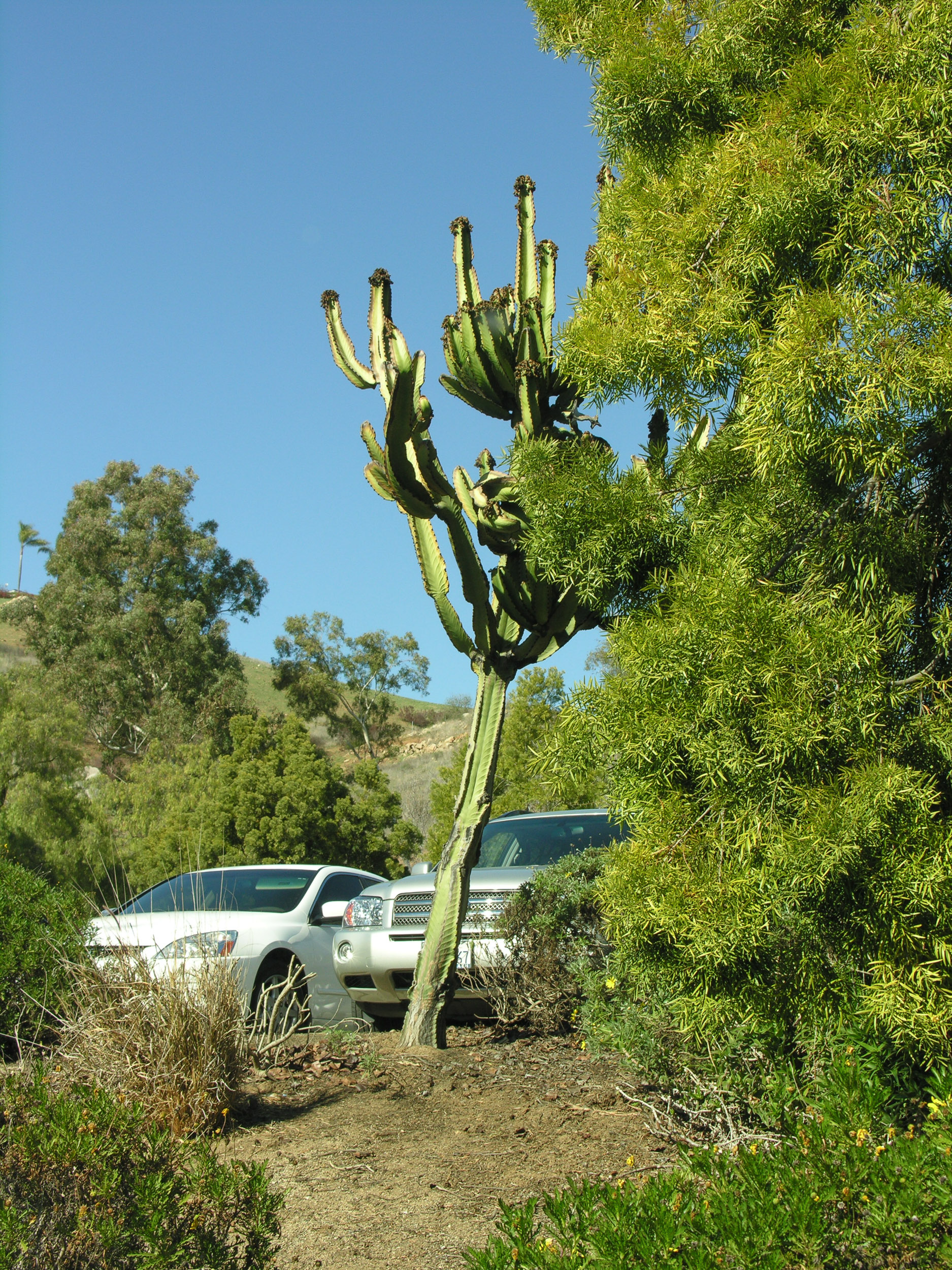
2/16/2007 · San Diego Zoo Safari Park, San Diego, California 

2/26/2010 · San Diego Zoo, San Diego, California 
| Kingdom | Plantae | Plants, but not fungi, lichens, or algae (from Stearn's Botanical Latin) |
| Subkingdom | Tracheobionta | Vascular plants—plants with a “circulatory system” for delivering water and nutrients |
| Division | Magnoliophyta | Flowering plants, also known as angiosperms |
| Class | Magnoliopsida | Dicotyledons—plants with two initial seed leaves |
| Subclass | Rosidae | Roses, legumes, proteas, dogwoods, hydrangeas, mistletoes, euphorbias, grapes, many more |
| Order | Malpighiales | A broad group encompassing 16,000 species |
| Family | Euphorbiaceae | Euphorbia or spurge family |
| Genus | Euphorbia | An extremely diverse-looking genus of mostly tropical and subtropical succulent plants. For Euphorbus, corpulent Greek physician of Juba II, King of Mauretania. Literally, “euphorbia” means “well-fed” |
| Species | candelabrum | Like a branched candlestick |

Euphorbia candelabrum description by Thomas H. Kent, not updated.

© FloraFinder.org. All rights reserved.