Lacanthis splendens (Bojer ex Hook.) Raf.
Euphorbia platyacantha Drake
Euphorbia melanacantha Drake
Euphorbia milii f. platyacantha (Drake) Leandri
Euphorbia splendens Bojer ex Hook.
Sterigmanthe splendens (Bojer ex Hook.) Klotzsch & Garcke
Euphorbia milii var. splendens (Bojer ex Hook.) Ursch & Leandri
Crown of thorns
The crown of thorns, associated by legend with the crown worn by Jesus, looks more like a rose bush on steroids than a cactus-like euphorbia, but a euphorbia it is. This red-flowering native of Madagascar is not found in the wild in North America. Plants are popular as house plants, with flowers (really modified leaves) that are yellow, gold, and orange, as well as red.
Plants: This succulent climbing shrub grows to 3′ (91 cm) tall, spewing densely spine-covered branches in every direction. The randomly curving branches are in search of other plants, which the shrub uses to support itself as it grows. Branches are dark and woody, not the green cactus-like color of many euphorbias. Spines are ⅜–¾″ (1–2 cm) long.
Leaves: Alternate, in spirals along branches, and obovate, spatulate, or lanceolate. Leaves are ⅜–1¾ ⨉ ½–¾″ (1–5 ⨉ 1.5–2 cm), with smooth edges.
Flowers: Usually scarlet red, though yellow, gold and orange cultivars exist. The flowers are really brightly colored bracts—modified leaves. The real flowers are yellow, and inconspicuous.
Fruits: Capsules contain one seed.
Habitats: A variety of bush and forest habitats, but always on rocks (usually granite formations).
Edibility: Poisonous  All euphorbias exude a
milky latex when cut, which can cause
dermatitis, and are poisonous when ingested.
All euphorbias exude a
milky latex when cut, which can cause
dermatitis, and are poisonous when ingested.
Online References:

2/26/2010 · San Diego Zoo, San Diego, California 
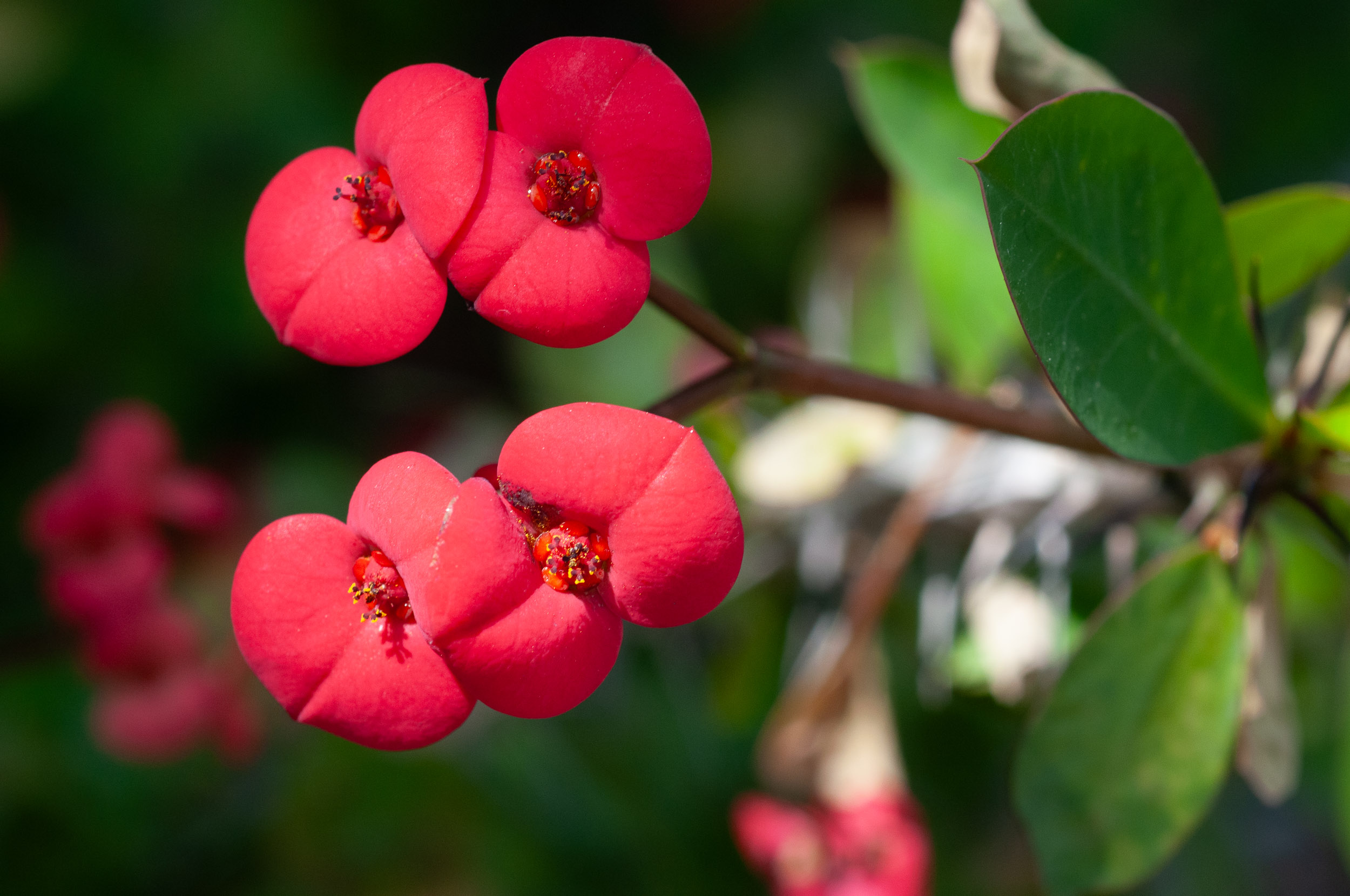
4/6/2011 · Howard Peters Rawlings Conservatory & Botanic Gardens, Druid Hill Park, Baltimore, Maryland · ≈ 4½ × 3″ (11 × 7.9 cm) 

2/16/2007 · San Diego Zoo Safari Park, San Diego, California 

4/6/2011 · Howard Peters Rawlings Conservatory & Botanic Gardens, Druid Hill Park, Baltimore, Maryland · ≈ 7 × 4½″ (17 × 11 cm) 

2/26/2010 · San Diego Zoo, San Diego, California 
| Kingdom | Plantae | Plants, but not fungi, lichens, or algae (from Stearn's Botanical Latin) |
| Subkingdom | Tracheobionta | Vascular plants—plants with a “circulatory system” for delivering water and nutrients |
| Division | Magnoliophyta | Flowering plants, also known as angiosperms |
| Class | Magnoliopsida | Dicotyledons—plants with two initial seed leaves |
| Subclass | Rosidae | Roses, legumes, proteas, dogwoods, hydrangeas, mistletoes, euphorbias, grapes, many more |
| Order | Malpighiales | A broad group encompassing 16,000 species |
| Family | Euphorbiaceae | Euphorbia or spurge family |
| Genus | Euphorbia | An extremely diverse-looking genus of mostly tropical and subtropical succulent plants. For Euphorbus, corpulent Greek physician of Juba II, King of Mauretania. Literally, “euphorbia” means “well-fed” |
| Species | milii | For Baron Milius, once Governor of Réunion, who introduced the species to France in 1821 |
| var. | splendens | “Splendid” |
Euphorbia milii var. splendens description by Thomas H. Kent, not updated.

© FloraFinder.org. All rights reserved.
