Hieracium gronovii L.
Gronovius’ hawkweed, hairy hawkweed, queendevil, beaked hawkweed
Gronovious’ hawkweed is a widespread North American hawkweed, though some sources believe it originated in Europe.
Plants: 12–18″ (30–45 cm) in height, rarely up to 2½′ (80 cm), with hairy stems. Stems, leaves, and stolons secrete a milky sap when cut.
Leaves: Most of the leaves are a basal rosette of spatula-shaped leaves up to 3½–4 ⨉ 1″ (9–10 ⨉ 2.6 cm). Leaves are alternate, usually unlobed and toothless, and oblanceolate, obovate, elliptic, or spatulate.
Flowers: Flower heads are typically composed of 25-50 flowers, and take the form of a raceme composed of several branching cymes. This compound inflorescence is called a thyrse. Each flower is yellow, ½–1″ (1.3–2.5 cm) across, with 20-40 rays. (An otherwise similar species, Hieracium scabrum, has 40-100 rays.) Flowers appear from May to October.
Fruits: Spindle-shaped achenes, tapering at both ends, how brown tufts of hair for wind dispersal.
Habitats: Dry prairies, savannas, fields, or roadsides; openings in beech-maple forests; sandy soils.
This hawkweed comparison table is an aid to identifying hawkweeds and similar-appearing species.
Online References:
References:
Clemants, Steven; Gracie, Carol, Wildflowers in the Field and Forest, Oxford University Press, 2006, p. 162
Hieracium gronovii L. var. foliosum Michx.
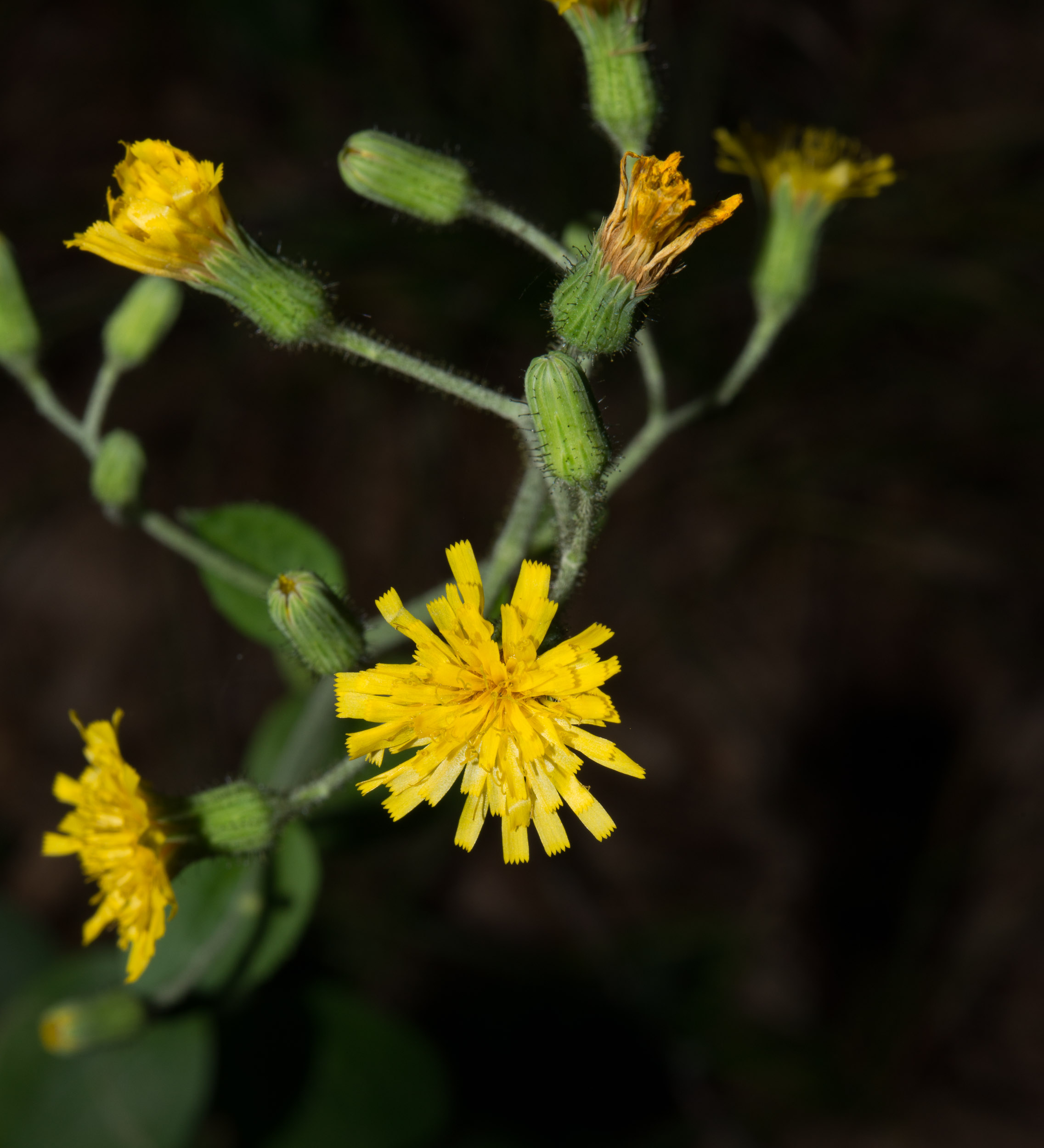
8/10/2013 · Stone Arch Bridge Trail, Near Flat Rock Hill, Dunstable, Massachusetts · ≈ 4 × 4″ (10 × 11 cm) 
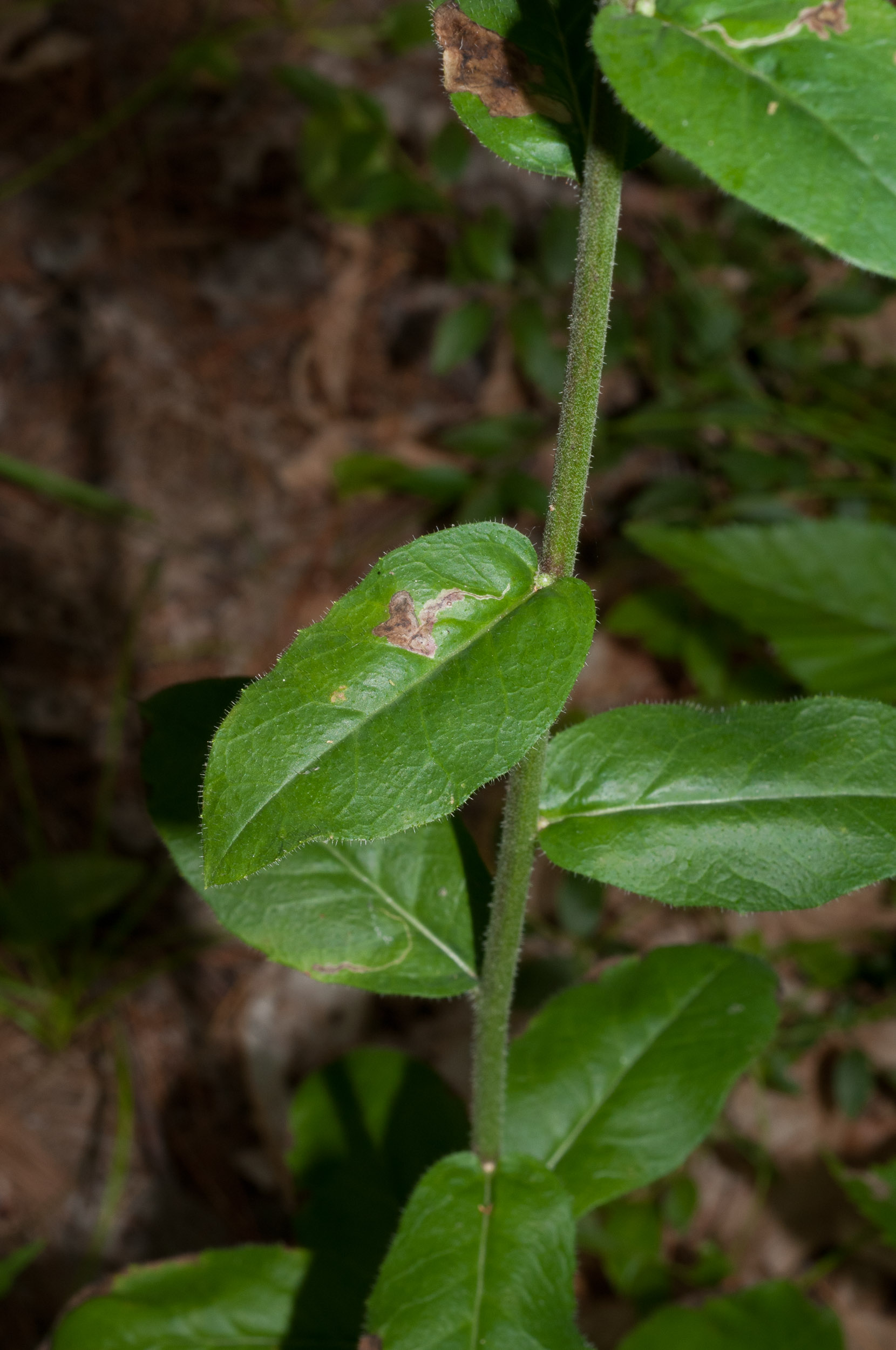
7/31/2012 · Bemis Rd Conservation Area, Pepperell, Massachusetts · ≈ 8 × 5″ (19 × 13 cm)  ID is uncertain

7/31/2012 · Bemis Rd Conservation Area, Pepperell, Massachusetts · ≈ 5 × 4″ (13 × 10 cm) ID is uncertain 

7/31/2012 · Bemis Rd Conservation Area, Pepperell, Massachusetts · ≈ 4½ × 3″ (11 × 7.9 cm) ID is uncertain 

8/10/2013 · Stone Arch Bridge Trail, Near Flat Rock Hill, Dunstable, Massachusetts · ≈ 8 × 11″ (21 × 27 cm) 

8/10/2013 · Stone Arch Bridge Trail, Near Flat Rock Hill, Dunstable, Massachusetts · ≈ 4 × 6″ (10 × 16 cm) 

7/31/2012 · Bemis Rd Conservation Area, Pepperell, Massachusetts · ≈ 4½ × 3″ (11 × 7.9 cm) ID is uncertain 
| Kingdom | Plantae | Plants, but not fungi, lichens, or algae (from Stearn's Botanical Latin) |
| Subkingdom | Tracheobionta | Vascular plants—plants with a “circulatory system” for delivering water and nutrients |
| Division | Magnoliophyta | Flowering plants, also known as angiosperms |
| Class | Magnoliopsida | Dicotyledons—plants with two initial seed leaves |
| Subclass | Asteridae | A large class that encompasses asters |
| Order | Asterales | Flowering plants with a central disk flower and surrounding petals, like daisies |
| Family | Asteraceae | The aster family, which also includes daisies and sunflowers; from the Greek ἀστήρ, “star,” for the star-shaped flowers |
| Genus | Hieracium | From Greek hierakion, “a hawk,” from Pliny’s belief that hawks strengthened their eyesight by eating these plants |
| Species | gronovii | For Jan Fredrik Gronon, for whom I can find no information other than that she lived from 1690-1762 |

Hieracium gronovii description by Thomas H. Kent, not updated.

© FloraFinder.org. All rights reserved.