Humulus lupulus L.
Hops, common hops
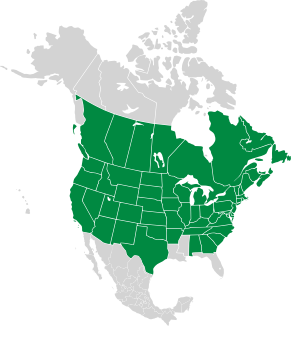
Hops, whose flowers both preserve and flavor beer, is a perennial plant that is distantly related to another common inebriant, cannabis. The five subspecies of hops have a native range spanning much of Asia, Europe, and Nroth America. Countless cultivars exist.
Plants: Vines reach up to 33′ (10 m) tall. (If you want to split hairs, these are bines, not vines—they spread by wrapping their stems around other things, rather than via tendrils.)
Leaves: Simple, with 3-5 deep lobes, either alternate or opposite.
Flowers: Male and female flowers occur on separate plants. Male (staminate) flowers lack petals, while female (pistillate) flowers have 5 petals. Female flowers. strobiles, are cone-shaped, and known as hops. The female flowers’ lupulin glands secrete the fine yellow resinous powder, a veritable hopucopia of resins and essential oils that fuel the beer industry.
Fruits: Dry achenes do not split open when ripe.
Habitats: Moist, rich soils.
Edibility: Well, the flowers are certainly drinkable...
Medical: In addition to flavoring beers, the unique combination of chemicals in hops have a variety of potential medical applications. Remarkably, hop genomes are similar in size to those of humans, complicating interpretation and hinting at a long and colorful evolutionary history. And although hops and cannabis diverged over 20 million years ago, they still have an estimated 73% overlap in genomic content.
Online References:
Pmc.ncbi.nlm.nih.gov (medical applications)
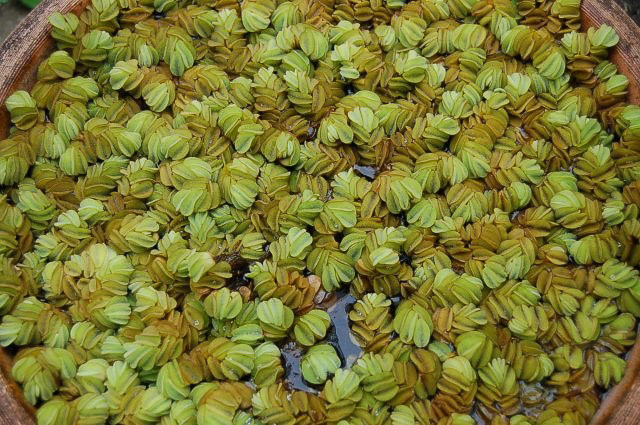
These are the female flowers (also called seed cones or strobiles) of the hop plant. · 7/17/2007 · Guam · By Jacquelyn Boyt 
| Kingdom | Plantae | Plants, but not fungi, lichens, or algae (from Stearn's Botanical Latin) |
| Subkingdom | Tracheobionta | Vascular plants—plants with a “circulatory system” for delivering water and nutrients |
| Division | Magnoliophyta | Flowering plants, also known as angiosperms |
| Class | Magnoliopsida | Dicotyledons—plants with two initial seed leaves |
| Subclass | Rosidae | Roses, legumes, proteas, dogwoods, hydrangeas, mistletoes, euphorbias, grapes, many more |
| Order | Urticales | Includes cannabis, nettles, mulberries, elms, others |
| Family | Cannabaceae | A small but varied group whose best known members are marijuana and hops for beer |
| Genus | Humulus | Vines that climb with hooked hairs; Latin Humulus may mean “hop” |
| Species | lupulus | Literally a “small wolf,” alluding to the plant’s habit of climbing over and smothering trees on which it grows. H. lupulus is the European hop and was once called “willow-wolf” because of its propensity for climbing on willows, and the word shows up again in the species Medicago lupulina |
Humulus lupulus description by Thomas H. Kent, not updated.

© FloraFinder.org. All rights reserved.