Hyoscyamus niger L.
Henbane, black henbane, stinking nightshade
Henbane is native to Europe and Siberia, but naturalized in Great Britain, Ireland, and North America. For as long as people have been classifying plants, “-banes” have designated poisonous plants, or those with magical or psychotropic powers.
Plants: Foul-smelling, sticky plants are up to 3′ (1 m) tall.
Leaves: Lanceolate to ovate, 1¾–12 ⨉ ¾–6″ (5–30 ⨉ 2–15 cm), mostly sessile, with bases that clasp the stem or petiole. Each leaf has coarse teeth or deep lobes.
Flowers: Tubular, five-parted, with petals fused into a cup shape. Flowers are ⅞–1¾″ (2.5–4.5 cm) in size, pale yellow to greenish yellow, with a network of darker veins, and centers are purple. They appear from June to August.
Fruits: Capsules are ovoid-rounded, and ½ ⨉ ⅜″ (1.5 ⨉ 1.2 cm). Seeds are yellow-brown, disc-shaped, and 1/32″ (1 mm) in diameter.
Habitats: Waste places, roadsides, or fields, at elevations below 1.8 mi (2.9 km).
Edibility: Poisonous  Black henbane is exceptionally
poisonous, as described below. Like many poisons, it also has medicinal properties when used
carefully.
Black henbane is exceptionally
poisonous, as described below. Like many poisons, it also has medicinal properties when used
carefully.
Medical: As far back as 4000 B.C., henbane has been variously used as a hallucinogenic, to induce a feeling of flying, as a conjurer of souls and demons, and as a cross between a deleriant and an aphrodisiac. Symptioms include loss of muscular control, dilation of the pupils, heart palpitation, hallucinations, delirium (“madness”); and in large doses, coma, and death. In smaller doses it has served as an analgesic, sedative, and narcotic. Henbane contains hyoscyamine, scopolamine, and other tropane alkaloids. Scopalomine patches are used today to ameliorate seasickness. Hyoscyamine is still used as an antispasmodic and to treat stomach and intestinal problems such as irritable bowel syndrome, cramps, and Parkinson’s disease.
Online References:
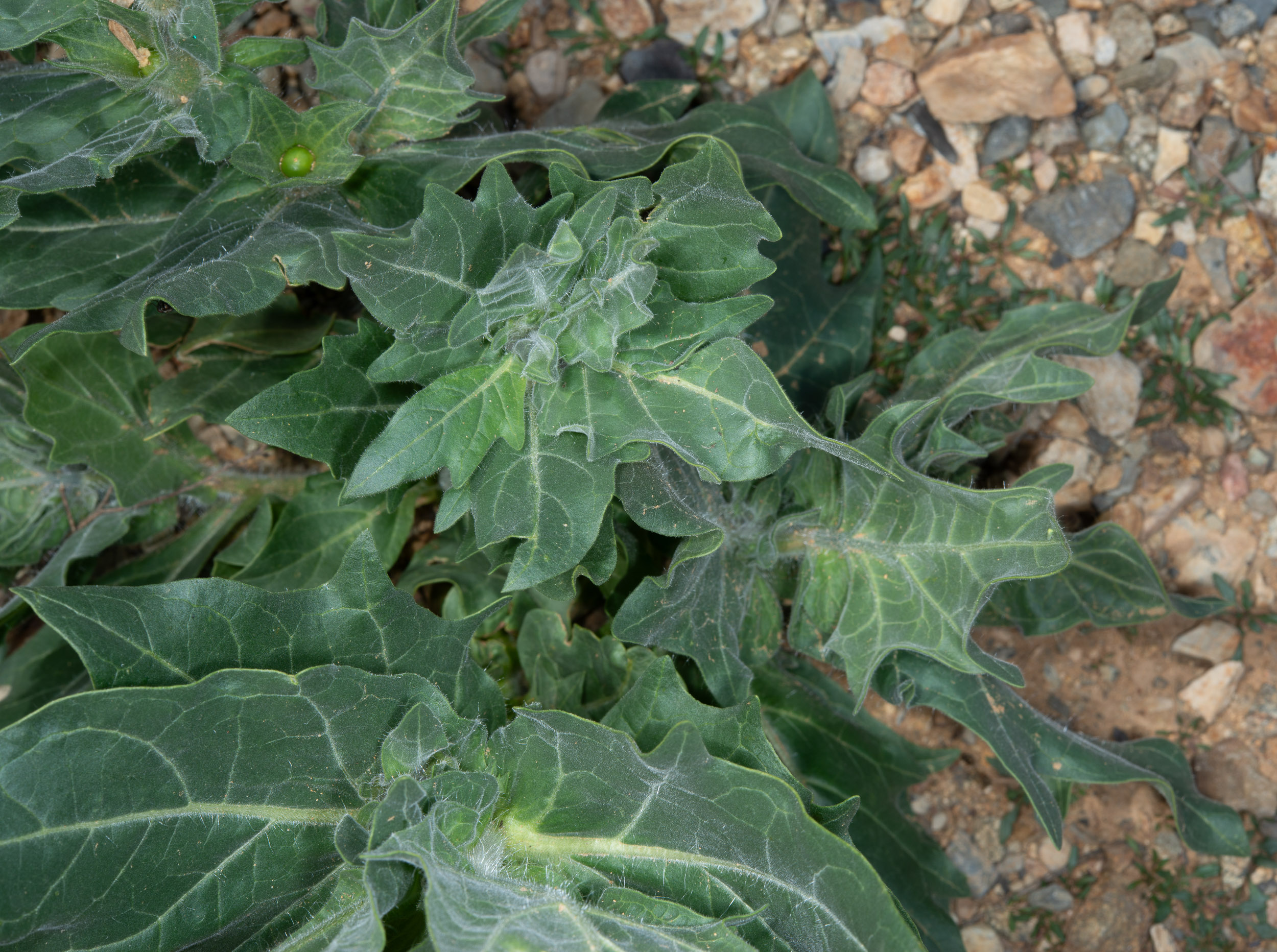
8/28/2014 · Eagle Nest Lake, Eagle Nest, New Mexico · ≈ 10 × 7″ (25 × 18 cm) 

8/28/2014 · Eagle Nest Lake, Eagle Nest, New Mexico · ≈ 7 × 10″ (16 × 25 cm) 

8/28/2014 · Eagle Nest Lake, Eagle Nest, New Mexico · ≈ 7 × 11″ (18 × 28 cm) 
| Kingdom | Plantae | Plants, but not fungi, lichens, or algae (from Stearn's Botanical Latin) |
| Subkingdom | Tracheobionta | Vascular plants—plants with a “circulatory system” for delivering water and nutrients |
| Division | Magnoliophyta | Flowering plants, also known as angiosperms |
| Class | Magnoliopsida | Dicotyledons—plants with two initial seed leaves |
| Subclass | Asteridae | A large class that encompasses asters |
| Order | Solanales | Potatoes, eggplants, tomatoes, peppers, tobacco, petunias, sweet potatoes, morning glories, many others |
| Family | Solanaceae | Nightshade or potato family |
| Genus | Hyoscyamus | From Greek hyoskýamos, (or hyós, ”hog,“ and kýamos, ”bean,“ because the plant was thought poisonous to pigs |
| Species | niger | Black |

Hyoscyamus niger description by Thomas H. Kent, not updated.

© FloraFinder.org. All rights reserved.