Ligusticum scoticum L.
Scots lovage, Scottish licorice-root
Scots lovage is a North American native, found on New England and Alaskan seacoasts. It is also native to temperate regions of Europe and Asia. It is a member of the carrot family.
Plants: Perennials are rarely branched and 6–24″ (15–60 cm) tall.
Leaves: Compound leaves are triangular, subdivided into groups of three leaflets, each further subdivided into three more. The entire compound leaf is 1¾–8″ (5–20 cm) long, and each of the three larger leaflets are ¾–1¾″ (2–5 cm) long. Leaves are thick and fleshy, sometimes shiny, rhombic to obovate, and toothed, lobed, or serrated.
Flowers: Compound umbels are 1½–2″ (4–6 cm) around, white, and roughly flat-topped. Each umbel branches into 10-20 smaller umbels; these in turn branch into 8-12 still smaller umbels. Each flower is only about 1/16″ (2 mm) around, and greenish-white.
Fruits: ⅛–3/16″ (4–6 mm) long, with five prominent ridges.
Habitats: Seacoast beaches, in rock crevices or cliff-top grasslands.
Edibility: Leaves, flowers, and young shoots are stongly flavored—think celery on steroids. Leaves are blanched to dilute the flavor. Seeds are also edible, with a flavor similar to fenugreek or cumin.
Online References:

6/10/2016 · Lobster Cove Trail, Monhegan Island, Maine 

6/10/2016 · Lobster Cove Trail, Monhegan Island, Maine 

6/10/2016 · Lobster Cove Trail, Monhegan Island, Maine 
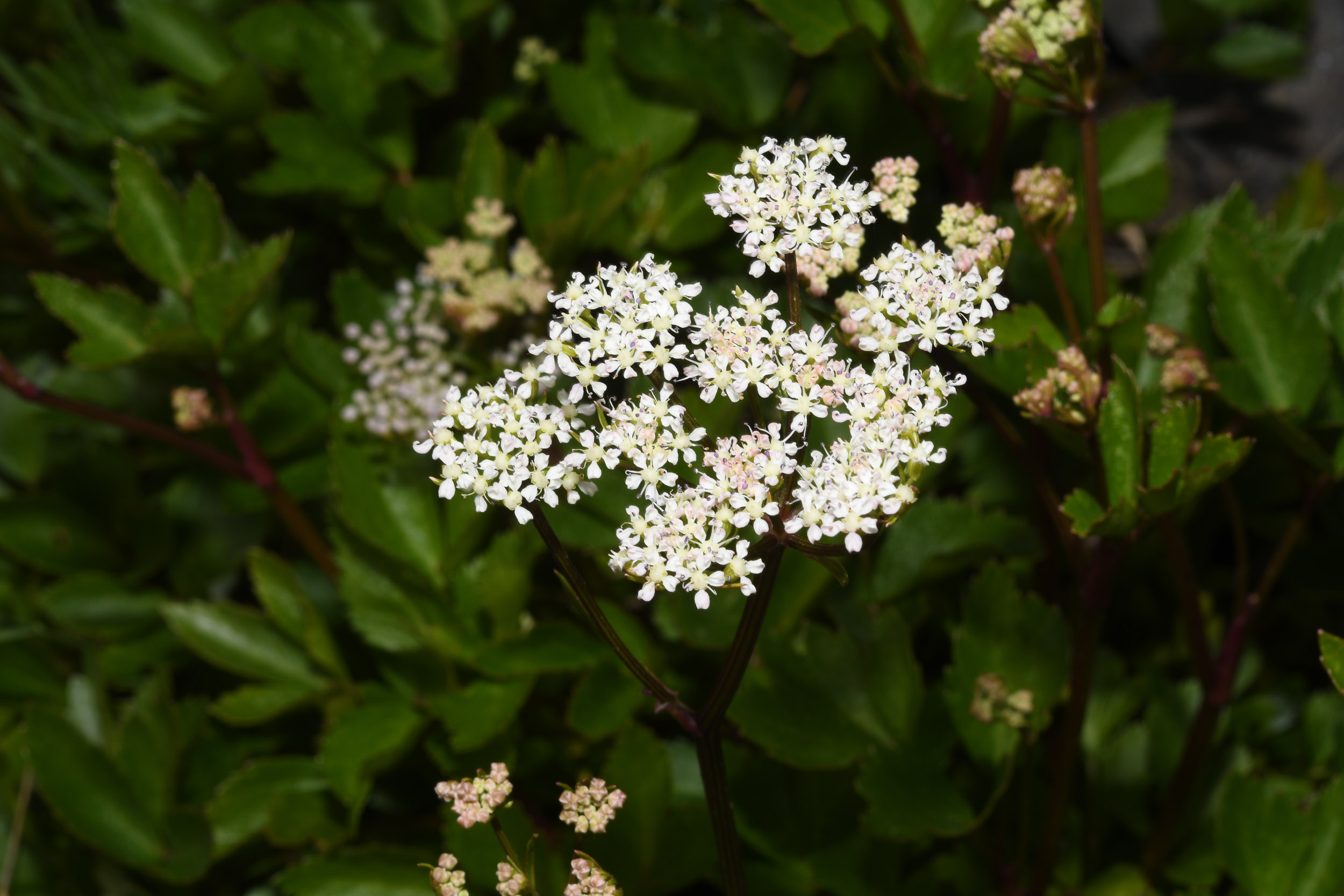
6/10/2016 · Lobster Cove Trail, Monhegan Island, Maine 

6/10/2016 · Lobster Cove Trail, Monhegan Island, Maine 
| Kingdom | Plantae | Plants, but not fungi, lichens, or algae (from Stearn's Botanical Latin) |
| Subkingdom | Tracheobionta | Vascular plants—plants with a “circulatory system” for delivering water and nutrients |
| Division | Magnoliophyta | Flowering plants, also known as angiosperms |
| Class | Magnoliopsida | Dicotyledons—plants with two initial seed leaves |
| Subclass | Asteridae | A large class that encompasses asters |
| Order | Apiales | Includes carrots, celery, parsley, and ivy |
| Family | Apiaceae | Carrot or parsley family, also includes angelica, anise, caraway, celery, chervil, cicely, coriander/cilantro, cumin, dill, fennel, hemlock, lovage, Queen Anne’s Lace, parsnip |
| Genus | Ligusticum | From the Greek ligustikos, “Ligurian, pertaining to Liguria, Italy” |
| Species | scoticum | Scottish |

Ligusticum scoticum description by Thomas H. Kent, not updated.

© FloraFinder.org. All rights reserved.