Lycium boerhaviifolium
Desert plum
Desert plum is native to much of South America, portions of Central America, and the Galápagos Islands.
Plants: Deciduous shrubs are 6–10′ (1.8–3 m) tall, and multiply branched. Dark brown branches have sharp spines that are initially ¼″ (6.3 mm) long, but lengthen with age.
Leaves: Alternate, grayish, fleshy, roughly round or ovate or obovate. They are 1–1½ ⨉ ¾–1¼″ (2.5–3.8 ⨉ 1.9–3.2 cm) in size, with wavy edges, on petioles up to ¼″ (6.3 mm) long.
Flowers: Racemes are about 1″ (2.5 cm) long. Flowers have corollas that are pale blue or violet, with tubular bases and five lobes. The calyx is ⅛″ (4.2 mm) long, bell shaped, with five teeth. ⅜″ (1 cm). They appear on short pedicels, or may grow from leaf axils. Flowers appear in spring.
Fruits: Roundish drupelike fruits often separate into two sections, each with a seed.
Habitats: Subtropical biomes.
Online References:
References:
McMullen, Conley K., Flowering Plants of the Galápagos, Comstock Publishing Associates, 1999, p. 158
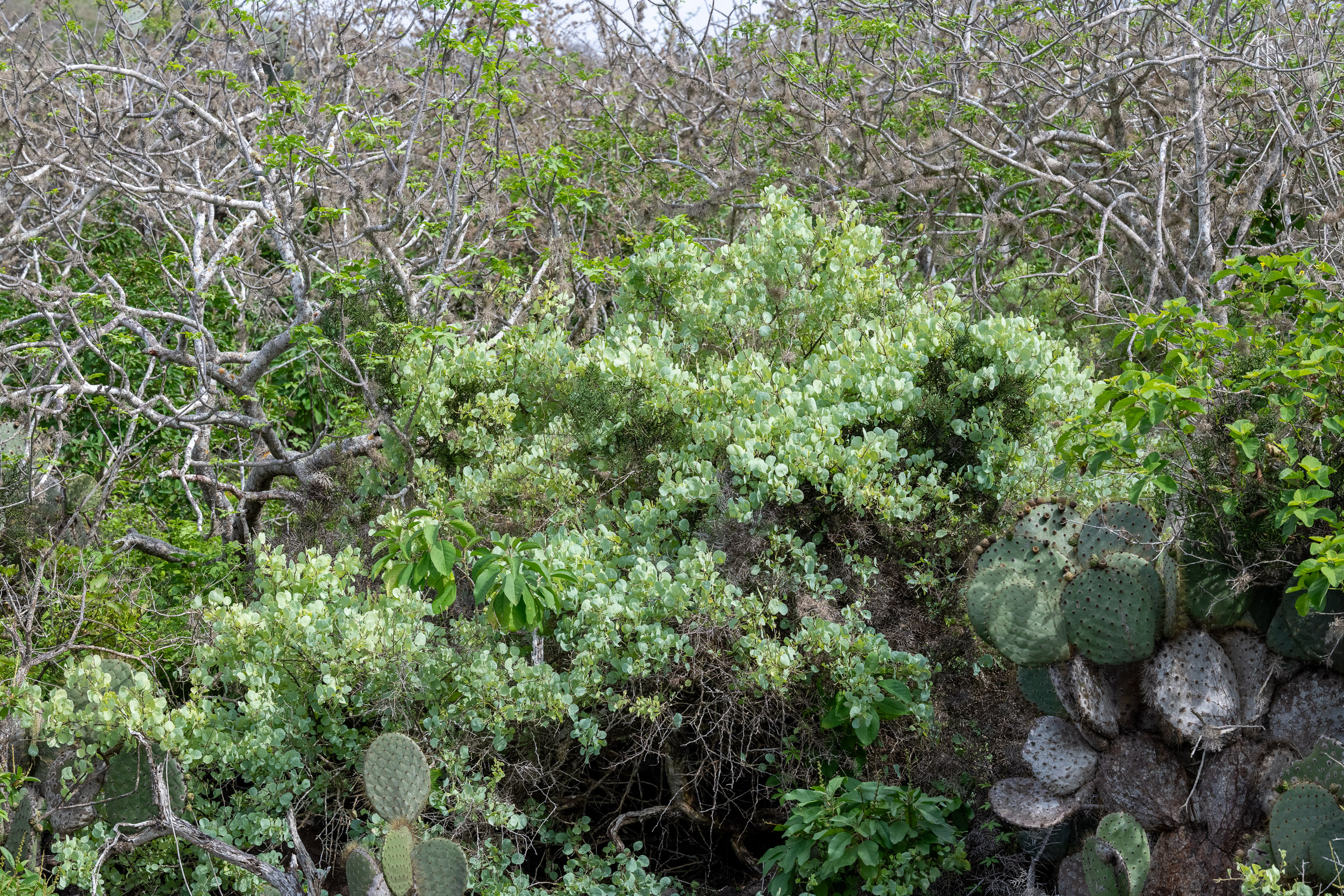
3/31/2025 · Rábida, Galápagos Islands, Ecuador 

3/31/2025 · Rábida, Galápagos Islands, Ecuador 

3/31/2025 · Rábida, Galápagos Islands, Ecuador 
| Kingdom | Plantae | Plants, but not fungi, lichens, or algae (from Stearn's Botanical Latin) |
| Subkingdom | Tracheobionta | Vascular plants—plants with a “circulatory system” for delivering water and nutrients |
| Division | Magnoliophyta | Flowering plants, also known as angiosperms |
| Class | Magnoliopsida | Dicotyledons—plants with two initial seed leaves |
| Subclass | Asteridae | A large class that encompasses asters |
| Order | Solanales | Potatoes, eggplants, tomatoes, peppers, tobacco, petunias, sweet potatoes, morning glories, many others |
| Family | Solanaceae | Nightshade or potato family |
| Genus | Lycium | Either (1) from Lycia, an ancient country in Asia Minor, and/or (2) from the Greek name Lykion used by Dioscorides and Pliny for some thorny tree or shrub, perhaps some species of Rhamnus, deriving probably from the Greek lykion for “thorn,” and reapplied by Linnaeus as the name for this genus. It is possible that the tree also came from the region of Lycia |
| Species | boerhaviifolium | With foliage resembling the genus Boerhavia |
Lycium boerhaviifolium description by Thomas H. Kent, not updated.

© FloraFinder.org. All rights reserved.