Lycopus virginicus L.
Virginia water horehound, sweet bugleweed, water bugle, carpenter’s herb, green archangel, purple archangel, Paul’s betony, woodbetony, wolf foot, Egyptian’s herb
Virginia water horehound is a North American native. “Horehound” is from “hore,” downy, and “hune,” an old English word for a type of plant.
Plants: 1–3′ (38–91 cm) tall, with an unbranched stem. It is erect, or sometimes leaning over against other plants. Stems are roughly square in cross-section, and covered with fine hairs which may point outward or lie flat against the stem (appressed). These plants often (but not always) lack the thick tuberous roots of other water-horehounds.
Leaves: 1–4½ ⨉ ⅜–1¾″ (3–12 ⨉ 1–5 cm). Oval or lanceolate, unlobed, with coarsely toothed edges. The lowest teeth are a little below the mid-point of each leaf. Leaves are more egg-shaped than those other water-horehounds. Leaves are dark green or purple, and opposite. Leaves nearer the bottom have a short stalk, while those near the top are attached almost directly to the stem (i.e. sessile). Upper leaf surfaces are nearly hairless, while lower surfaces have a hairy central vein and may have fine hairs elsewhere.
Flowers: Flowers appear in tight clusters at leaf axils. They are tubular in shape, and each is about ⅜″ long ⨉ ⅛″ around (1 cm ⨉ 3.2 mm). They emerge in all directions from the axil. Flowers are white, with a few pink spots.
Fruits: Each flower is replaced by four small nutlets, packed together in roughly the shape of a square. Individual nutlets are 1/32–1/16 ⨉ ~1/32″ (1.3–2 ⨉ 0.7–1.3 mm).
Habitats: River banks, floodplains, wet meadows, clearings, and shores.
Edibility: Cherokee peoples “chewed the roots of Virginia water-horehound and fed them to infants to give them ‘eloquence of speech.’”
Medical: Virginia water horehound, and other members of Lycopus, have a long history of use in folk cures, but these have not be substantiated with formal studies. The plant does have mild sedative properties, and shows some promise in the treatment of some thyroid disorders, such as Grave’s disease and other forms of hyperthyroidism. For the same reason, it is dangerous for people with hypothyroism, myxedema, and enlargement of the thyroid. It should not be taken by pregnant mothers.
Members of Lycopus, the water-horehounds, are notoriously hard to distinguish. They are also easily confused with some members of other genera.
 |
Simmilar species. |
Online References:
References:
Clemants, Steven; Gracie, Carol, Wildflowers in the Field and Forest, Oxford University Press, 2006, p. 342
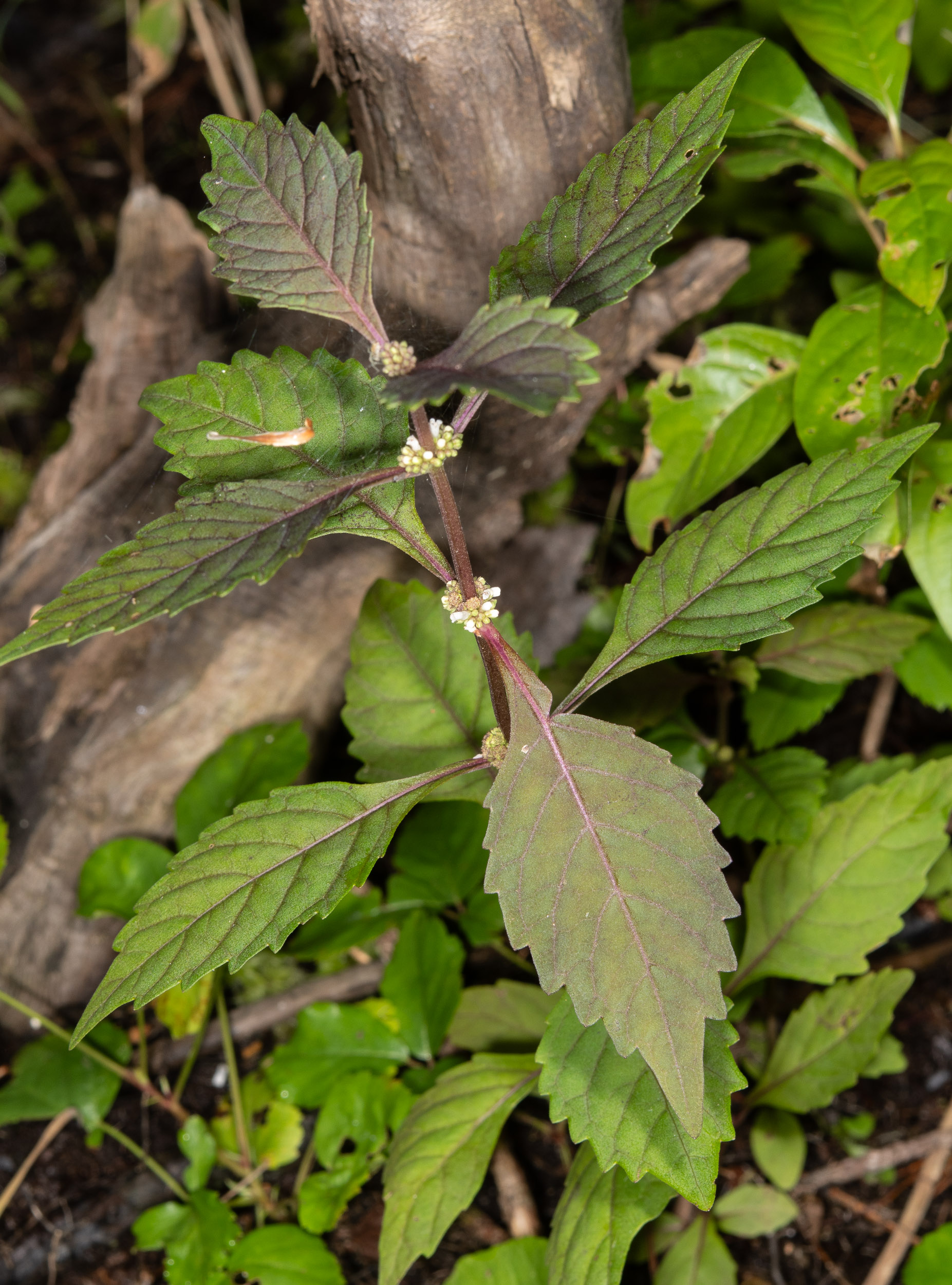
8/26/2018 · Henry E. Cowdrey Nature Center, Lunenburg, Massachusetts · ≈ 5 × 7″ (13 × 18 cm) 
| Kingdom | Plantae | Plants, but not fungi, lichens, or algae (from Stearn's Botanical Latin) |
| Subkingdom | Tracheobionta | Vascular plants—plants with a “circulatory system” for delivering water and nutrients |
| Division | Magnoliophyta | Flowering plants, also known as angiosperms |
| Class | Magnoliopsida | Dicotyledons—plants with two initial seed leaves |
| Subclass | Asteridae | A large class that encompasses asters |
| Order | Lamiales | Aromatic herbs and shrubs, including lavender, lilac, olive, jasmine, ash, teak, snapdragon, sesame, psyllium, garden sage, mint, basil, and rosemary |
| Family | Lamiaceae | Mint family |
| Genus | Lycopus | From the Greek lykos, “wolf,” and pous, “foot” |
| Species | virginicus | From or referring to Virginia |

Lycopus virginicus description by Thomas H. Kent, not updated.

© FloraFinder.org. All rights reserved.