Mammillaria haageana Pfeiff.
Mexican pincushion cactus
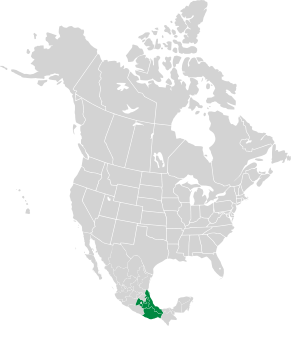
These cacti are native to southern Mexico.
Plants: Spherical in shape, usually occurring alone, sometimes in clusters, up to 6″ (15 cm) high and 4″ (11 cm) wide. Spine groups on the side are arranged in a spiral pattern (instead of as vertical rows as in many other cacti), and they are closely spaced. Radial spines are in groups of 18-30, smooth, white, and bristled. They are 1/16–3/16″ (3–6 mm) long.
Flowers: Flowers are funnel-shaped, ranging from bright purple-pink to carmine, forming a complete ring around the top of the cactus. Flowers appear from March to April.
Fruits: Fruits are red, and ¾″ (2 cm) long.
Habitats: Deciduous tropical forests, dry scrub, oak forests, juniper forest, pine forest, lava flows, and often in disturbed areas; at elevations of 1476–8530′ (450–2600 m).
Edibility: Fruits, locally called chilitos, are edible.
If you look closely at the photo, you’ll notice that in 1979 this cactus was labelled Mammillaria elegans dealgata. When I first saw this name, I surmised that some droll botanist had perpetrated a small joke on the botanical community. What else could Mammillaria elegans possibly mean other than “nice boobs?” I was partly right. Mammillaria does refer to breasts, specifically nipples, and elegans means “elegant.” But in this context, Mammillaria refers to the tubercules on the plant surface, small raised bumps arranged in spiral patterns, the base of each group of spines. In most cacti, these are arranged as a series of vertical ribs along the stem of the cactus, but in Mammillaria, they follow the Fibonacci number sequence, a pattern that is also common elsewhere in nature.
This genus has an unusual approach to plant metabolism, absorbing CO₂ at night and re-emitting it during the day, in a way that improves photosynthesis. This is called Crassulacean acid metabolism, and it is a trait these cacti have in common with pineapples.
Online References:
The Mammillaria Forum (superb photos)
References:
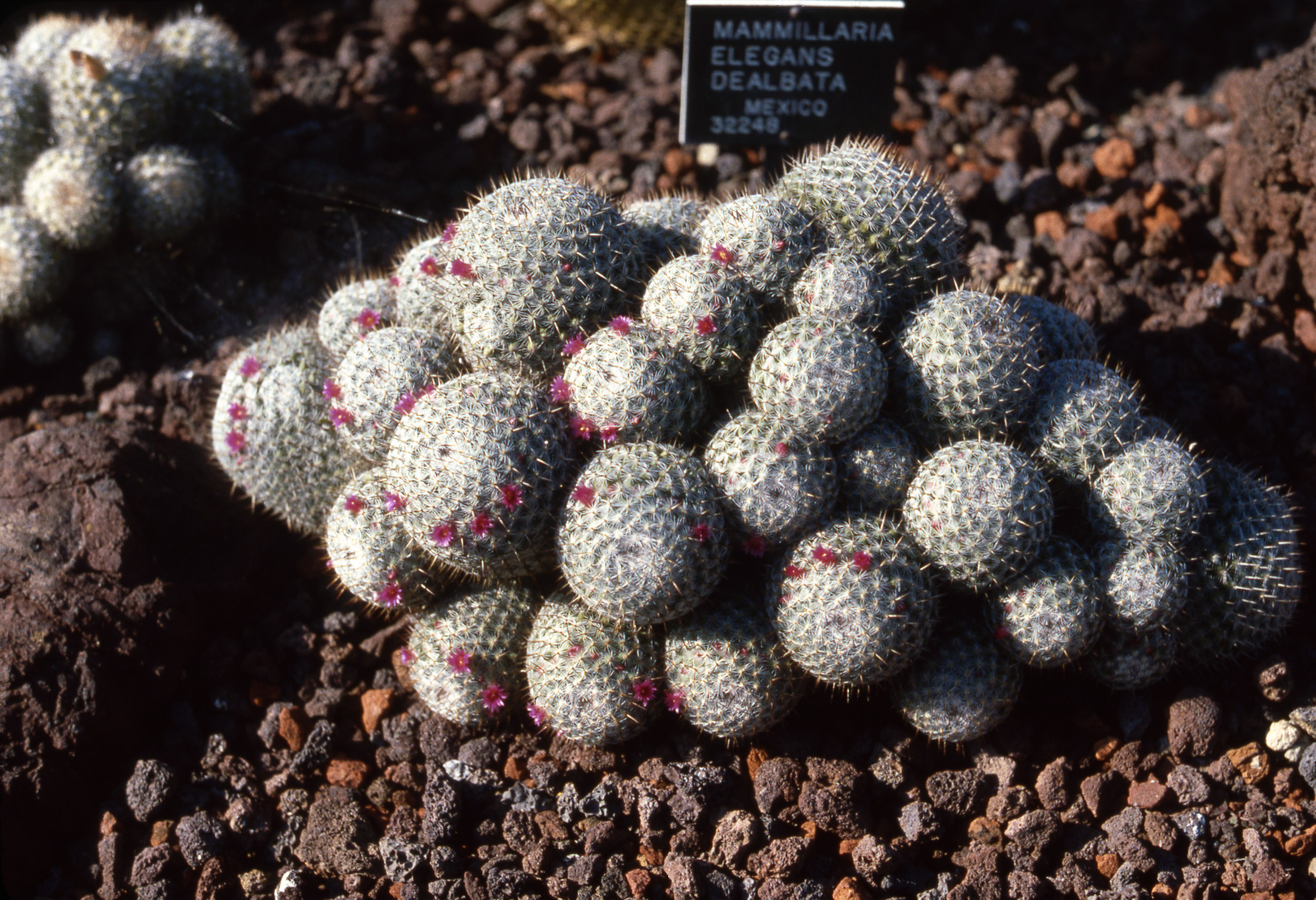
1 · 4/11/1979 · Huntington Library Desert Garden, San Marino, California 
| Kingdom | Plantae | Plants, but not fungi, lichens, or algae (from Stearn's Botanical Latin) |
| Subkingdom | Tracheobionta | Vascular plants—plants with a “circulatory system” for delivering water and nutrients |
| Division | Magnoliophyta | Flowering plants, also known as angiosperms |
| Class | Magnoliopsida | Dicotyledons—plants with two initial seed leaves |
| Subclass | Caryophyllidae | Cacti, many other succulents, carnivorous plants, and leadworts |
| Order | Caryophyllales | Includes cacti, carnations, amaranths, ice plants, and many carnivorous plants |
| Family | Cactaceae | Succulent (water-storing) plants, often spiny |
| Genus | Mammillaria | From Latin mammilla, “nipple,” referring to the tubercules on members of this genus |
| Species | haageana |
Mammillaria haageana description by Thomas H. Kent, not updated.

© FloraFinder.org. All rights reserved.