Nymphaea odorata Aiton var. maxima (Conrad) B. Boivin
Nymphaea tuberosa Paine
Nymphaea odorata Aiton ssp. tuberosa (Paine) Wiersma & Hellquist
Fragrant white water lily, American white waterlily
Tuberous water lily is native to North and Central America. The name derives from egg-sized brown tubers on the roots, which are edible. Beautiful in the wild, and coveted as an ornamental, it is nevertheless considered an invasive in some habitats. Plants spread slowly, but they eventually commandeer large patches of water less than eight feet deep at the expense of other plants.
Plants: Water lilies are instantly recognizable by their round or egg-shaped, flat leaves, often turned up slightly at the edges in order to float. This subspecies has roots that are constricted at branch nodes, forming detachable (and edible) tubers. Another subspecies, N. odorata ssp. odorata, does not have these constrictions.
Leaves: Leaves are “lily pads,” 4–16″ (10–40 cm) around, with a cone-shaped portion missing, resembling green Pacmen. Waxy surfaces and upturned edges keep the leaves afloat. Upper surfaces are green, somewhat glossy; undersides are often purplish. They are attached by long petioles (stems) that lead down to root systems on pond bottoms.
Flowers: If they are flowering, as they do during the first half of the day, you’ll see their large, very attractive, white (sometimes pink), fragrant blossoms. These iconic blossoms are 2½–6″ (6.3–15 cm) around, with 17-43 white (rarely pink) petals and yellow centers made up of 35-120 prominent yellow stamens.
Fruits: Pollinated flowers are pulled underwater, where the seeds develop. Fruit is round and berry-like, containing oval seeds ⅛–¼″ (3.2–6.3 mm) long.
Habitats: Clear, slow-moving or still fresh water with ample sunlight.
Edibility: Young unrolling leaves and unopened flower buds may be boiled for 5-10 minutes and served buttered; root tubers may be prepared like potatoes.
Online References:

6/15/2010 · Garden in the Woods, Framingham, Massachusetts 
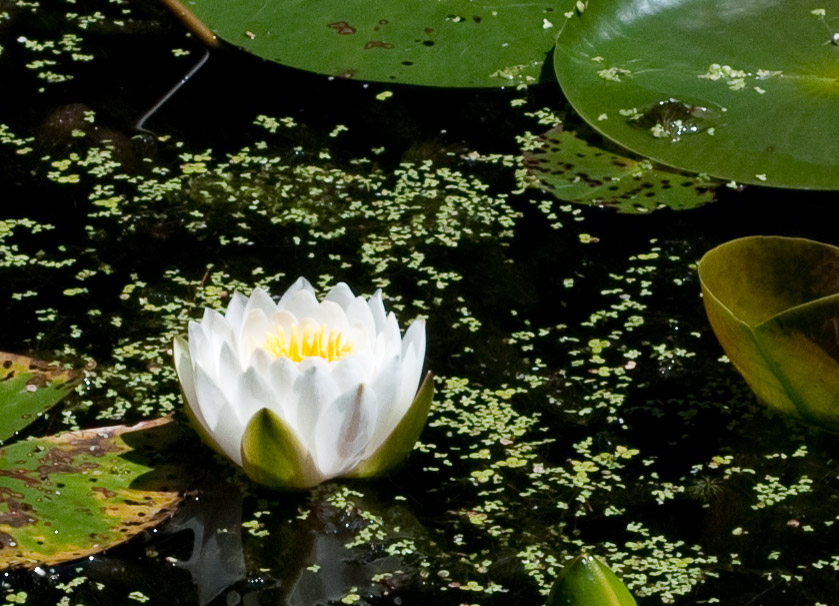
6/15/2010 · Garden in the Woods, Framingham, Massachusetts 
| Kingdom | Plantae | Plants, but not fungi, lichens, or algae (from Stearn's Botanical Latin) |
| Subkingdom | Tracheobionta | Vascular plants—plants with a “circulatory system” for delivering water and nutrients |
| Division | Magnoliophyta | Flowering plants, also known as angiosperms |
| Class | Magnoliopsida | Dicotyledons—plants with two initial seed leaves |
| Subclass | Magnoliidae | Includes magnolias, nutmeg, bay laurel, cinnamon, avocado, black pepper, and many others |
| Order | Nymphaeales | Water lilies and other aquatic plants |
| Family | Nymphaeaceae | Water lily family |
| Genus | Nymphaea | From the Greek Νυμφαία, possibly related to Νύμφη, meaning “nymph” |
| Species | odorata | Fragrant, sweet-smelling |
| ssp. | tuberosa | Tuberous, alluding to the fact that the rhizomes of some species have tubers |
Nymphaea odorata ssp. tuberosa description by Thomas H. Kent, not updated.

© FloraFinder.org. All rights reserved.
