Purshia tridentata (Pursh) DC.
Antelope bitterbrush, bitterbrush, antelope bush
Bitterbrush is native to western North America, where it is found at elevations of 3281–8858′ (1–2.7 km). Its first known collection was by Meriwether Lewis on the Lewis and Clark Expedition in July of 1806 near Lewis and Clark Pass, Montana. Frederick Pursh, the first to receive, work on, and publish the Lewis and Clark botanical collections, named the plant Tigarea tridentata in his 1814 publication, Flora Americae Septentrionalis.
Plants: Low, twisted, gnarly, and spreading, about 3′ (91 cm) high and 6′ (1.8 m) around. There are many horizontal, even prostrate branches and stems.
Leaves: Thick and small, less than 1″ (2.5 cm) long, with very fine hairs that make the plant look grayish. There are three separated teeth at the end of each leaf, providing the “trident” in the species name “tridentata.” (There may be two more lobes as well.) The leaves curl tightly during droughts to reduce water loss.
Flowers: Creamy yellow or white, ¼–¾″ (8–20 mm) aorund, with 5 petals and an unruly collection of about 25 yellow-tipped stamens. Flowers appear from March to June.
Fruits: Slightly fuzzy, ⅛–¼″ (5–7 mm) long, and tapered, with achenes 1/32″ (1.5 mm) long.
Habitats: Sagebrush desert and ponderosa pine forests.
Online References:
Purshia tridentata (Pursh) DC. var. tridentata
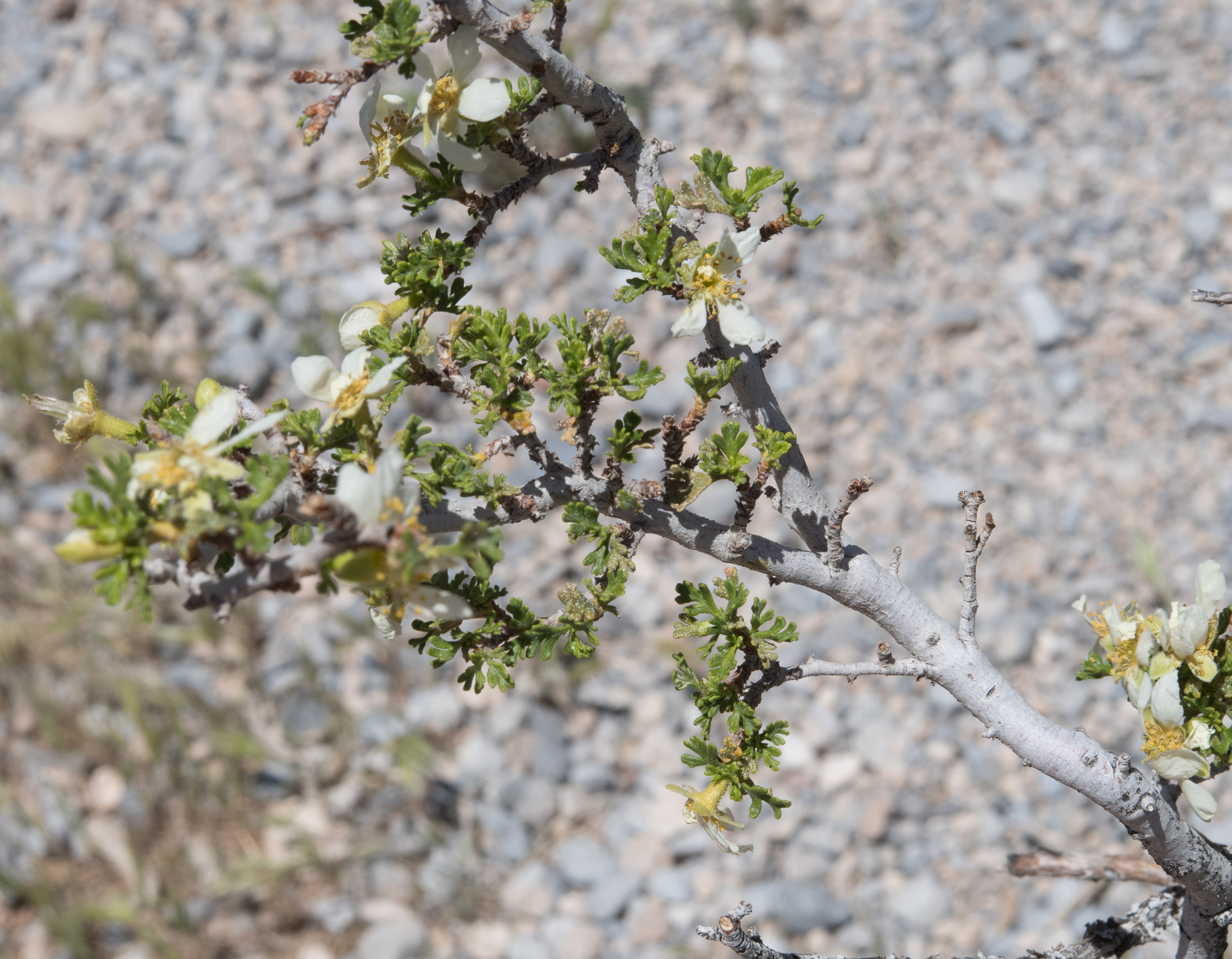
4/28/2018 · High Point Overlook, Scenic Drive, Red Rock Canyon, Nevada · ≈ 8 × 6″ (21 × 16 cm) 

4/30/2018 · Kelbaker Road, Mojave National Preserve, California · ≈ 6 × 4″ (16 × 11 cm) 

4/28/2018 · Red Rock Canyon, Nevada · ≈ 7 × 4½″ (18 × 12 cm) 

4/30/2018 · Kelbaker Road, Mojave National Preserve, California · ≈ 7 × 4½″ (18 × 12 cm) 

6/1/2009 · Bryce Canyon, Utah · ≈ 7 × 4½″ (17 × 11 cm) 
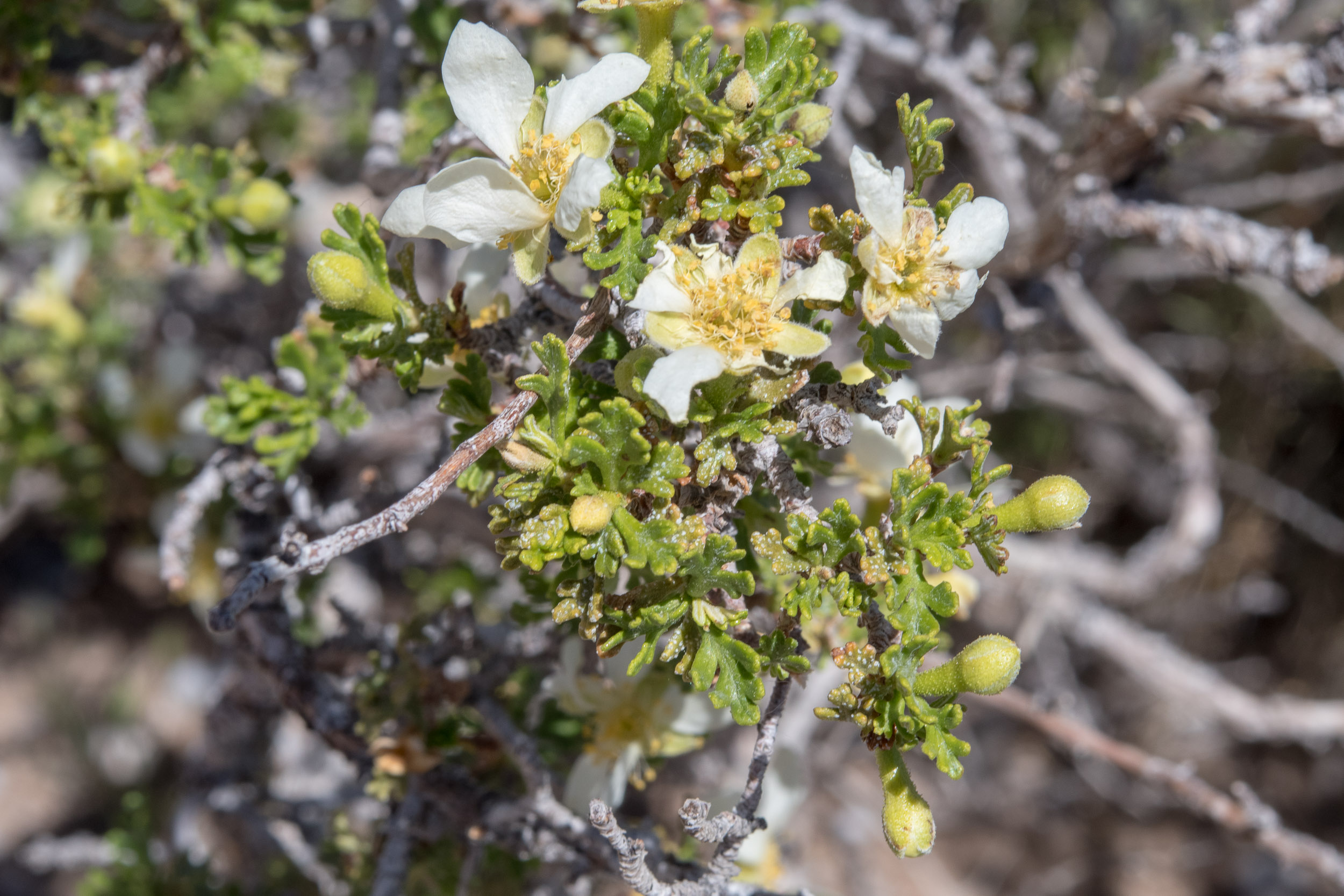
4/28/2018 · High Point Overlook, Scenic Drive, Red Rock Canyon, Nevada · ≈ 5 × 3½″ (13 × 9.2 cm) 

4/30/2018 · Kelbaker Road, Mojave National Preserve, California · ≈ 5 × 8″ (13 × 20 cm) 

4/28/2018 · Red Rock Canyon, Nevada · ≈ 14 × 10″ (36 × 26 cm) 

4/30/2018 · Kelbaker Road, Mojave National Preserve, California · ≈ 7 × 4½″ (18 × 12 cm) 
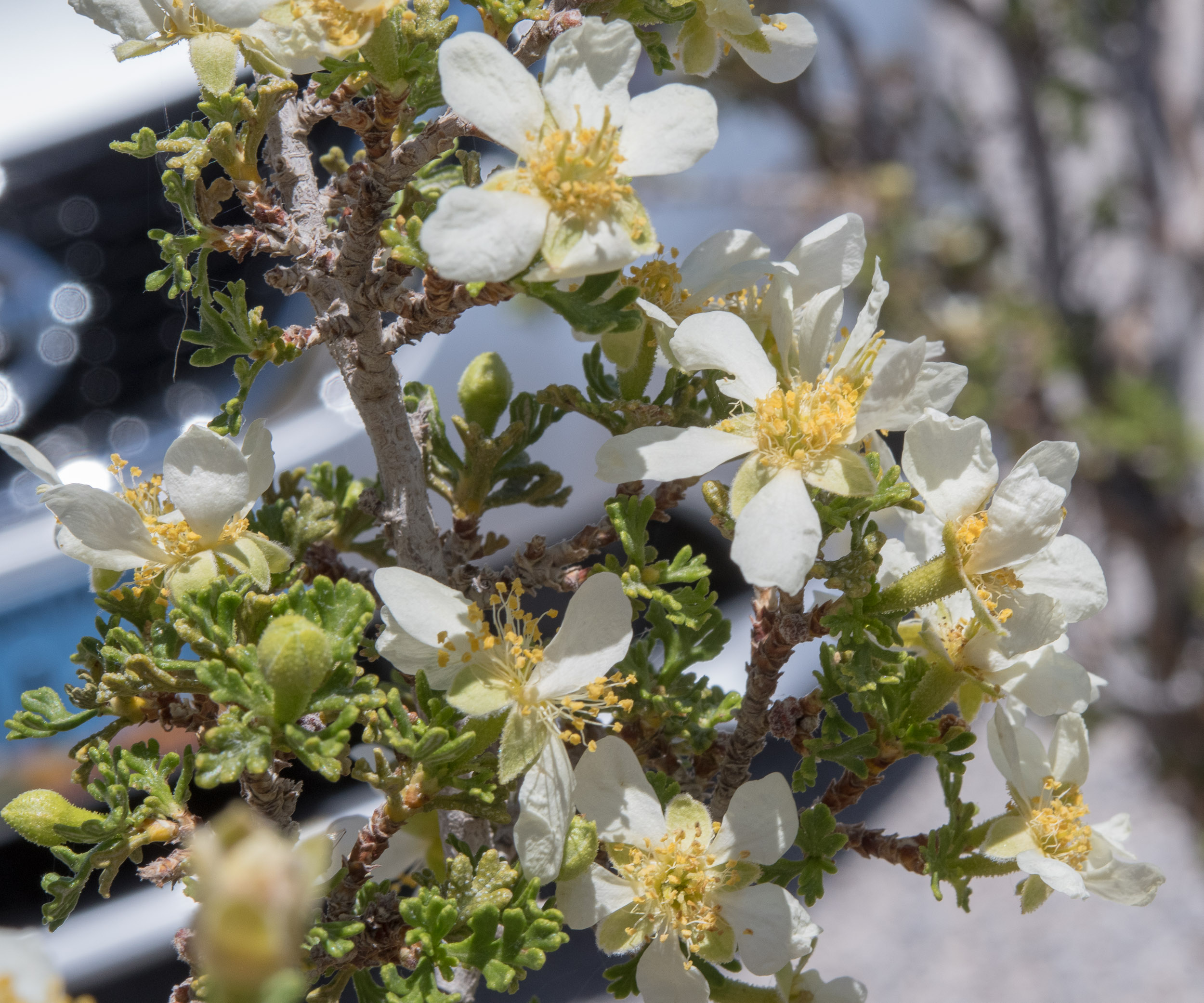
4/28/2018 · High Point Overlook, Scenic Drive, Red Rock Canyon, Nevada · ≈ 4 × 3½″ (11 × 9.2 cm) 

4/28/2018 · Red Rock Canyon, Nevada · ≈ 6 × 4″ (16 × 11 cm) 
| Kingdom | Plantae | Plants, but not fungi, lichens, or algae (from Stearn's Botanical Latin) |
| Subkingdom | Tracheobionta | Vascular plants—plants with a “circulatory system” for delivering water and nutrients |
| Division | Magnoliophyta | Flowering plants, also known as angiosperms |
| Class | Magnoliopsida | Dicotyledons—plants with two initial seed leaves |
| Subclass | Rosidae | Roses, legumes, proteas, dogwoods, hydrangeas, mistletoes, euphorbias, grapes, many more |
| Order | Rosales | Rose family and eight others |
| Family | Rosaceae | Includes apples, apricots, plums, cherries, peaches, pears, raspberries, strawberries, almonds, roses, meadowsweets, photinias, firethorns, rowans, and hawthorns; many others |
| Genus | Purshia | For Frederick Traugott Pursh (1774-1820), a Saxon explorer, plant collector, horticulturist and author |
| Species | tridentata | Three-toothed |
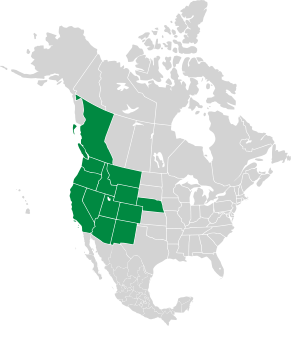
Purshia tridentata description by Thomas H. Kent, not updated.

© FloraFinder.org. All rights reserved.