Ranunculus ficaria L.
Lesser celandine, fig buttercup, pilewort, small celandine, lesser crowfoot, dusky maiden
Lesser celandine is native to Europe and western Asia. Introduced to North America, it has become naturalized here. It often carpets large areas. In many regions it is considered an invasive for its tendency to displace other vegetation, or because it poisons livestock.
Plants: Low-growing, 4–14″ (10–35 cm) in height. It is a perennial that stores energy in numerous white finger-like tubers.
Leaves: Leaves are thick, heart-shaped (cordate), spirally arranged, ¾–1½″ (1.9–3.8 cm), on long stems (petioles). Leaves are sometimes mottled with darker green patches.
Flowers: Flowers are up to 1″ (2.5 cm) around, with 7-12 glossy yellow petal-like tepals, and 3 sepal-like tepals (confused yet?). They appear as early as February, or, further north, from April-May.
Fruits: Achenes are spherical, up to ⅜″ (1.3 cm) around.
Habitats: Damp shady areas, and weedy places.
Edibility: Poisonous  Toxic to people, horses, cattle,
sheep, and probably other mammals.
Toxic to people, horses, cattle,
sheep, and probably other mammals.
 |
Somewhat similar species. |
Online References:
References:
Clemants, Steven; Gracie, Carol, Wildflowers in the Field and Forest, Oxford University Press, 2006, p. 216
Ficaria verna Huds.

4/8/2012 · North Central Railroad Trail, Monkton Rd, Sparks, Maryland · ≈ 1½ × 1′ (48 × 33 cm) 
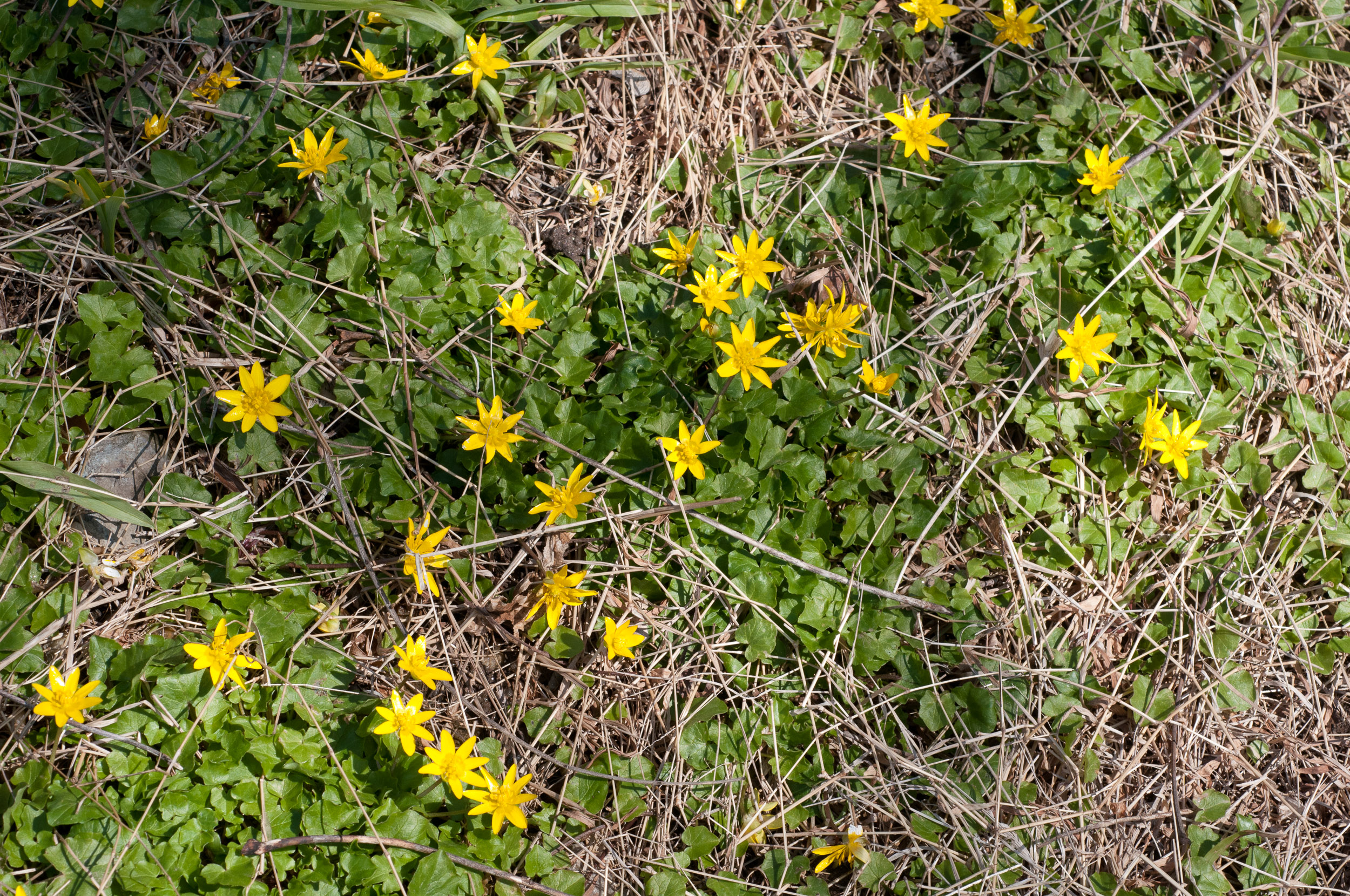
4/4/2011 · Oregon Ridge State Park, Timonium, Maryland · ≈ 1½ × 1′ (52 × 34 cm) 
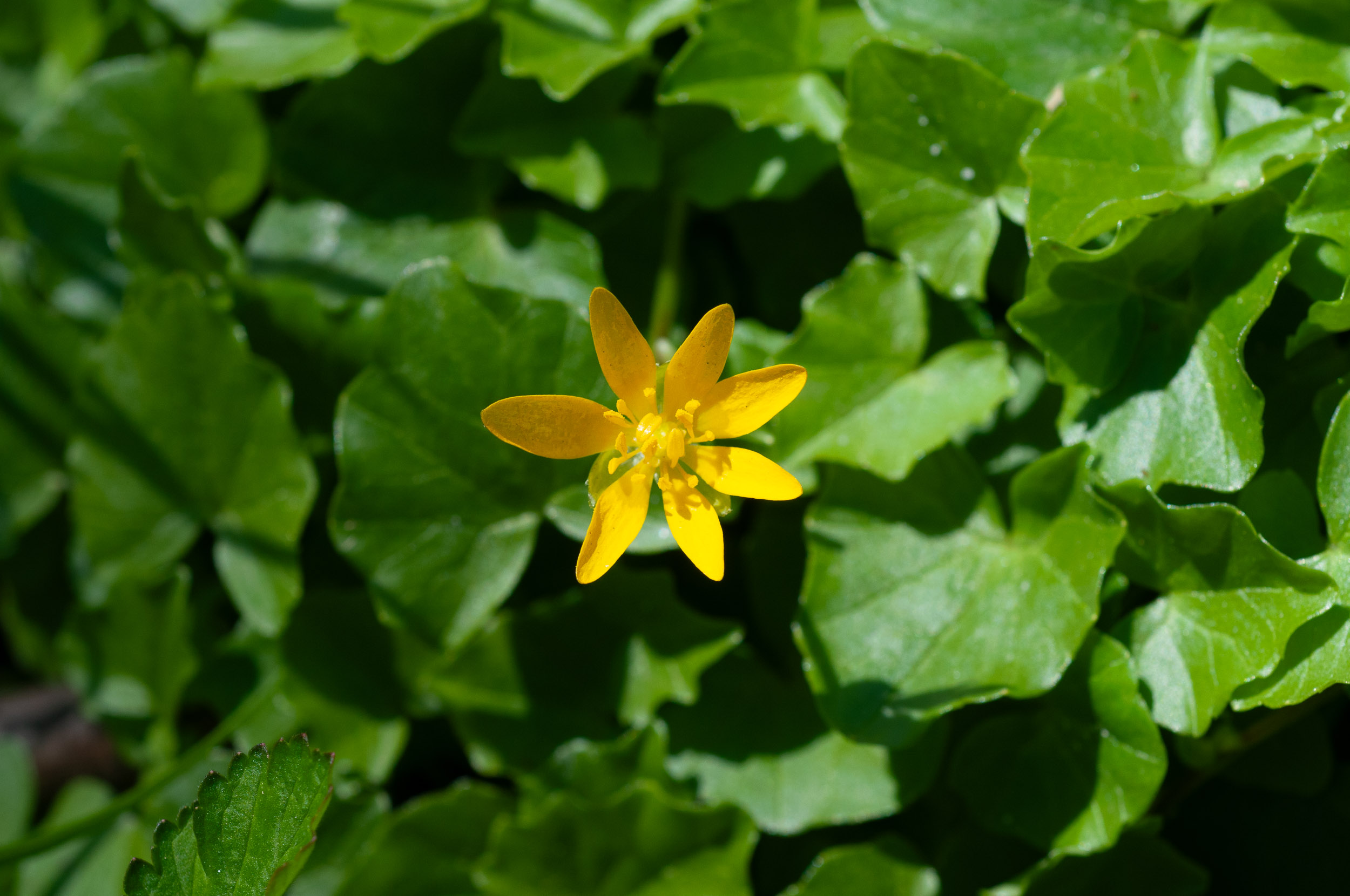
4/6/2012 · North Central Railroad Trail, Sparks, Maryland · ≈ 5 × 3½″ (13 × 9.2 cm) 

4/8/2012 · North Central Railroad Trail, Monkton Rd, Sparks, Maryland · ≈ 14 × 9″ (35 × 23 cm) 

4/4/2011 · Oregon Ridge State Park, Timonium, Maryland · ≈ 7 × 4½″ (17 × 11 cm) 

4/8/2012 · North Central Railroad Trail, Monkton Rd, Sparks, Maryland 
| Kingdom | Plantae | Plants, but not fungi, lichens, or algae (from Stearn's Botanical Latin) |
| Subkingdom | Tracheobionta | Vascular plants—plants with a “circulatory system” for delivering water and nutrients |
| Division | Magnoliophyta | Flowering plants, also known as angiosperms |
| Class | Magnoliopsida | Dicotyledons—plants with two initial seed leaves |
| Subclass | Magnoliidae | Includes magnolias, nutmeg, bay laurel, cinnamon, avocado, black pepper, and many others |
| Order | Ranunculales | Basal (evolved earlier) eudicots, also called “true dicots” |
| Family | Ranunculaceae | Buttercup family |
| Genus | Ranunculus | From Latin rana, “little frog,” because many species grow in moist places |
| Species | ficaria | From Latin rana, “little frog,” because these tend to grow in moist places |

Ranunculus ficaria description by Thomas H. Kent, not updated.

© FloraFinder.org. All rights reserved.