FloraFinder uses cookies only for correct operation. More info. Okay
Solidago gigantea Aiton
Smooth goldenrod, giant goldenrod
Giant goldenrod is a North American native. They are
fond of boundaries of wetlands and shaded floodplains.
For a comparison chart of some of the varieties of goldenrods, see
Solidago.
Plants: Plants are 3–7′ (91–213 cm) tall, erect.
Stems are light green
or pale purple, hairless, sometimes with a whitish waxy bloom. They occur in large patches.
Leaves: Narrow (lanceolate), ~3½ ⨉ ⅜–½″ (9.1–9.7 ⨉ 1–1.4 cm) (roughly equal
in size throughout the plant).
They are pointed at both ends, alternate, sessile, with sharp teeth and three veins.
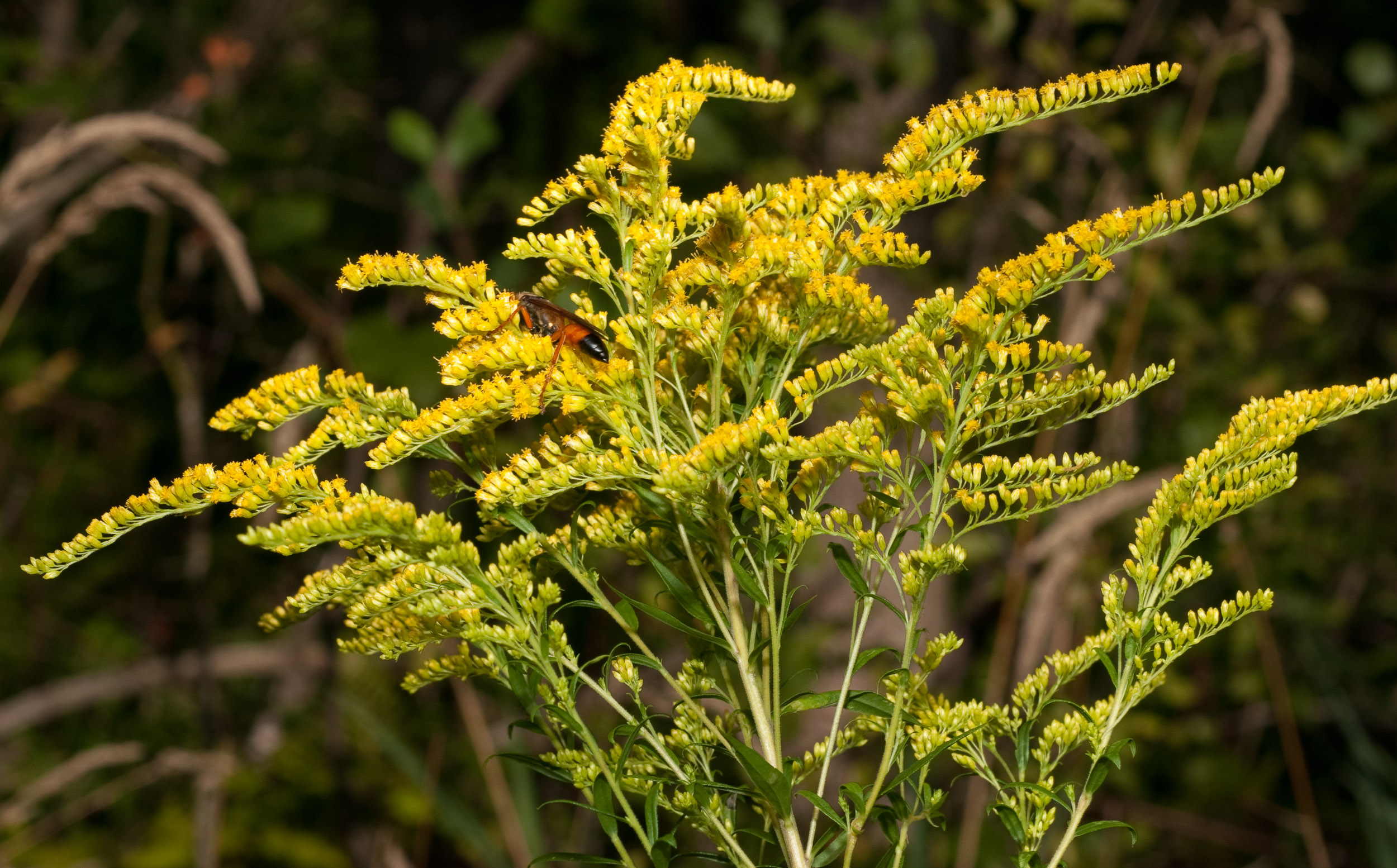
Flowers: Flowerheads may be tight and roughly conical,
but are often looser, composed of gently curved tiers of up to 600 small yellow flowers.
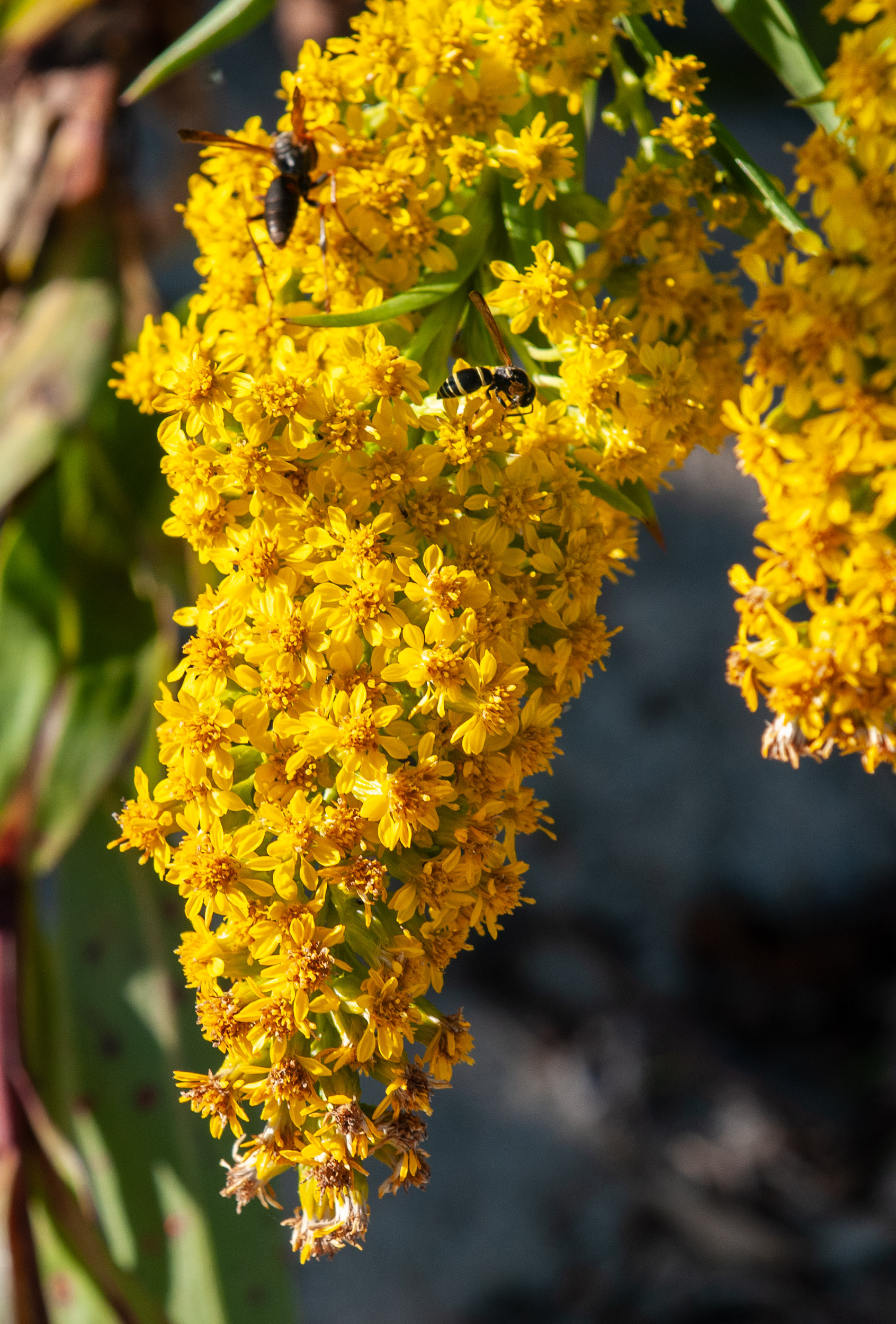
Each composite flower has 9-15 conspicuous ray florets and 7-12 disc florets.
Fruits: Flowers become small spherical arrangements of
seeds on “parachutes,” called cypselae, like dandilions gone to seed. The
cypselae are ~1/32″ (1.3–1.5 mm) in diameter.
Habitats: Boundaries of wetlands and shaded floodplains.
Aster latissimifolius (Mill.) Kuntze var. serotinus Kuntze Solidago gigantea Aiton var. leiophylla Fernald Solidago gigantea Aiton var. pitcheri (Nutt.) Shinners Solidago gigantea Aiton var. serotina (Kuntze) Cronquist Solidago gigantea Aiton ssp. serotina (Kuntze) McNeill Solidago gigantea Aiton var. shinnersii Beaudry Solidago ×leiophallax Friesner Solidago pitcheri Nutt. Solidago serotina Aiton, non Retz. Solidago serotinoides Á. Löve & D. Löve
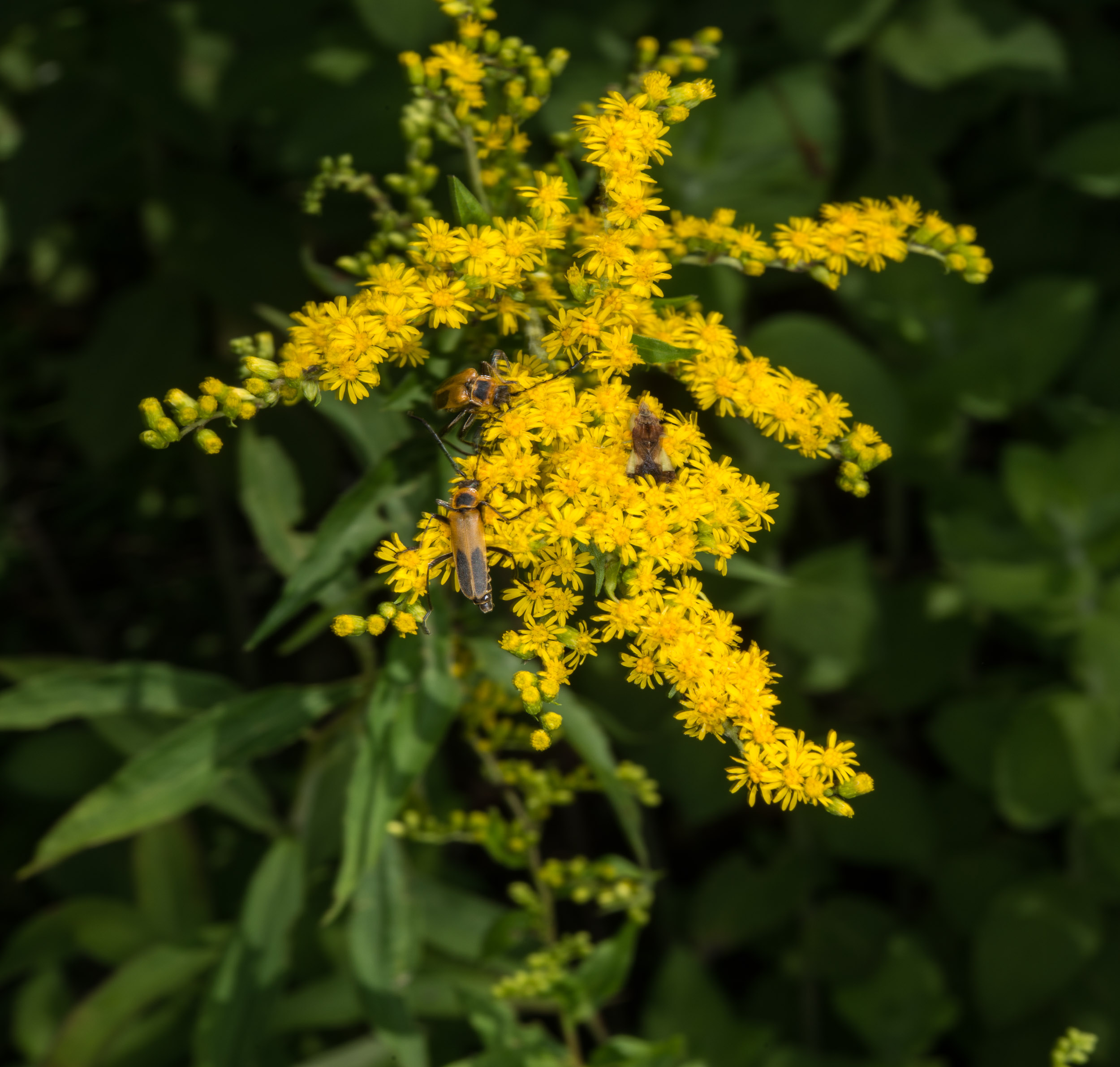
The beetles are goldenrod soldier beetles (Chauliognathus pensylvanicus), and they help pollinate the goldenrod · 8/14/2014 · Oak Hill, Littleton Conservation Land, Littleton, Massachusetts · ≈ 6 × 6″ (14 × 14 cm)
8/23/2013 · Andres Institute of Art, Big Bear Mountain, Brookline, New Hampshire · ≈ 5 × 5″ (12 × 12 cm) ID is uncertain
8/23/2013 · Andres Institute of Art, Big Bear Mountain, Brookline, New Hampshire · ≈ 7 × 4½″ (18 × 12 cm) ID is uncertain
8/11/2010 · Nashua River Rail Trail, Groton Center, Groton, Massachusetts · ≈ 10 × 6″ (26 × 16 cm) ID is uncertain
8/11/2010 · Nashua River Rail Trail, Groton Center, Groton, Massachusetts · ≈ 9 × 10″ (23 × 25 cm) ID is uncertain
Formed by a gall midge, probably Rhopalomyia capitata · 8/12/2017 · Bates Land and Blackman Land, Groton Conservation Trust, Groton, Massachusetts · ≈ 4 × 3″ (9.9 × 7.6 cm)


 ID is uncertain