Trifolium repens L.
White clover
White clover is native to Europe, northern Africa, and western Asia. It has been introduced to many other places as a pasture crop, including North America, where it is now abundant. White clovers are common in lawns. If you are battling them as weeds, you might want to reconsider, since they and other clovers trap nitrogen from the air, converting it to fertilizer. Clovers help lawns stay healthy.
Plants: Stems are 4–16″ (10–40 cm) long, but often lying on their sides, so these clovers are usually close to the ground.
Leaves: In groups of 3 as with all clovers. Leaflets are oval, ½–1¼″ (1.3–3.2 cm) long, with a slight indentation at the end. Each leaflet bears a pale green “V” close to the base, and slightly toothed leaf edges.
Flowers: On stalks 1–4″ (2.5–10 cm) long. Flowerheads are ½–1¼″ (1.3–3.2 cm) around, and rounded. Flowers are usually white, but may be quite pink.
Fruits: Dried seeds are 1/16–3/16″ (3–5 mm) long.
Habitats: Waste ground, pastures, open fields, roadsides, railroads.
Edibility: Boiled for five to ten minutes to improve digestibility, leaves may be added to salads or other dishes.
 |
Some clovers. |
Online References:
Trifolium repens L. var. atropurpureum hort.

6/14/2010 · Tom and Susan’s, Pepperell, Massachusetts · ≈ 7 × 4½″ (17 × 11 cm) 

6/14/2010 · Tom and Susan’s, Pepperell, Massachusetts · ≈ 3½ × 2½″ (9.8 × 6.6 cm) 

6/10/2005 · Pepperell, Massachusetts 

6/22/2010 · Nashua River Rail Trail, Ayer, Massachusetts · ≈ 4½ × 3½″ (12 × 9.8 cm) 
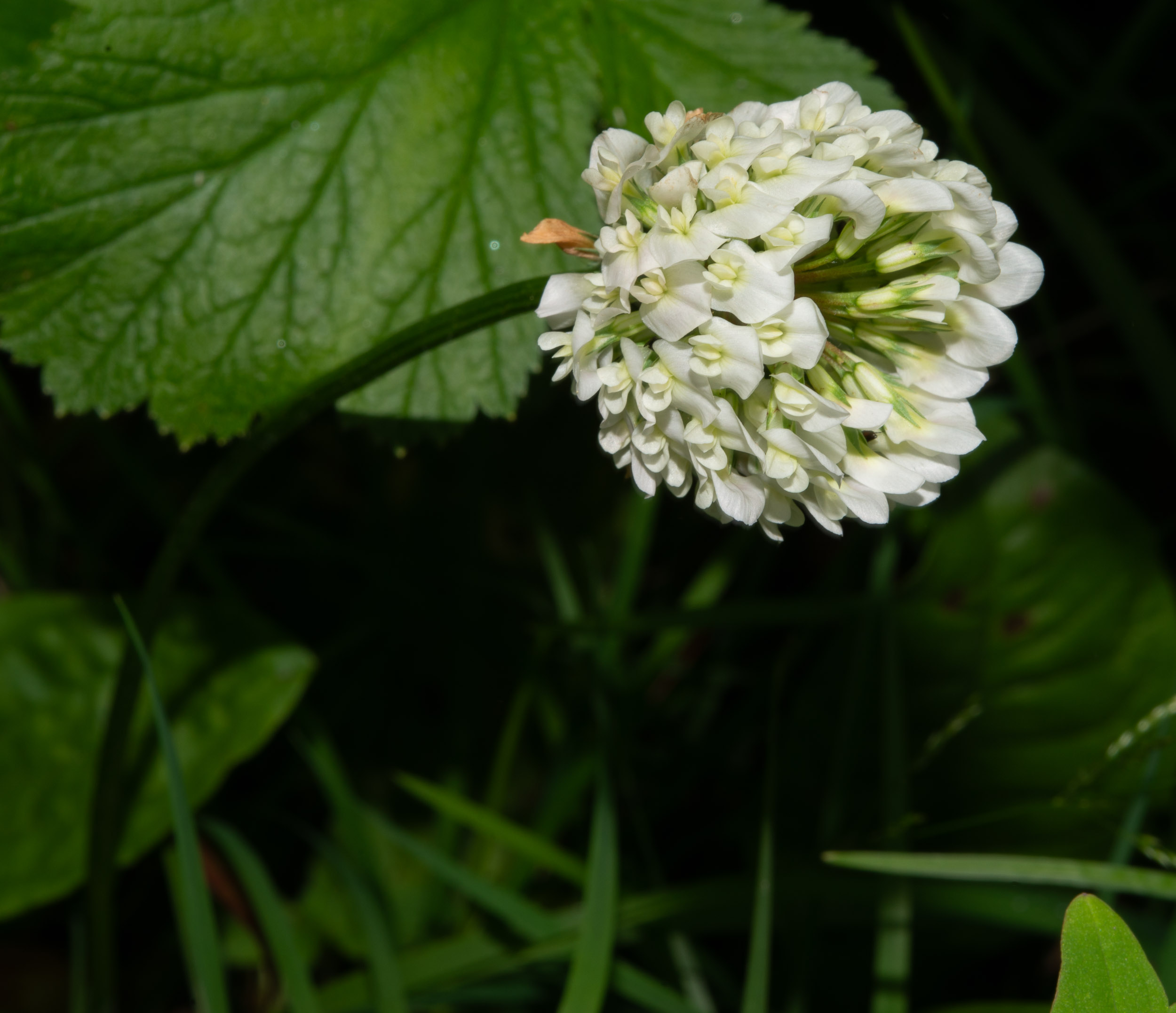
7/12/2015 · Smuggler’s Notch, Cambridge, Vermont · ≈ 4½ × 3½″ (11 × 9.6 cm) 

6/14/2010 · Tom and Susan’s, Pepperell, Massachusetts · ≈ 2 × 1¾″ (5.1 × 4.6 cm) 

6/14/2010 · Tom and Susan’s, Pepperell, Massachusetts · ≈ 3 × 3½″ (7.6 × 9.2 cm) 

6/14/2010 · Tom and Susan’s, Pepperell, Massachusetts · ≈ 6 × 4″ (15 × 10 cm) 
| Kingdom | Plantae | Plants, but not fungi, lichens, or algae (from Stearn's Botanical Latin) |
| Subkingdom | Tracheobionta | Vascular plants—plants with a “circulatory system” for delivering water and nutrients |
| Division | Magnoliophyta | Flowering plants, also known as angiosperms |
| Class | Magnoliopsida | Dicotyledons—plants with two initial seed leaves |
| Subclass | Rosidae | Roses, legumes, proteas, dogwoods, hydrangeas, mistletoes, euphorbias, grapes, many more |
| Order | Fabales | Legumes (pea and bean families) |
| Family | Fabaceae | Legume family (peas and beans) |
| Genus | Trifolium | “Three-leaved,” for the 3-leaf clusters |
| Species | repens | Having creeping and rooting stems |

Trifolium repens description by Thomas H. Kent, not updated.

© FloraFinder.org. All rights reserved.