Xylococcus bicolor Nutt.
Mission manzanita
Mission manzanita has a limited native range in California and Baja California, Mexico. There is speculation that this plant depends on grizzly bears, long gone from the region, to eat and distribute the seeds—the long-lived species may be on the decline.
Plants: This shrub reaches 9½′ (3 m) in height and about 6½′ (2 m) in diameter. Bark is gray at first, becoming reddish and somewhat peeling later.
Leaves: Narrow pointed ovals, dark green on top, light and feltlike on the bottom, curled downward.
Flowers: White to pink to yellowish at the open end, bell-shaped, ¼–⅜″ (8–10 mm) long.
Fruits: Hard reddish fruits ¼″ (6.3 mm) around, composed almost entirely of a large, hard seed.
Habitats: The California chaparral and woodlands and California coastal sage and chaparral ecoregions. It grows at elevations below 3,500 feet.
Online References:
Arctostaphylos bicolor (Nutt.) A. Gray
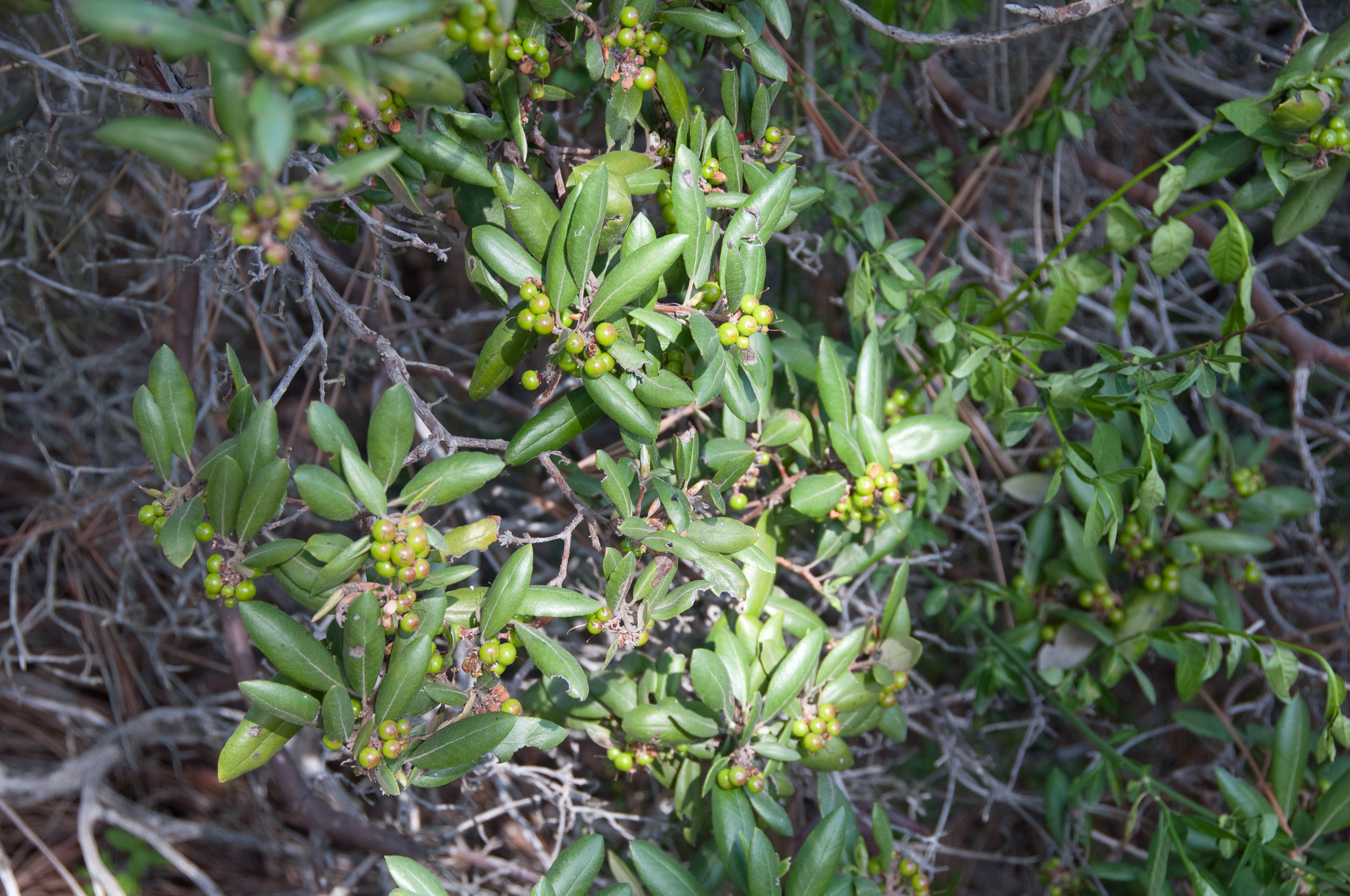
2/26/2010 · Torrey Pines State Natural Reserve, La Jolla, California · ≈ 1½ × 1′ (52 × 34 cm) 
| Kingdom | Plantae | Plants, but not fungi, lichens, or algae (from Stearn's Botanical Latin) |
| Subkingdom | Tracheobionta | Vascular plants—plants with a “circulatory system” for delivering water and nutrients |
| Division | Magnoliophyta | Flowering plants, also known as angiosperms |
| Class | Magnoliopsida | Dicotyledons—plants with two initial seed leaves |
| Subclass | Asteridae | A large class that encompasses asters |
| Order | Ericales | Tea, persimmon, blueberry, Brazil nut, azalea, many others |
| Family | Ericaceae | Heath or heather family |
| Genus | Xylococcus | From the Greek for “wood berry” |
| Species | bicolor | Named for the two-colored flowers |

Xylococcus bicolor description by Thomas H. Kent, not updated.

© FloraFinder.org. All rights reserved.