Carex flaccidula Steud.
Carex rosea Schkuhr ex Willd. var. pusilla Peck & Howe
Carex rosea Schkuhr ex Willd.
Rosy sedge
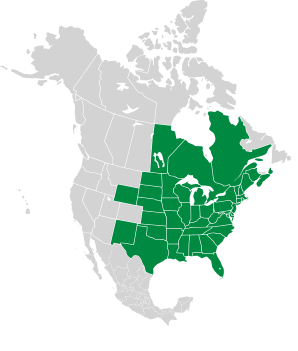
Rosy sedge is native to central and eastern North America.
|
Desperately Seeking Carex With close to 800 species in North America, and 2000 worldwide, many Carex species are difficult to identify. You might want to consult this quick guide to Carex anatomy. |
Plants: Dense clumps are up to 3′ (90 cm) tall.
Leaves: Smooth, hairless, up to 1′ ⨉ ~1/16″ (40 cm ⨉ 1.8–2.6 mm), with sheaths that tightly wrap around the stem. Young leaves have V-shaped cross sections.
Flowers: Inflorescences are ¾–2½ ⨉ ⅛–¼″ (2–7 cm ⨉ 5–8 mm), with four to eight spikes per stem. The spikes become more crowded toward the tip of the culm. The terminal spike has staminate (male) flowers at its tip, and pistillate (female) flowers at its base, making them androgynous. Lower spikes may be androgenous or entirely pistillate. There is a bristly bract at the base of each spike. There are 7-14 perigynia per spike, each narrowly oval in shape, and 1/16–⅛ ⨉ 1/32–1/16″ (2.6–4 ⨉ 1.1–1.8 mm) in size.
Fruits: Achenes are ~1/16″ (1.6–2.2 mm) long.
Habitats: Stream shores, bottomlands, ponds.
 |
Similar species. |
Online References:
References:

6/17/2025 · Devil’s Back, Orr’s Island, Maine 
| Kingdom | Plantae | Plants, but not fungi, lichens, or algae (from Stearn's Botanical Latin) |
| Subkingdom | Tracheobionta | Vascular plants—plants with a “circulatory system” for delivering water and nutrients |
| Division | Magnoliophyta | Flowering plants, also known as angiosperms |
| Class | Liliopsida | Monocots (plants with a single seed leaf); includes the lily family |
| Subclass | Commelinidae | Dayflowers and spiderworts, and several others |
| Order | Cyperales | Flowering plants including grasses |
| Family | Cyperaceae | Sedge family |
| Genus | Carex | The “true” sedges |
| Species | rosea | Rosy-colored |
Carex rosea description by Thomas H. Kent, not updated.

© FloraFinder.org. All rights reserved.