Cereus senilis (Haworth) A. P. de Candolle 1828
Pilocereus senilis (Haworth) Lamaire 1839
Cephalocereus senilis (Haworth) Pfeiffer 1838
Bunny cactus, old man cactus, old man of Mexico, veijo, white Persian cat cactus
These cacti are natives of the Mexican states of Hidalgo and Guanajuato.
Plants: Forming tall columns up to 49′ (15 m) high, and branching only at the base, these cacti make an imposing statement. Columns contain 20-30 ribs, and are up to 12″ (30 cm) in diameter. Fine white spines in groups of 20-30, are 2–4½″ (6–12 cm) long. In addition, pseudocephalia resembling very fine dense white hair appears initially on one side, then covering the entire top of each column—hence the name “old man cactus.” These hairs help to shield the cactus from the heat. (There is another old man cactus too though.
Flowers: Funnel-shaped flowers 2½–3½″ (7–9 cm) around are pink, tinged with yellow.
Fruits: Roughly oval, ⅞–1″ (2.5–3 cm) around.
Habitats: Limestone hiils of Hidalgo and Guanajuato.
References:
Online References:

2/24/2010 · San Diego (Quail) Botanic Garden, Encinitas, California 
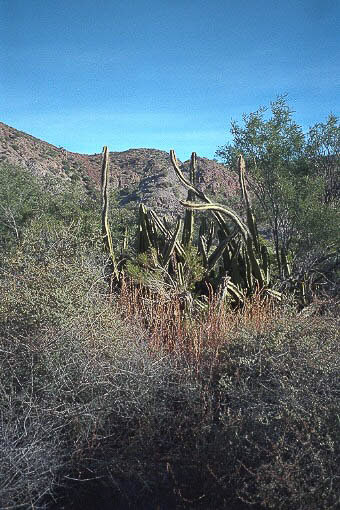
1/5/2026 · Islands in the Sea of Cortez, Mexico 
| Kingdom | Plantae | Plants, but not fungi, lichens, or algae (from Stearn's Botanical Latin) |
| Subkingdom | Tracheobionta | Vascular plants—plants with a “circulatory system” for delivering water and nutrients |
| Division | Magnoliophyta | Flowering plants, also known as angiosperms |
| Class | Magnoliopsida | Dicotyledons—plants with two initial seed leaves |
| Subclass | Caryophyllidae | Cacti, many other succulents, carnivorous plants, and leadworts |
| Order | Caryophyllales | Includes cacti, carnations, amaranths, ice plants, and many carnivorous plants |
| Family | Cactaceae | Succulent (water-storing) plants, often spiny |
| Genus | Cephalocereus | From Greek kephale, “head,” and cereus, “waxy” (unconfirmed) |
| Species | senilis | “Old,” for the white hairs |
Cephalocereus senilis description by Thomas H. Kent, not updated.

© FloraFinder.org. All rights reserved.
