Corema conradii (Torr.) Torr. ex Loudon
Broom crowberry
Broom crowberry is a small evergreen perennial shrub. Its population is scattered, and often associated with pitch pine (Pinus rigida).
Plants: Up to 2′ (60 cm) high, forming scattered plants or sometimes dense stands. The habit is shrublike. Bark is gray to orange-red.
Leaves: Yellow-green, with linear needle-like leaves. Each leaf is up to 1/16–3/16 ⨉ ~1/32″ (3–6 ⨉ 0.5–0.8 mm), and has a leaf stalk. There are 2-4 leaves per node.
Flowers: Tiny, reddish or purplish sepals, appearing in April to August.
Fruits: Tiny gray drupes under 1/16″ (2 mm).
Habitats: Grasslands, sandplains and barrens, shrublands, thickets, and rocky plateaus such as hilltops.
 |
These unrelated species, both commonly called crowberries, are closely similar, and sometimes appear together—one might say that crowberries of a feather flock together. |
Edibility: Not edible.
Online References:
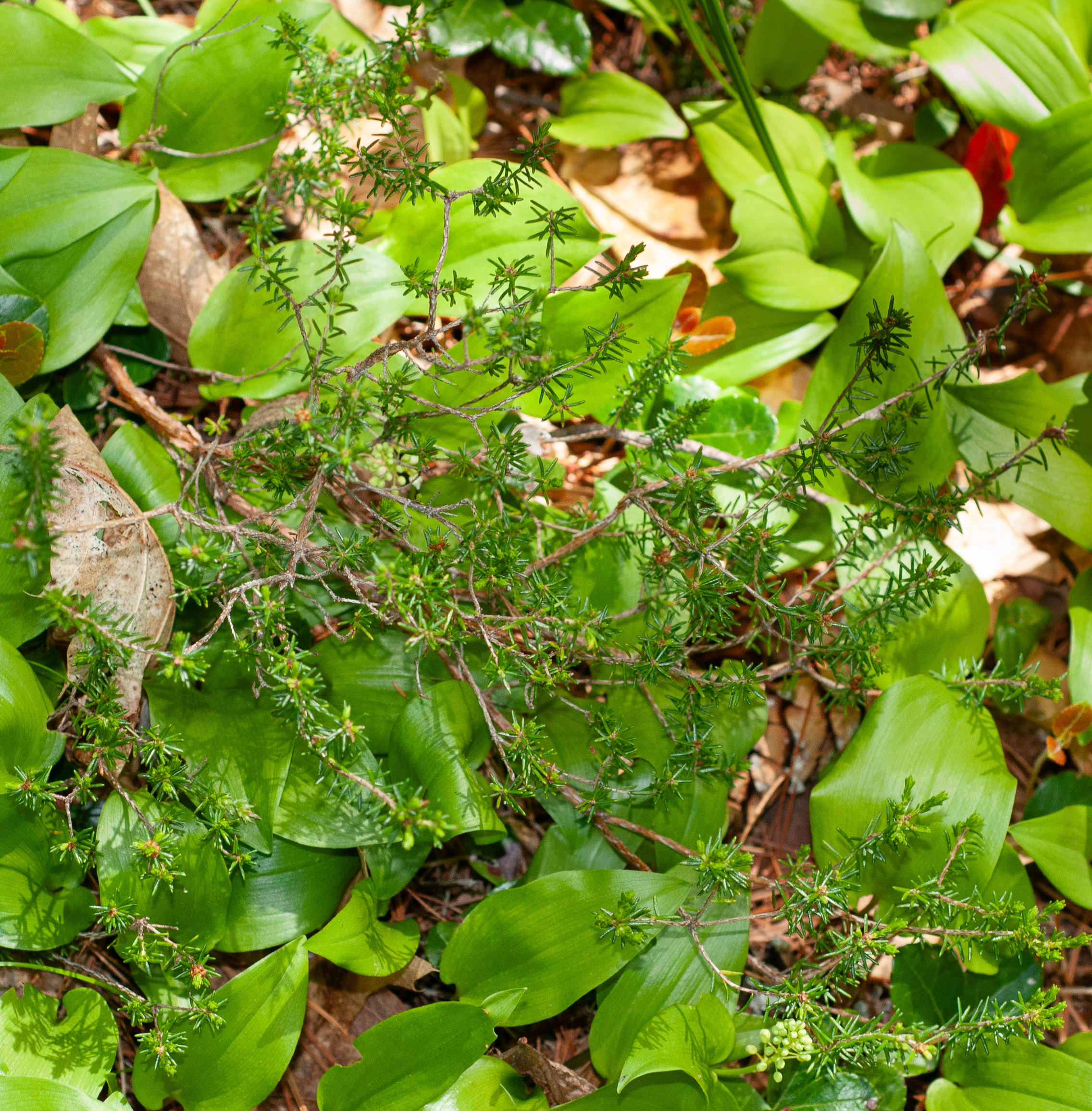
5/15/2010 · Garden in the Woods, Framingham, Massachusetts · ≈ 9 × 9″ (23 × 23 cm) 
| Kingdom | Plantae | Plants, but not fungi, lichens, or algae (from Stearn's Botanical Latin) |
| Subkingdom | Tracheobionta | Vascular plants—plants with a “circulatory system” for delivering water and nutrients |
| Division | Magnoliophyta | Flowering plants, also known as angiosperms |
| Class | Magnoliopsida | Dicotyledons—plants with two initial seed leaves |
| Subclass | Asteridae | A large class that encompasses asters |
| Order | Ericales | Tea, persimmon, blueberry, Brazil nut, azalea, many others |
| Family | Empetraceae | Heath or heather family, also includes cranberry, blueberry, huckleberry, azalea, rhododendron |
| Genus | Corema | From Greek, korema, “broom,” alluding to growth form |
| Species | conradii | For botanist and discoverer S. White Conrad (1779-1831) |
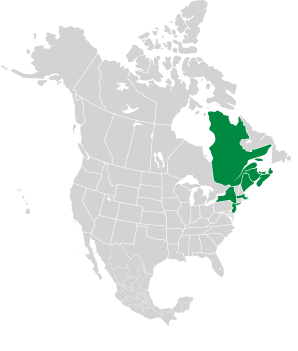
Corema conradii description by Thomas H. Kent, not updated.

© FloraFinder.org. All rights reserved.