Elymus macgregorii R. Brooks & J.J.N. Campb.
MacGregor’s wildrye, early wildrye
MacGregor’s wildrye is a fairly rare member of the wild-rye genus.
Some terms:
- A spike is the roughly cylindrical inflorescence of a grass.
- A spikelet is the structure, resembling a tiny ear of corn, that encloses the flower. Spikelets are often paired.
- A glume is the outer part of the “corn husk,” a pair of bracts that protect the flower.
- A lemma is the inner part of the “corn husk,” looking very much similar to the glume.
- An awn is a hairlike protuberance that extends from both glumes and and the lemmas.
- The floret is a tiny flower, usually appearing for a fairly brief period, hidden inside the “husk.”
Plants: These perennials appear in tufts. Stems are 1–4′ (40–120 cm) tall. Stem bases are green.
Leaves: There are 4-8 leaves per stem, each ¼–½″ (7–15 mm) wide. Leaf blades have shiny, smooth surfaces.
Flowers: Spikes are 1½–4½″ (4–12 cm) long,
and usually ¾–1″ (2.2–3 cm) wide, sometimes spread and much wider. Spikelets are
⅜–½″ (1–1.5 cm) long, excluding the awns. Usually there are two spikelets per
node, sometimes three. The glumes enclosing the flowers are ¼–⅝ ⨉ 1/32–1/16″ (8–16 ⨉ 1–1.8 mm) in size,
with awns that extend for another ½″ (1.5 cm) or more.
The lemmas that enclose the flowers are ⅛–⅜″ (6–12 mm) long,
with awns that are ¾–1″ (2–3 cm) long.
Each spikelet has 3-4 Florets, appearing mid-May to mid-June,
about 10 days earlier than E. virginicus.
Fruits: The seeds lie within the glumes. Habitats: Rich, mesic, rocky forests, floodplains,
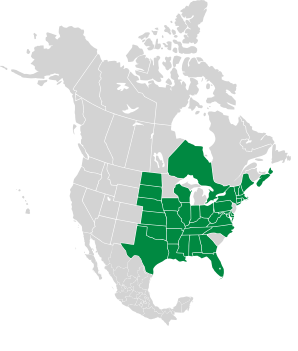
and riparian habitats. It is often found in the same habitats with, and hybridizes
with, E. virginicus and E. hystrix. Online References:
References:
7/26/2025 · River Point Conservation Area, Falmouth, Maine · ≈ 6 × 5″ (15 × 12 cm) Elymus macgregorii description by Thomas H. Kent, not updated. © FloraFinder.org. All rights reserved.

Similar species.


Kingdom Plantae Plants, but not fungi, lichens, or algae (from Stearn's Botanical Latin)
Subkingdom Tracheobionta Vascular plants—plants with a “circulatory system” for delivering water and nutrients
Division Magnoliophyta Flowering plants, also known as angiosperms
Class Liliopsida Monocots (plants with a single seed leaf); includes the lily family
Subclass Commelinidae Dayflowers and spiderworts, and several others
Order Cyperales Flowering plants including grasses
Family Poaceae Grasses (but not sedges or rushes)
Genus Elymus From the Greek name elymos for “millet,” in turn from elyo, “to cover”
Species macgregorii For botanist John MacGregor