Haplopappus pluriflorus (Torr. & A. Gray) H.M. Hall
Isocoma wrightii (A. Gray) Rydb.
Isocoma pluriflora (Torr. & A. Gray) Greene
Jimmyweed, jimmy goldenweed, southern goldenbush
Jimmyweed is native to the southwestern United States and northern Mexico.
Plants: Herbaceous perennial subshrubs are 1–3½′ (30–106 cm) tall, with over 25 erect or ascending stems that are usually hairless.
Leaves: Alternate, light or dull green, linear, and ⅜–1¾″ long ⨉ 1/16–⅛″ wide (1–5 cm ⨉ 2–4 mm). Leaf axils often contain small leaflets.
Flowers: Inflorescences contain many flowerheads, each containing 8-17 disc florets and flat or rounded yellow-tipped phyllaries. Flowers appear from July to October.
Fruits: Cypselae.
Habitats: Creosote and mesquite communities. mesas and plains with saline, sandy, clay or alkaline soils, common along roadsides, at elevations of 3500–6500′ (1–2.0 km).
Edibility:  Roots are very toxic, and plant
juices can raise blisters.
Roots are very toxic, and plant
juices can raise blisters.
 |
Similar species. |
Online References:

8/27/2014 · Rio Grande Nature Center, Albuquerque, New Mexico · ≈ 11 × 7″ (28 × 18 cm) 
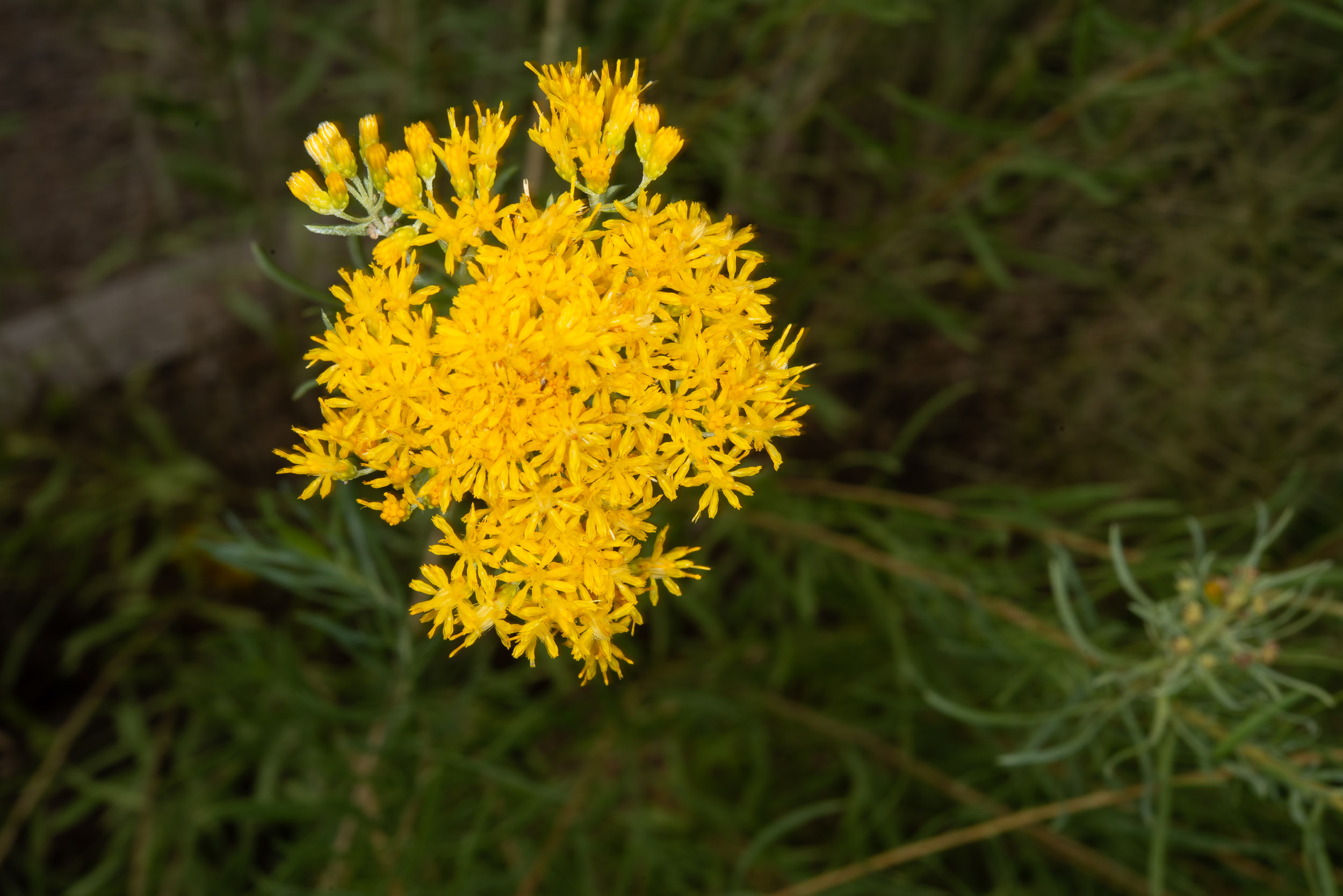
8/27/2014 · Rio Grande Nature Center, Albuquerque, New Mexico · ≈ 8 × 6″ (20 × 14 cm) 

8/27/2014 · Rio Grande Nature Center, Albuquerque, New Mexico · ≈ 9 × 6″ (23 × 15 cm) 
| Kingdom | Plantae | Plants, but not fungi, lichens, or algae (from Stearn's Botanical Latin) |
| Subkingdom | Tracheobionta | Vascular plants—plants with a “circulatory system” for delivering water and nutrients |
| Division | Magnoliophyta | Flowering plants, also known as angiosperms |
| Class | Magnoliopsida | Dicotyledons—plants with two initial seed leaves |
| Subclass | Asteridae | A large class that encompasses asters |
| Order | Asterales | Flowering plants with a central disk flower and surrounding petals, like daisies |
| Family | Asteraceae | The aster family, which also includes daisies and sunflowers; from the Greek ἀστήρ, “star,” for the star-shaped flowers |
| Genus | Isocoma | From the Greek meaning “an equal hair-tuft,” and referring to the flowers |
| Species | pluriflora | Many-flowered |
Isocoma pluriflora description by Thomas H. Kent, not updated.

© FloraFinder.org. All rights reserved.
