Laetiporus conifericola Burds. & Banik 2001
Sulphur shelf, chicken of the woods, chicken mushroom, chicken fungus
Laetiporus, meaning “bright spores,” is native to North America and Europe. Until DNA tests recently proved this to be a distinct species, Laetiporus conifericola was thought to be Laetiporus sulphureus. But this mushroom is found on the west coast, while L. sulphureus is found in the east.
Identification: Sulphur shelf is so brightly colored that it is hard to miss, and hard to confuse with other species. It is a bracket fungus, meaning that it grows from the sides of trees. It inhabits cone-bearing trees, and is composed of many horizontal layers called shelves, each 2½–22″ (7–55 cm) wide. It is yellow to orange, and lacks gills. It makes a white spore print. This mushroom is easily confused with Laetiporus gilbertsonii. The main distinction is that L. gilbertsonii grows on oaks and eucalyptus trees, while L. conifericola grows on cone-bearing trees.
Habitats: On conifers, especially fir, spruce and hemlock, in western North America.
Edibility: Not edible. Sour-tasting and indigestible, causing nausea, dizziness, and possibly hallucinations. Its close cousin, Laetiporus gilbertsonii, is generally considered edible, but some people don’t respond well to it.
 |
Some sulfur shelf mushrooms. |
Online References:
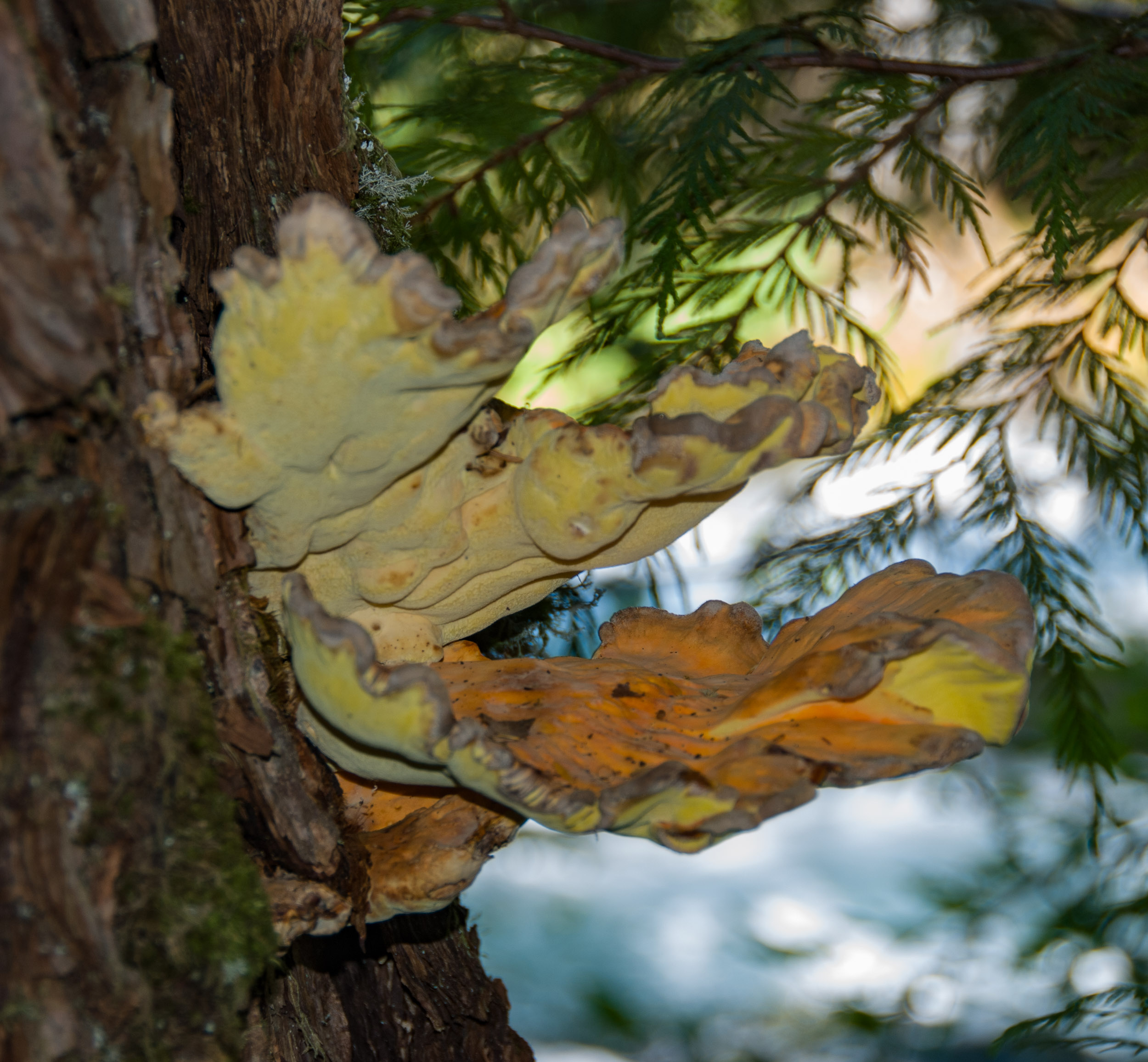
8/30/2007 · Sahalie Falls, Oregon  ID is uncertain
| Roughly 75 people in North America are poisoned each year by mushrooms, often from eating a poisonous species that resembles an edible species. Though deaths are rare, there is no cure short of a liver transplant for severe poisoning. Don’t eat any mushroom unless you are absolutely certain of its identity! Please don’t trust the identifications on this site. We aren’t mushroom experts and we haven’t focused on safely identifying edible species. |
Laetiporus conifericola description by Thomas H. Kent, not updated.

© FloraFinder.org. All rights reserved.