Mycoblastus sanguinarius (L.) Norman
Bloody heart lichen, blood lichen
Identification: Grayish white or grayish green, with tiny gray “warts.” Occurs on the wood or bark of deciduous trees. This is a crustose lichen (a thin layer that almost looks like paint), but thicker than most. The apothecia (fruiting bodies) are shiny black dots less than ⅛″ (3.2 mm) across. There is a bright red zone underneath (the reason for the name “bloody heart lichen”), but you’ll need to slice into it to see it. (I don’t know what the red-brown region is on the photo—I don’t think it is part of the lichen.)
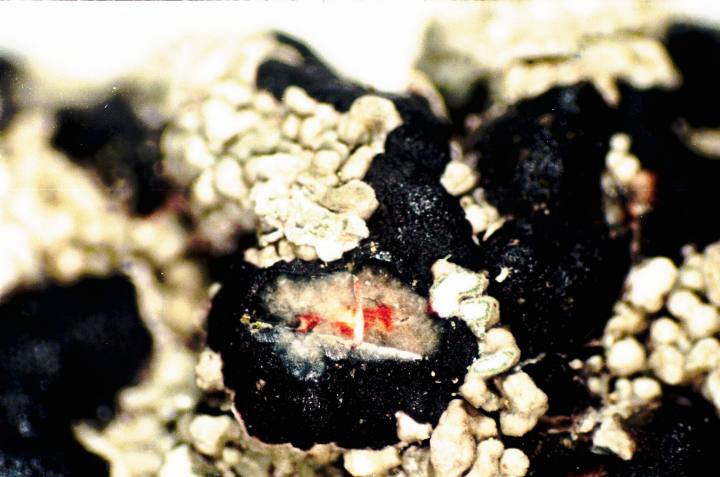
Photograph of a herbarium specimen taken through a dissecting microscope (x8) shows a bright red pigment in a cut apothecium.
M. sanguinarius was growing on a dead branch along the trail up Black Mountain, S of Tunk Lake, NE of Ellsworth, Hancock County, Maine, USA (44o35’ N., 68o06’ W); collected by E.C. Uebel, identified by Dr. Irwin Brodo (No. U-515, 11 Jul 2005). 
Online References:
References:

1 · 4/3/2010 · Birch Point Beach State Park, Owl’s Head, Maine · ≈ 4 × 6″ (10 × 15 cm)  ID is uncertain
| Kingdom | Fungi | Mushrooms, lichens, gel fungi, yeasts, and molds; also called eukaryotes |
| Division | Ascomycota | Sac fungi |
| Subdivision | Pezizomycotina | Sac fungi with filaments |
| Class | Lecanoromycetes | “Lichenized” fungi |
| Order | Lecanorales | Mostly lichen-forming fungi |
| Suborder | Lecanorineae | Lichens |
| Family | Mycoblastaceae | A family of ascomycete fungi |
| Genus | Mycoblastus | A genus of crostose lichens commonly called blood lichens |
| Species | sanguinarius | Blood red |
Mycoblastus sanguinarius description by Thomas H. Kent, not updated.

© FloraFinder.org. All rights reserved.