Parkinsonia aculeata L.
Mexican palo verde, espinillo, palo verde, Parkinsonia, Jerusalem thorn, jelly bean tree, palo de rayo, retama
Some palo verdes
Parkinsonia aculeata
Parkinsonia florida
Parkinsonia microphylla




|
Parkinsonia aculeata L. Mexican palo verde, espinillo, palo verde, Parkinsonia, Jerusalem thorn, jelly bean tree, palo de rayo, retama Some palo verdes | |||
| You are here Parkinsonia aculeata |
Parkinsonia florida |
Parkinsonia microphylla |
|
|---|---|---|---|
| Common Name | |
|
|
| Plant | A spiny shrub or small tree, 6½–26′ (2–8 m) tall, singly or multiply stemmed. Branches are zigzagged, with pairs or triplets of spines ¼–⅜″ (7–12 mm) long at each branch node. Trunks and branches are smooth and green, becoming scaly as the tree ages. It can form impenetrable thickets, and it is considered weedy or invasive in many areas. | 15–30′ (4.6–9.1 m). Trunk and branches are bluish green, photosynthetic. | The most notable difference between this palo verde and blue palo verde is the trunk and branch color. Foothills palo verde is yellow-green, vs. a bluish cast to blue palo verde. The trunk and branches are irregularly shaped, and have thorns. Trees are 12–18′ (3.7–5.5 m) high, with several major stems. |
| Leaves | Straplike, hanging petioles are flattened, 6–8″ (15–20 cm) long, with tiny elliptic leaflets spread out in two rows along the petioles. Leaflets are in one to three pairs. Petioles and leaflets are hairless. The branches and petioles are both photosynthetic, and the tree is drought deciduous, dropping the small leaves during summer to conserve water. | Bipinnate, with leaflets ⅛–¼″ (3.2–6.3 mm) long; often leafless. | Compound and pinnate, 1″ (2.5 cm) long, with tiny round leaflets. Trees are drought deciduous, dropping leaves during droughts to reduce water loss. They are even “branch deciduous,” dropping some branches if needed. |
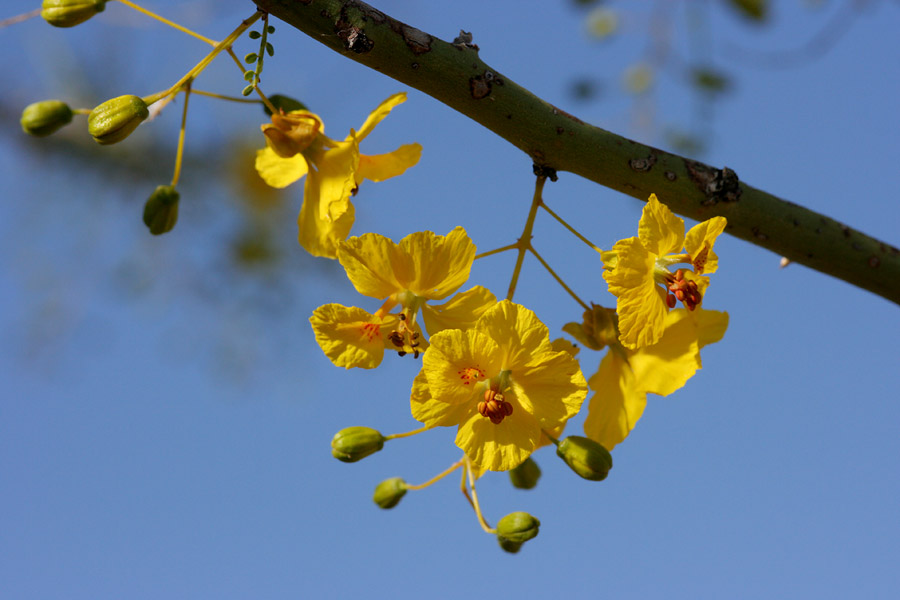
| Flowers | Yellow-orange, fragrant, in groups of 8-10. Each flower is ¾″ (2 cm) around, with five sepals and five petals. Most of the petals are similar in shape, but the bottom one is elongated, with red dots, and becomes entirely red with age. Flowers appear from March to April and from September to October. |
|
|
| Fruit | Leathery light brown seedpods are up to 4″ (10 cm), containing multiple seeds. | A flat pod with one or more seeds, brown, turning white with age, up to 3″ (7.6 cm) long. | Pods 1½–3″ (4–8 cm) long contain one to five seeds. |
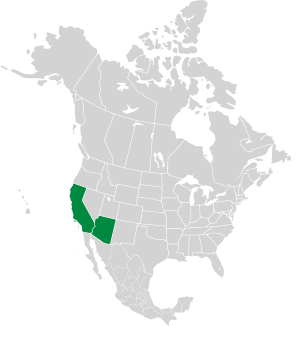
| Range/ Zones |
|
|
|
| Habitats | Semi arid, but moist habitats. It is found in grasslands, woodlands, disturbed habitats, and wastelands. It is salt tolerant, hence found in coastal habitats. | Creosote bush scrub, below 3600′ (1.1 km) | Common in the Mohave and Sonoran deserts of Arizona, California, and Baja Mexico; at up to 4000′ (1.2 km). |
Parkinsonia aculeata description by Thomas H. Kent, not updated.
© FloraFinder.org. All rights reserved.