Setaria faberi Herrm.
Giant foxtail, Japanese bristlegrass
Giant foxtail is not native to North America, but it is now widespread. In some states it is considered an invasive species because it competes with several crops.
Plants: 2–5′ (60–152 cm) tall, with multiple stems.
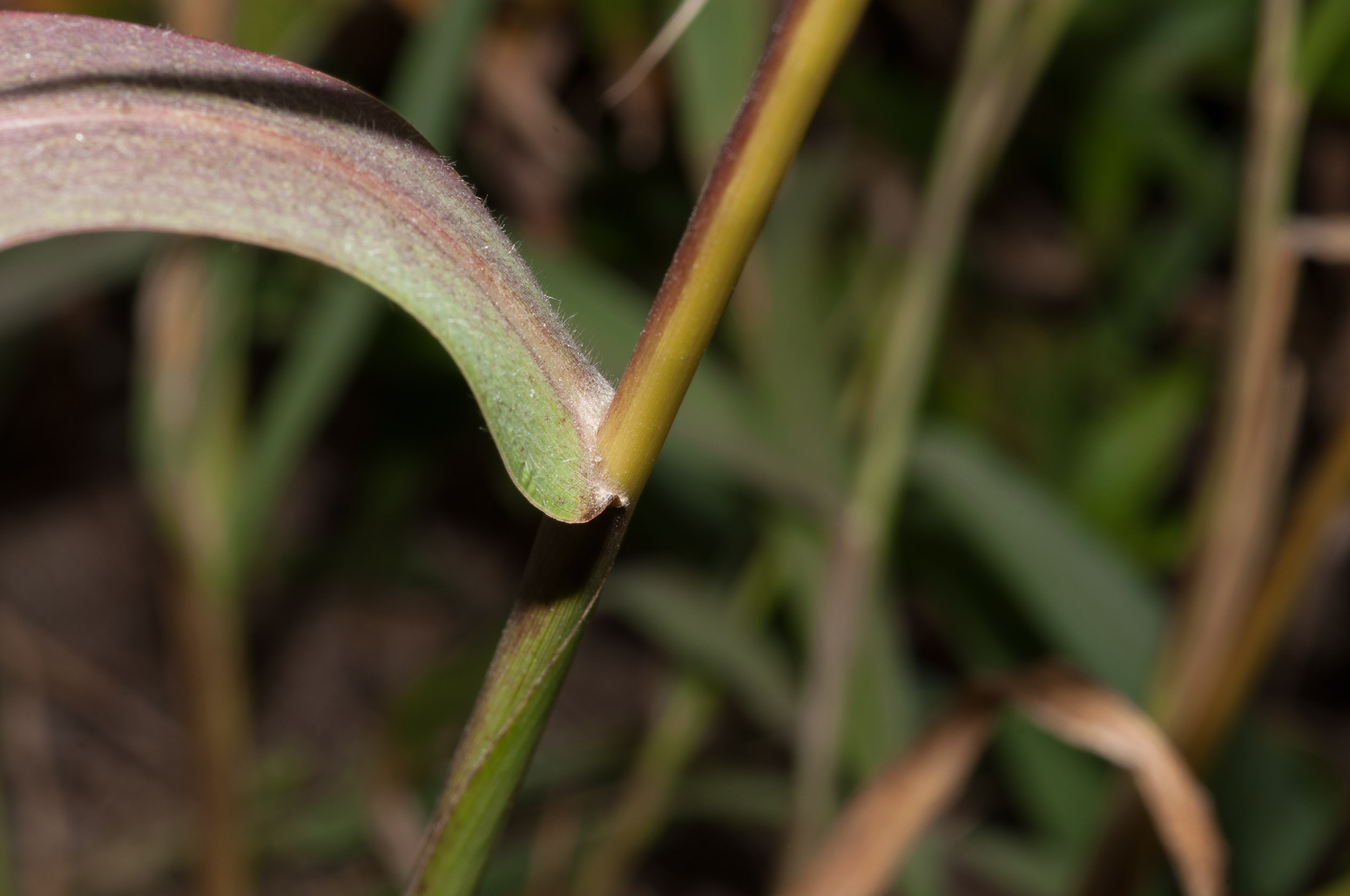
Leaves: Grass blades are alternate, reaching up to 1′ (38 cm) long and ¾″ (1.9 cm) wide. They are not very stiff, often drooping. Upper leaf surfaces usually have scattered fine, stiff, bristled hairs, but they may also be smooth. Leaf blade edges have tiny teeth that make them feel rough. At the base of each grass blade, just above where it connects to the stem, there is a ringlike tuft of white hairs up to ⅛″ (3 mm) long.
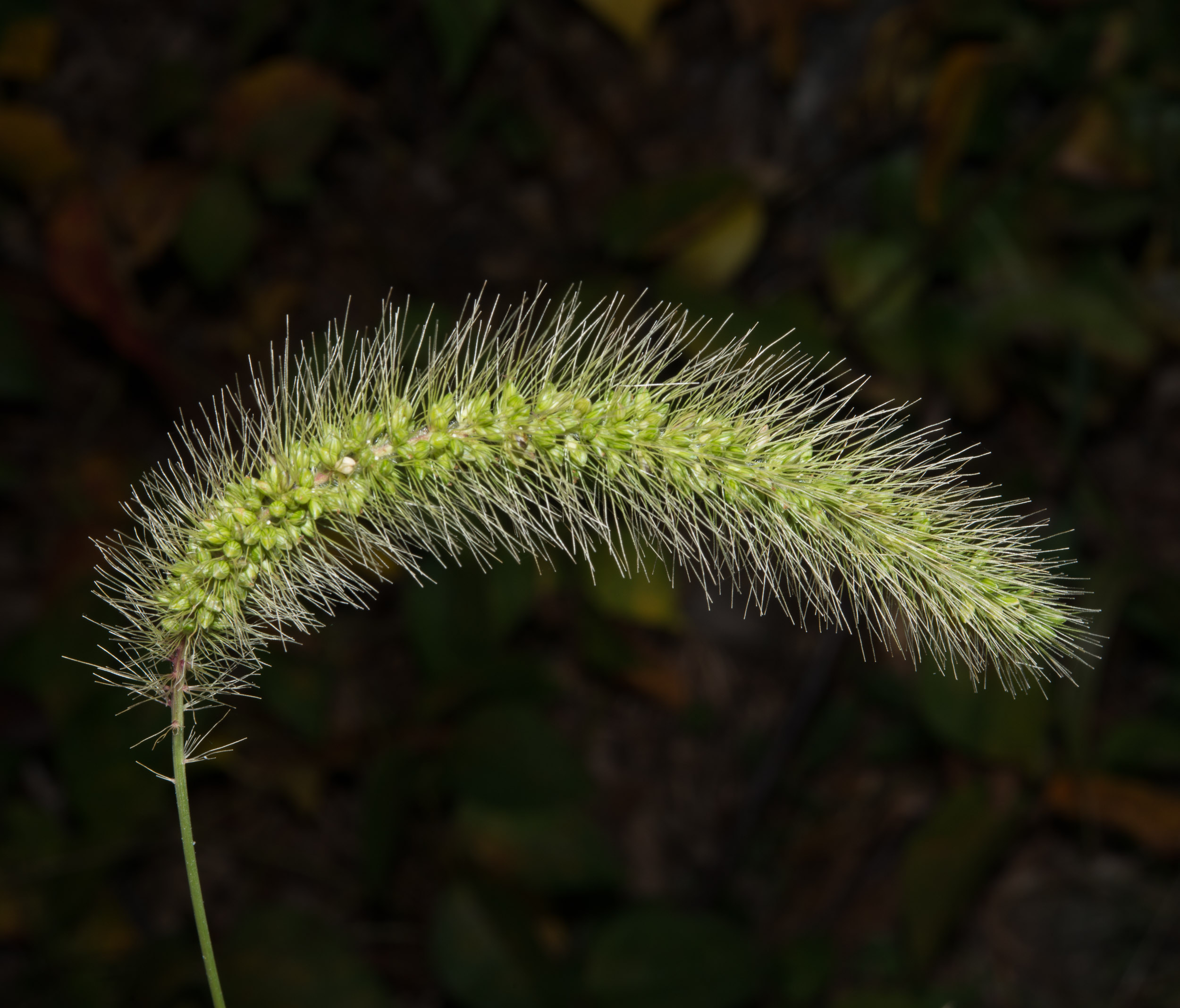
Flowers: Stem tops have a panicle—the “foxtail”—up to 7″ (17 cm) long. Bristly and usually somewhat bent under its own weight, the flowerheads are initially green, becoming light brown over time.
Fruits: Lemmas are egg-shaped, and 1/16–⅛″ (2–3 mm) long.
Habitats: Meadows, fields, landfills, mined land, construction sites, vacant lots, yard boundaries, gardens, railroads, roadsides, and waste land.
 |
Some foxtails. |
Online References:
References:
Uva, Richard H.; Neal, Joseph C.; DiTomaso, Joseph M., Weeds of the Northeast, Comstock Publishing Associates, 1997, p. 82 (good comparison between giant
Unknown Reference!

9/19/2013 · Harvard, Massachusetts · ≈ 8 × 6″ (20 × 14 cm) 
9/19/2013 · Harvard, Massachusetts · ≈ 6 × 5″ (15 × 12 cm) 
9/24/2010 · Nissitissit River Wildlife Management Area, Pepperell, Massachusetts · ≈ 4½ × 3″ (11 × 7.9 cm)  ID is uncertain

9/19/2013 · Harvard, Massachusetts · ≈ 6 × 8″ (14 × 20 cm) 

9/19/2013 · Harvard, Massachusetts · ≈ 8 × 6″ (20 × 14 cm) 

9/19/2013 · Harvard, Massachusetts · ≈ 6 × 8″ (14 × 20 cm) 

9/24/2010 · Nissitissit River Wildlife Management Area, Pepperell, Massachusetts · ≈ 8 × 5″ (19 × 13 cm) ID is uncertain 

9/24/2010 · Nissitissit River Wildlife Management Area, Pepperell, Massachusetts · ≈ 5 × 3½″ (13 × 9.2 cm) ID is uncertain 
| Kingdom | Plantae | Plants, but not fungi, lichens, or algae (from Stearn's Botanical Latin) |
| Subkingdom | Tracheobionta | Vascular plants—plants with a “circulatory system” for delivering water and nutrients |
| Division | Magnoliophyta | Flowering plants, also known as angiosperms |
| Class | Liliopsida | Monocots (plants with a single seed leaf); includes the lily family |
| Subclass | Commelinidae | Dayflowers and spiderworts, and several others |
| Order | Cyperales | Flowering plants including grasses |
| Family | Poaceae | Grasses (but not sedges or rushes) |
| Genus | Setaria | From Latin saeta, “a bristle or hair,” for the bristly spikelets |
| Species | faberi | After Ernst Faber (1839-1899), a German missionary, writer on Confucius and plant collector in China, author of An Introduction to Chinese Religious Studies and German Daoism and Historical Nature of Daoism |

Setaria faberi description by Thomas H. Kent, not updated.

© FloraFinder.org. All rights reserved.