Opposite, elliptic to broad-ovate, with smooth edges. They are ⅞–3″ (2.5–7.5 cm) long, and dull blue-green to dark green.
Opposite, roughly oval-shaped, with smooth edges. Younger leaves may have lobes.
Flowers
Tubular yellow or pale yellow flowers are twinned, hanging side-by-side like two funnel-shaped bells. Each flower has five flaring, triangular lobes, five pale yellow stamens and a yellow style. Each flower is ½–¾″ (1.3–1.9 cm) long. They appear from April to June.
Blooms are a creamy white color, in pairs, appearing in March-April, and very fragrant, with a lemony smell. Each flower is ⅜″ (1 cm) in size.
Flowers are white, showy, fragrant, about 1″ (2.5 cm) in size. They fade to a yellow color, so the vine appears to have white and yellow flowers
Fruit
Fruits are pairs of bright red berries, each about ¼–5/16″ (6.3–8.5 mm) long, shaped like two rounded cones, and joined at the bases. I don’t think there is any other fruit that resembles these. Each fruit contains several seeds.
Orange to red berries ⅛–¼″ (6–8 mm) around.
Black, about ⅛″ (3.2 mm) around.
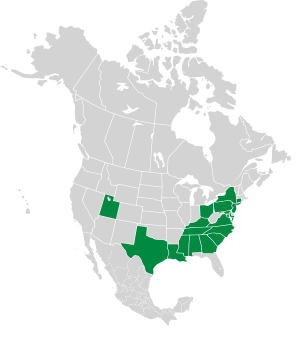
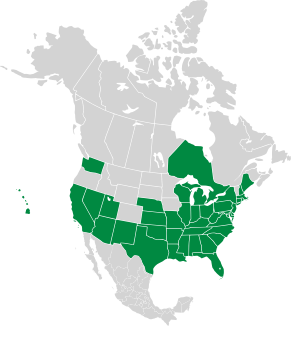
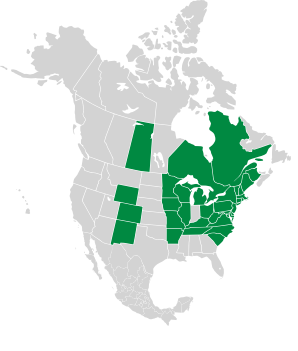
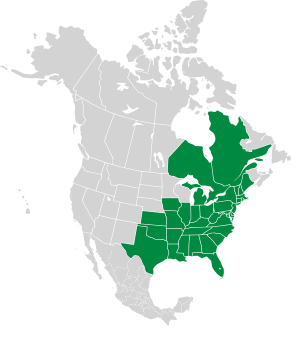
Range/ Zones
USDA Zones: 3-7
USDA Zones: 4-8
USDA Zones: 5a-8b
Habitats
Dry to moist upland woods, and occasionally in coniferous swamps and growing along streams.
Woodlands, fields, and most disturbed sites.
Disturbed areas, such as roadsides and floodplains. It spreads more slowly in forested areas.
Deciduous shrubs are up to 20′ (6 m) in size. Mature stems contain a hollow white or tan pith. Bark is deeply fissured and exfoliating, often peeling.
Deciduous shrubs are 6½–8′ (2–2.5 m) in size. Stems are hollow.
Trumpet honeysuckle is a twining vine 3–20′ (91–609 cm) long, depending upon what it has to climb over. Bark is orange-brown, and peeling.
Leaves
Opposite, medium to dark green, ⅞–3½ ⨉ ¾–1½″ (2.5–9 ⨉ 2–4 cm), lanceolate to ovate, with smooth edges and at least some rough-feeling hairs.
Opposite, simple, narrowly ovate to oblong-elliptic. They are ⅞–1¾″ (2.5–5 cm) long, have blunt or pointed tips, with hairy undersides.
Roughly oval in shape, opposite, bluish green, and 1–3″ (2.5–7.6 cm) long. Leaves at the base of flowers are fused at the base.
Flowers
Fragrant white flowers, aging to yellow or pale orange in color, occur in pairs. Flowers have two lips and are about 1″ (2.5 cm) in size. They appear from May to June.
Yellow, white, or sometimes pink flowers occur along leaf axils, in pairs. Each flower is ¾–1″ (1.9–2.5 cm) long, with a thin tube and two lips. The upper lip has four erect lobes, and the lower lip bends downward. Surfaces are hairy, especially the tube. There are five yellow-tipped stamens, and a white style, with a green, dome-shaped stigma.
In clusters of 2-4, each red or orange with yellow interiors, 1–2″ (2.5–5 cm) long, trumpet-shaped. They appear from April to July.
Fruit
Bright red to black, translucent berries are 1/16–⅛″ (2–6 mm) in size. Each berry contains multiple seeds.
Bright red or orange berries are ¼–5/16″ (7–8 mm) in diameter.
Berries are orange-red to deep red in color
Range/ Zones
USDA Zones: 3-8
USDA Zones: 4-8
USDA Zones: 4-9
Habitats
Anthropogenic habitats, i.e. those disturbed or modified by man, such as roadsides and railroads, woodland borders, some forests, fields, unused or disturbed lands and yard edges..
Anthropogenic (man-made or disturbed habitats), floodplains, forests, or wetland margins.
Densely branched shrub, up to 10–12′ (3–3.7 m) around
Mexican honeysuckle is an evergreen shrub 3–4′ (91–121 cm) high and 4–6′ (1.2–1.8 m) around.
Leaves
Leaves are oval in shape, with smooth edges and a bluish cast, 1½–2½″ (3.8–6.3 cm) long × 1–1½″ (2.5–3.8 cm) wide, in opposite pairs
Roughly oval, soft and velvety, 2–3″ (5–7.6 cm) long.
Flowers
Pairs of flowers, each about ¾″ (1.9 cm) around, may be white, pink, or rose. Each flower has five spatula-shaped, somewhat unruly-looking petals, and five anthers
Bright orange, tubular in shape, and attractive to hummingbirds.
Fruit
Berries are orange to red, about ¼″ (6.3 mm) in diameter, often lasting through the winter
An oblong capsule with acute apex, ½–¾″ (1.5–2 cm) long, initially green, then black when ripe.
Range/ Zones
USDA Zones: 3a-8b
USDA Zones: 9-11
Habitats
In the US, it invades thickets, open woodlands, roadsides and fence rows. It prefers moist, loamy soil, with partial sun.
Deciduous and evergreen tropical and subtropical forests and thickets, both moist and dray.
Justicia spicigera description by Thomas H. Kent, not updated.