Lycopus americanus Muhl. ex W.P.C. Barton
American water-horehound
Similar species
Lycopus americanus
Lycopus uniflorus
Lycopus virginicus


|
Lycopus americanus Muhl. ex W.P.C. Barton American water-horehound Similar species | |||
| You are here Lycopus americanus |
Lycopus uniflorus |
Lycopus virginicus |
|
|---|---|---|---|
| Common Name | |
|
|
| Plant | 1–3′ (30–91 cm) tall, unbranched or sparingly branched, sometimes sprawling. The main stem is four-angled and ridged, and hairless or nearly so. | 4–20″ (10–50 cm) tall, usually straight or with a few branches. Stems are four-angled and almost hairless. | 1–3′ (38–91 cm) tall, with an unbranched stem. It is erect, or sometimes leaning. Stems are roughly square in cross-section, and covered with fine hairs which may point outward or lie flat against the stem (appressed). These plants often (but not always) lack the thick tuberous roots of other water-horehounds. |
| Leaves | Lower leaves are deeply lobed, and up to 3½″ (8.9 cm) long × 1½″ (3.8 cm) wide. Leaves are narrowly oval, narrowly oblong, or linear. They are opposite, becoming smaller near the top, and coarsely toothed. Upper leaf surfaces are typically hairless. | Up to 3″ (7.6 cm) long × 1″ (2.5 cm) wide. They are hairless or nearly so, with 2-7 teeth on each side of the leaf. The leaves are opposite, and each pair are rotated 90° from the previous pair. | 1–4½″ (3–12 cm) × ⅜–1¾″ (1–5 cm). Oval or lanceolate, unlobed, with coarsely toothed edges. The lowest teeth are a little below the mid-point of each leaf. Leaves are more egg-shaped than those other water-horehounds. Leaves are dark green or purple, and opposite. Leaves nearer the bottom have a short stalk, while those near the top are attached almost directly to the stem. Upper leaf surfaces are nearly hairless, while lower surfaces have a hairy central vein and may have fine hairs elsewhere. |
| Flowers | In small clusters at leaf axils. Individual flowers are ⅛″ (3.2 mm) in size, and white, with tiny purplish spots. They are tubular in shape, emerging in all directions from leaf axils. | Flowers occur in dense clusters at leaf axils. They are tubular, reaching in every direction from the leaf axil, and about ⅛″ (3.2 mm) around at the end. | Flowers appear in tight clusters at leaf axils. They are tubular in shape, and each is about ⅜″ (1 cm) long × ⅛″ (3.2 mm) in diameter. They emerge in all directions from the axil. Flowers are white, with a few pink spots. |
| Fruit | Nutlets are in groups of four, together forming a square shape. Each is 1/32–1/16″ (1.2–1.7 mm) long. | Nutlets are 1/32–1/16″ (1–2 mm), in groups of four. | Each flower is replaced by four small nutlets, packed in roughly the shape of a square. Nutlets are 1/32–1/16″ (1.3–2 mm) × ~1/32″ (0.7–1.3 mm). |
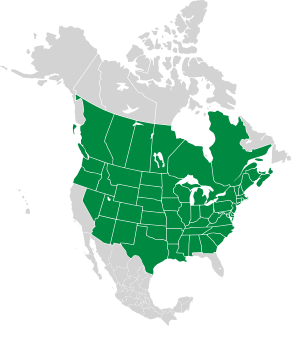
| Range/ Zones |
|
|
|
| Habitats | Lake and river shores, and wetland edges. | Wet areas such shores, swamps, marshes, wet meadows, and stream banks. | River banks, floodplains, wet meadows, clearings, and shores. |

Lycopus americanus description by Thomas H. Kent, not updated.
© FloraFinder.org. All rights reserved.