Setaria pumila (Poir.) Roem. & Schult.
Yellow foxtail, yellow bristlegrass, pigeon grass, cattail grass
Some foxtails
Setaria faberi
Setaria pumila
Setaria viridis


|
Setaria pumila (Poir.) Roem. & Schult. Yellow foxtail, yellow bristlegrass, pigeon grass, cattail grass Some foxtails | |||
Setaria faberi |
You are here Setaria pumila |
Setaria viridis |
|
|---|---|---|---|
| Common Name | |
|
|
| Plant | Plants are 2–5′ (60–152 cm) tall, the largest foxtails, with multiple stems. The grass blades alternate, reaching up to 1′ (38 cm) long and ¾″ (1.9 cm) wide. | Plants grow in clumps to heights of 3′ (1 m). | Plants grow in clumps with erect stems up to 3′ (1 m) high. |
| Leaves | Not very stiff, often drooping. Upper leaf surfaces usually have scattered fine, stiff, bristled hairs, but they may also be smooth. Leaf blade edges have tiny teeth that make them feel rough. At the base of each grass blade, just above where it connects to the stem, there is a ringlike tuft of white hairs up to ⅛″ (3 mm) long. | Grass blades are flat or sometimes "keeled," 4–12″ (10–30 cm) by ⅛–½″ (5–12 mm). Just above the point where the grass blade attaches to the stem, there are a lot of small hairs (ligule), on the inside of the blade. | Leaf blades are medium dull green, rough but hairless (except sometimes near the edges), and up to 1′ ⨉ ⅞″ (40 ⨉ 2.5 cm). |
| Flowers | Flowerheads are up to 7″ (17 cm) long. Bristly and drooping under its own weight, they are green to light brown or purplish over time.
|
The flowerhead is ¾–6″ long ⨉ ⅜″ in diameter (2–15 ⨉ 1 cm), and erect rather than nodding. It blooms from June through December. | Flowerheads are a green panicle up to 6″ long ⨉ ¼–⅝″ around (15 cm ⨉ 8.5–16 mm), usually erect, sometimes slightly nodding. |
| Fruit | The flowerhead is made up of spikelets, small seed pods, with bristles that appear yellow at maturity. | Spikelets are ~1/16″ (1.8–2.2 mm) long. | |
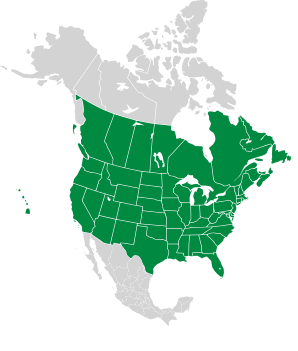
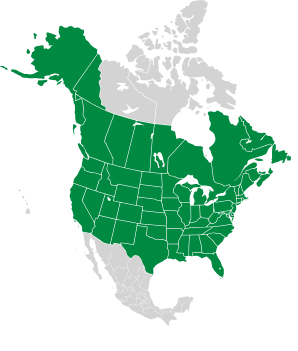
| Range/ Zones |
|
|
|
| Habitats | Meadows, fields, landfills, mined land, construction sites, vacant lots, yard boundaries, gardens, railroads, roadsides, and waste land. | Roadsides, ditch banks, fields, pastures, cropland, orchards, vineyards, gardens, turf, disturbed sites. | Margins of woods, upland prairies, streambanks, pond margins, pastures, fields, lawns, cultivated areas, disturbed sites, roadsides, railroads. |
Setaria pumila description by Thomas H. Kent, not updated.
© FloraFinder.org. All rights reserved.